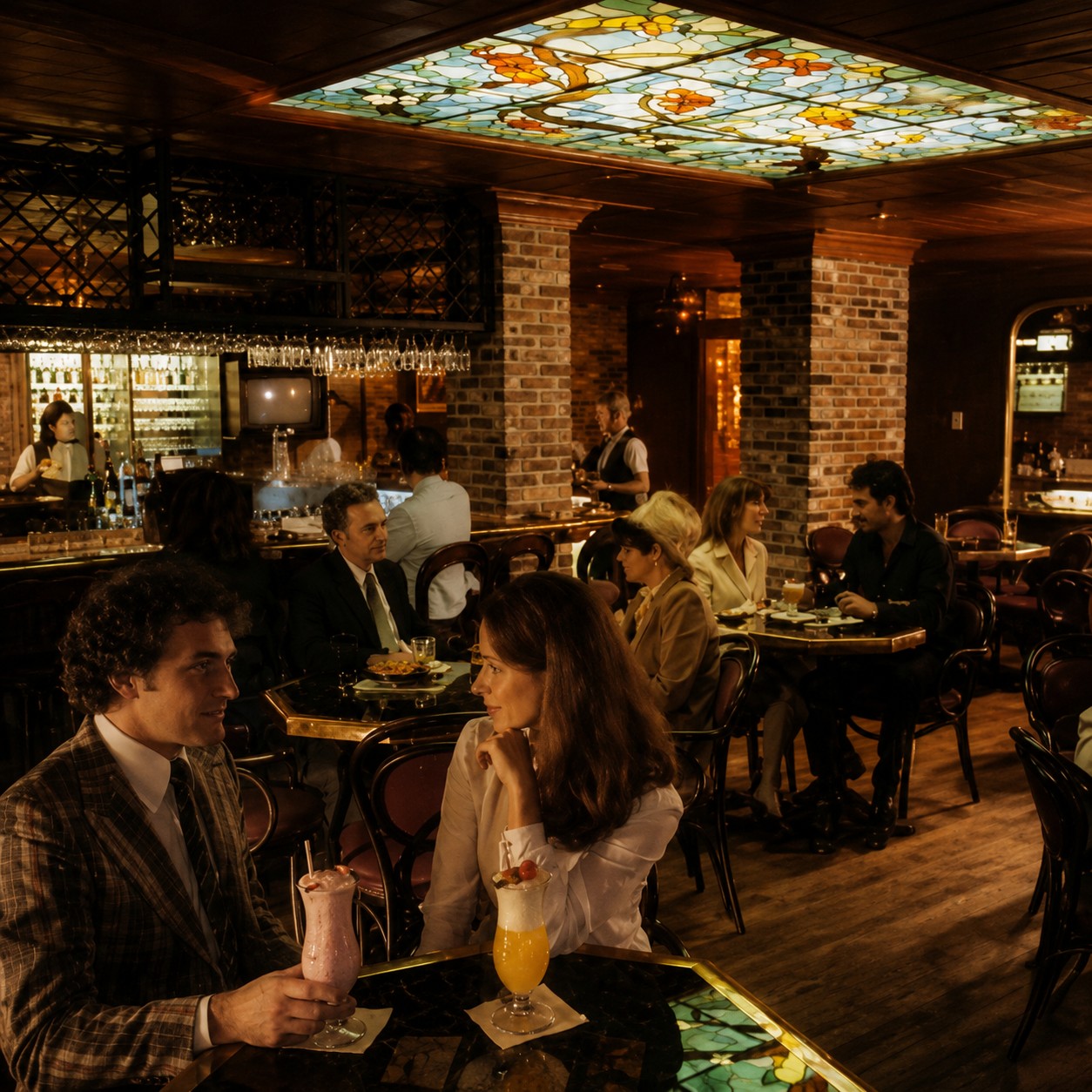
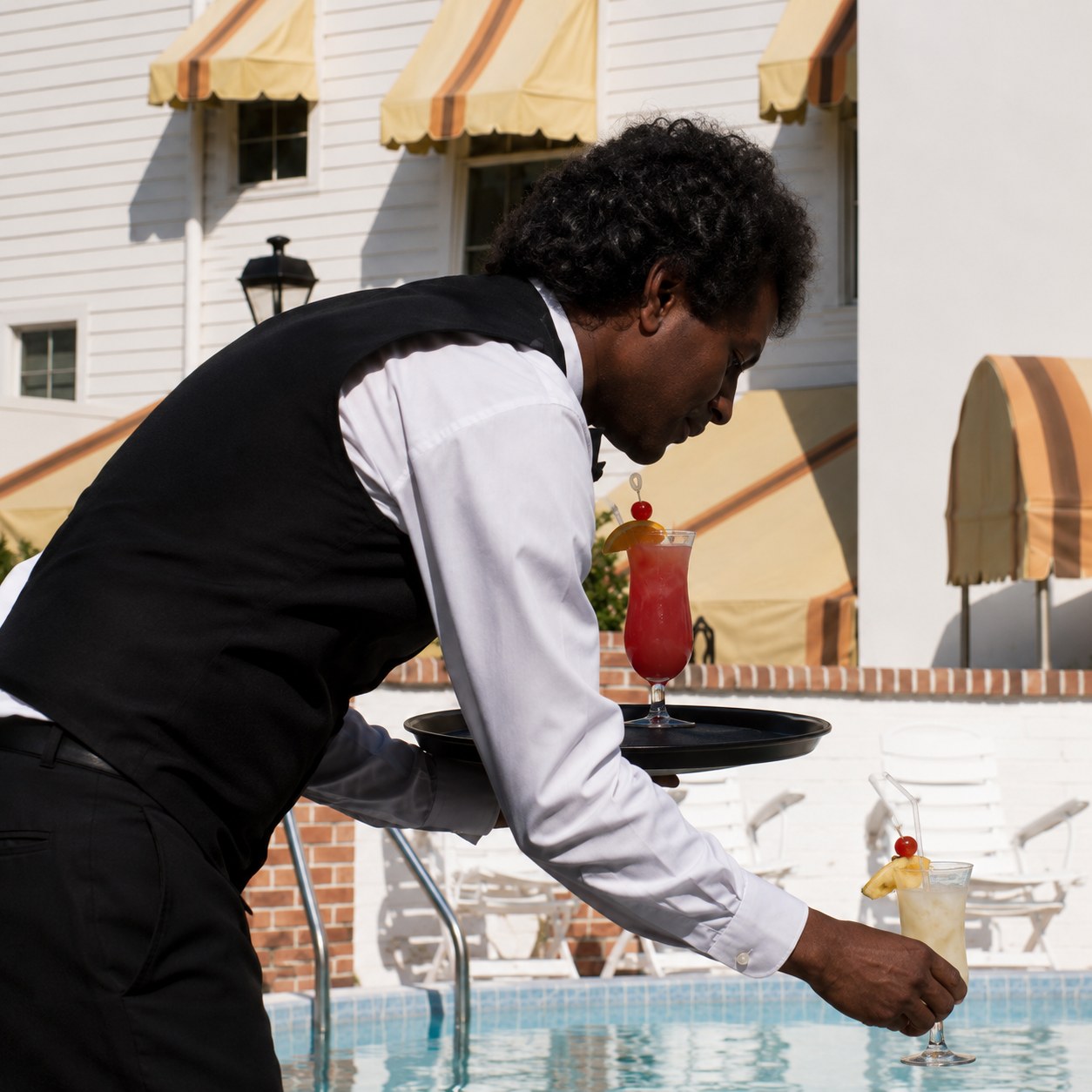
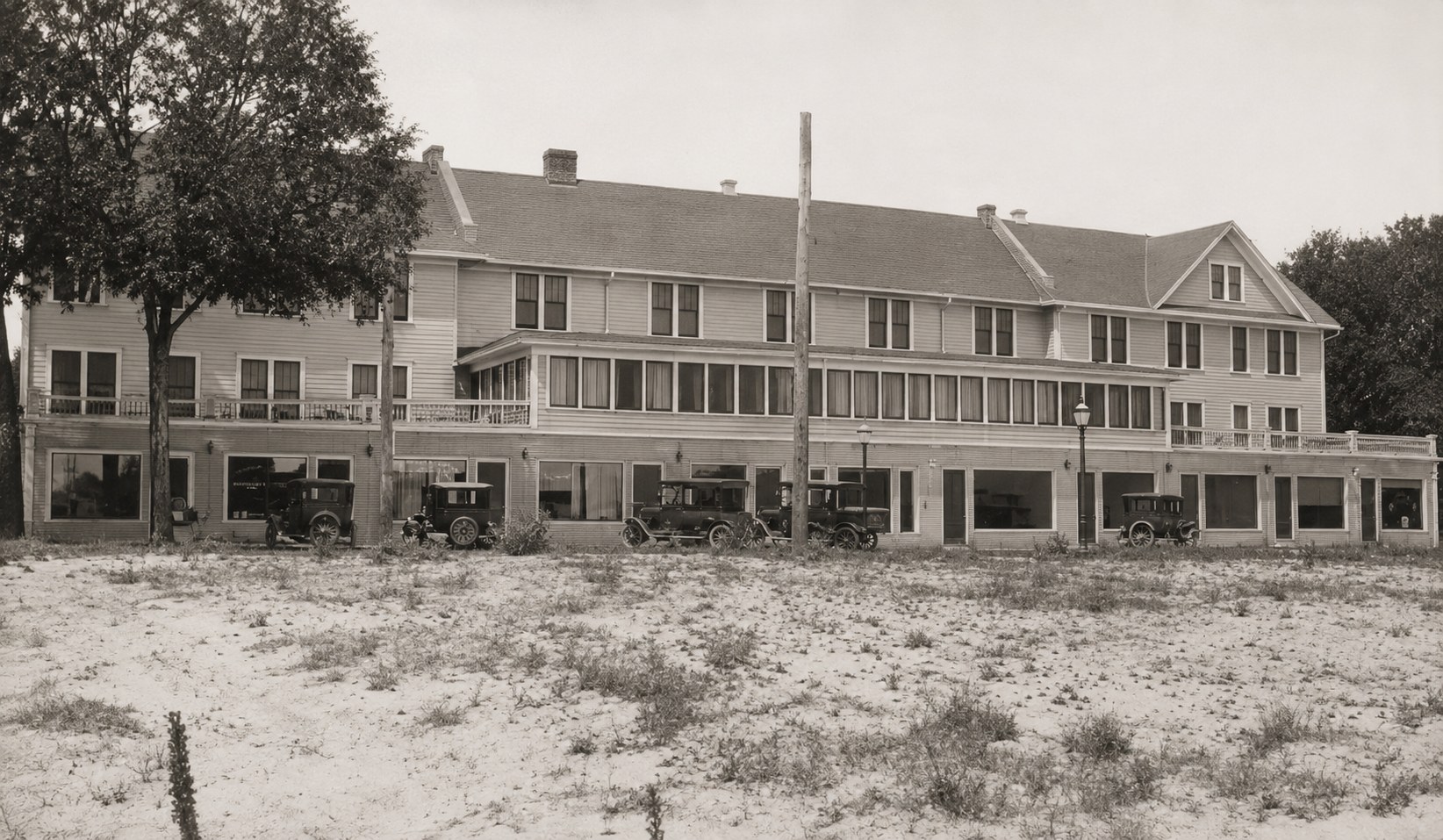
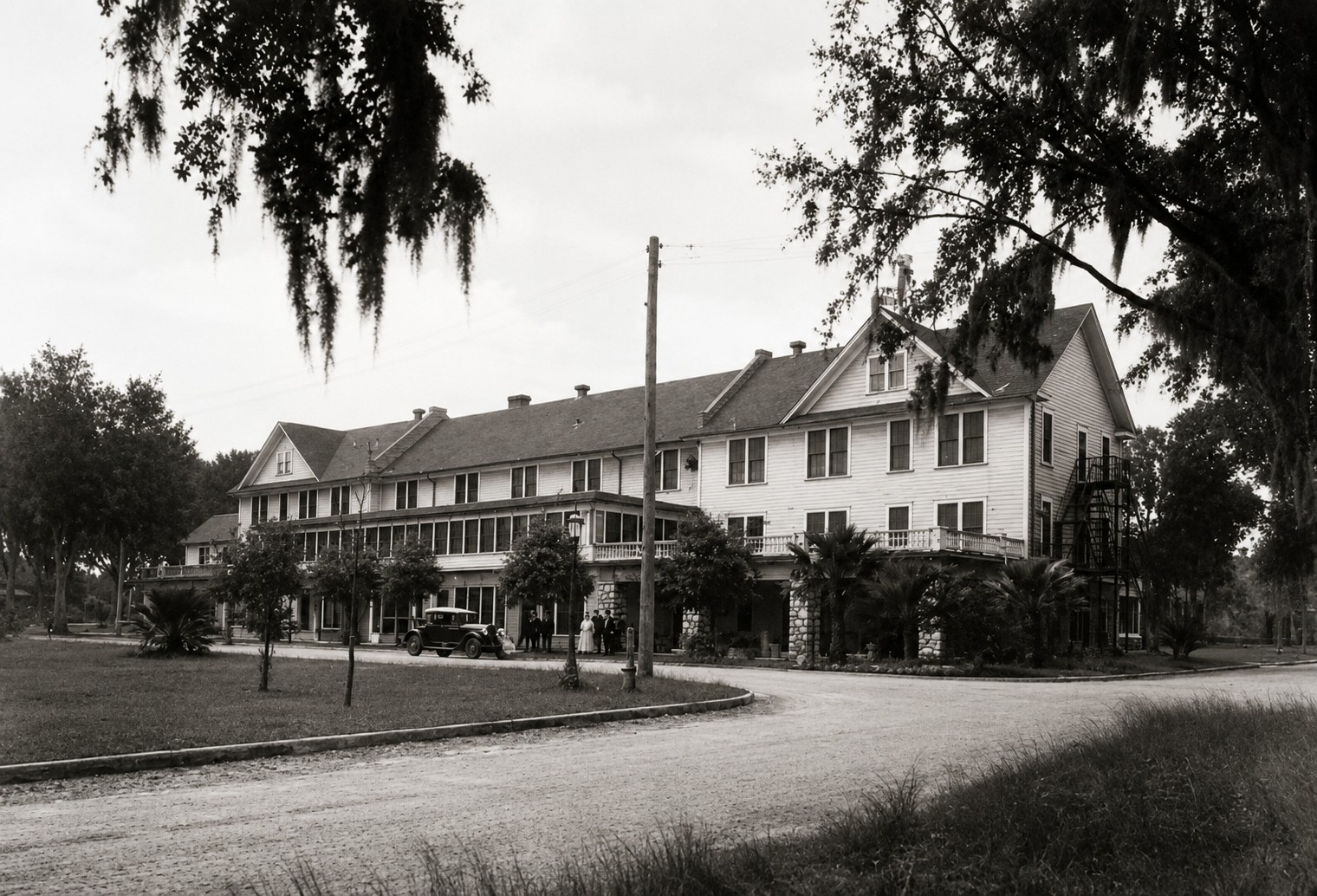
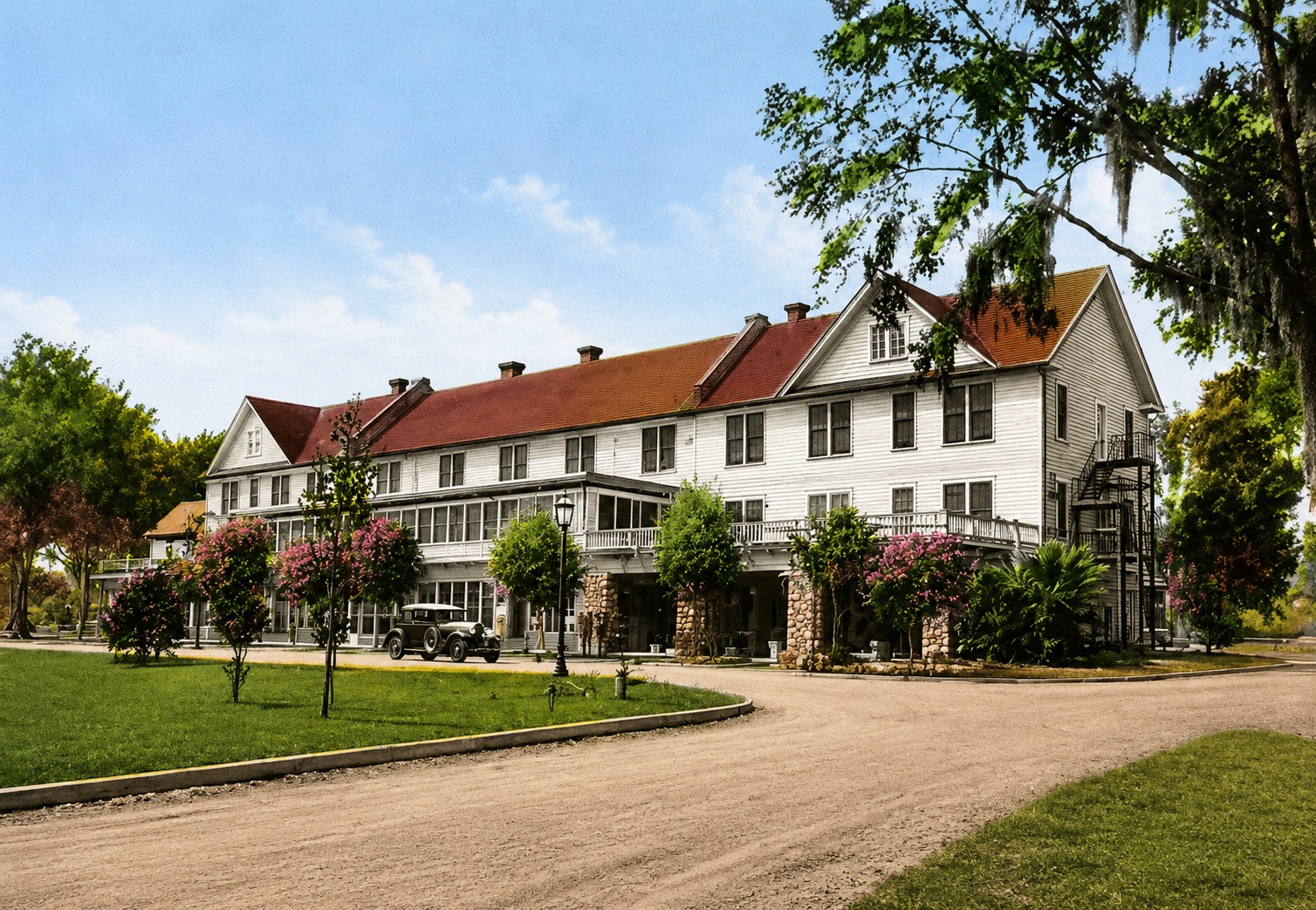
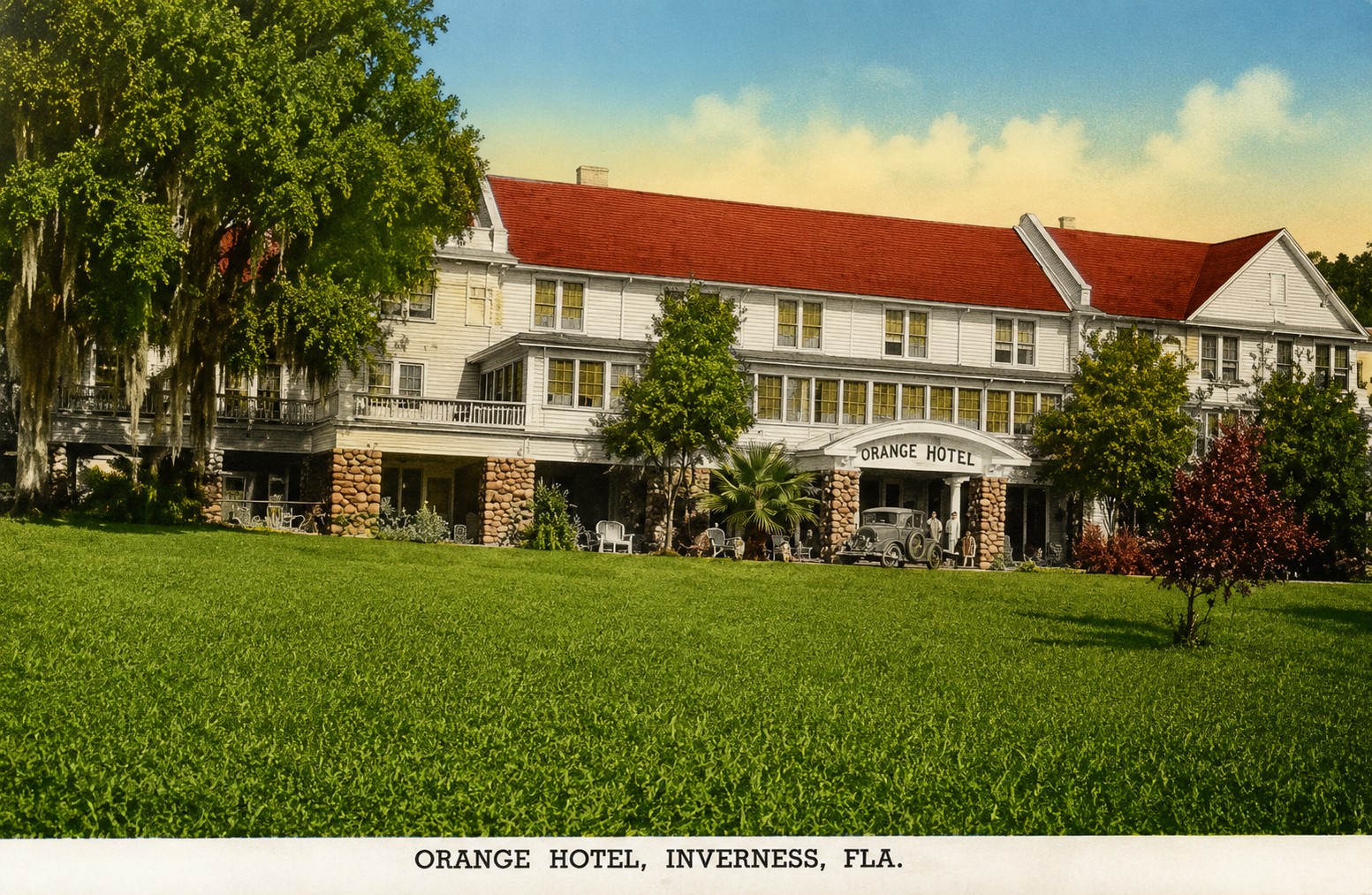
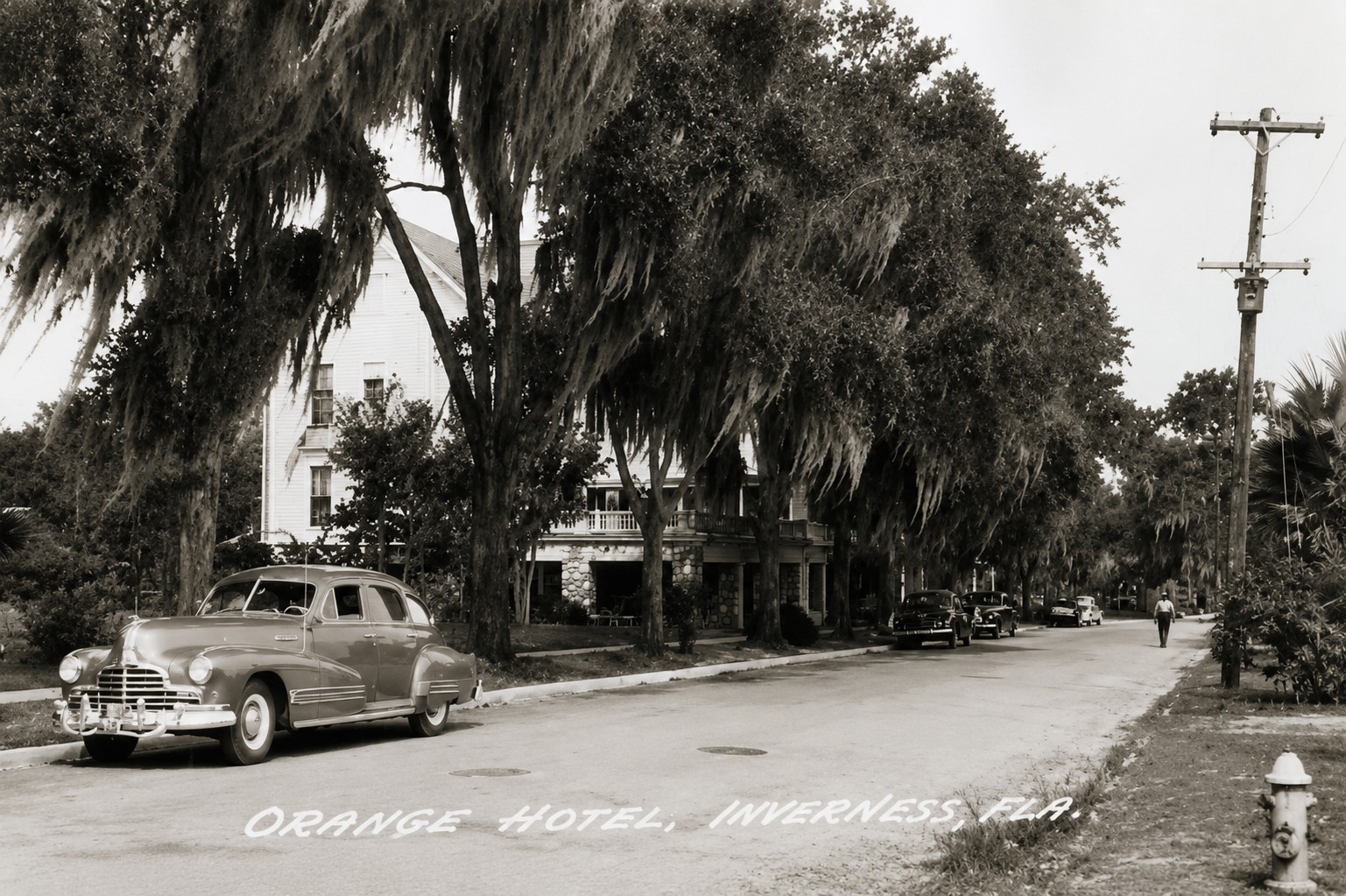
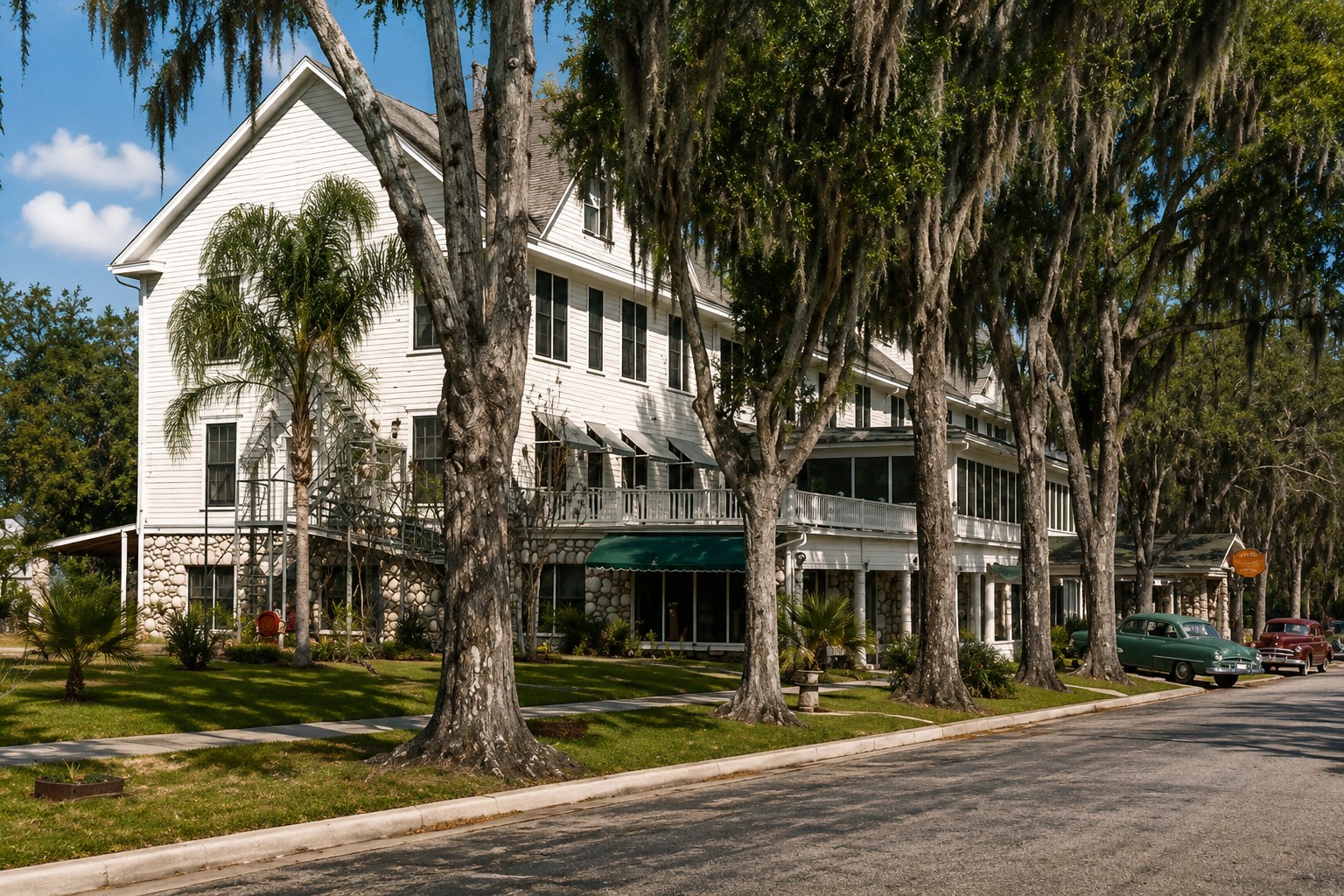
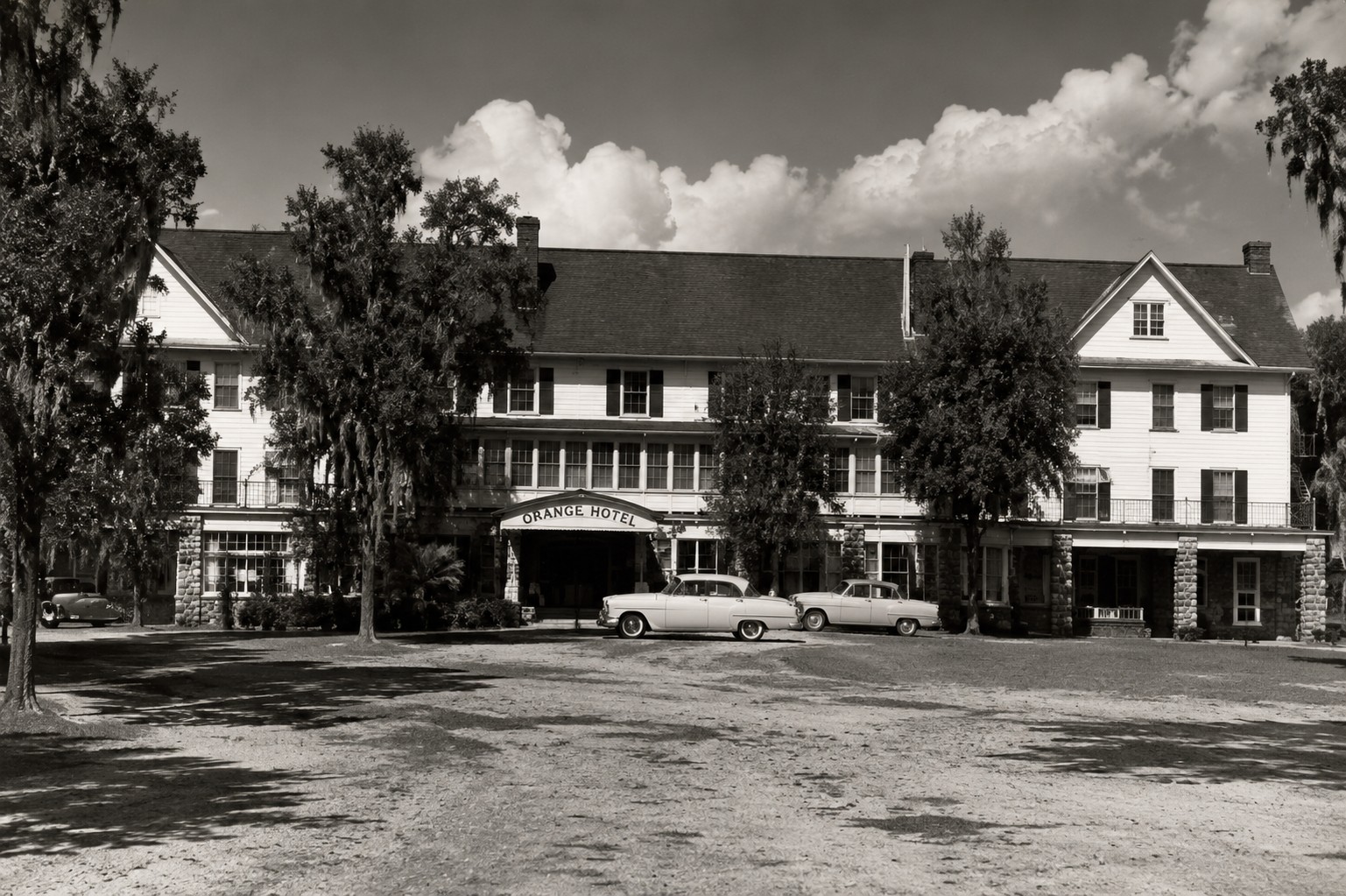
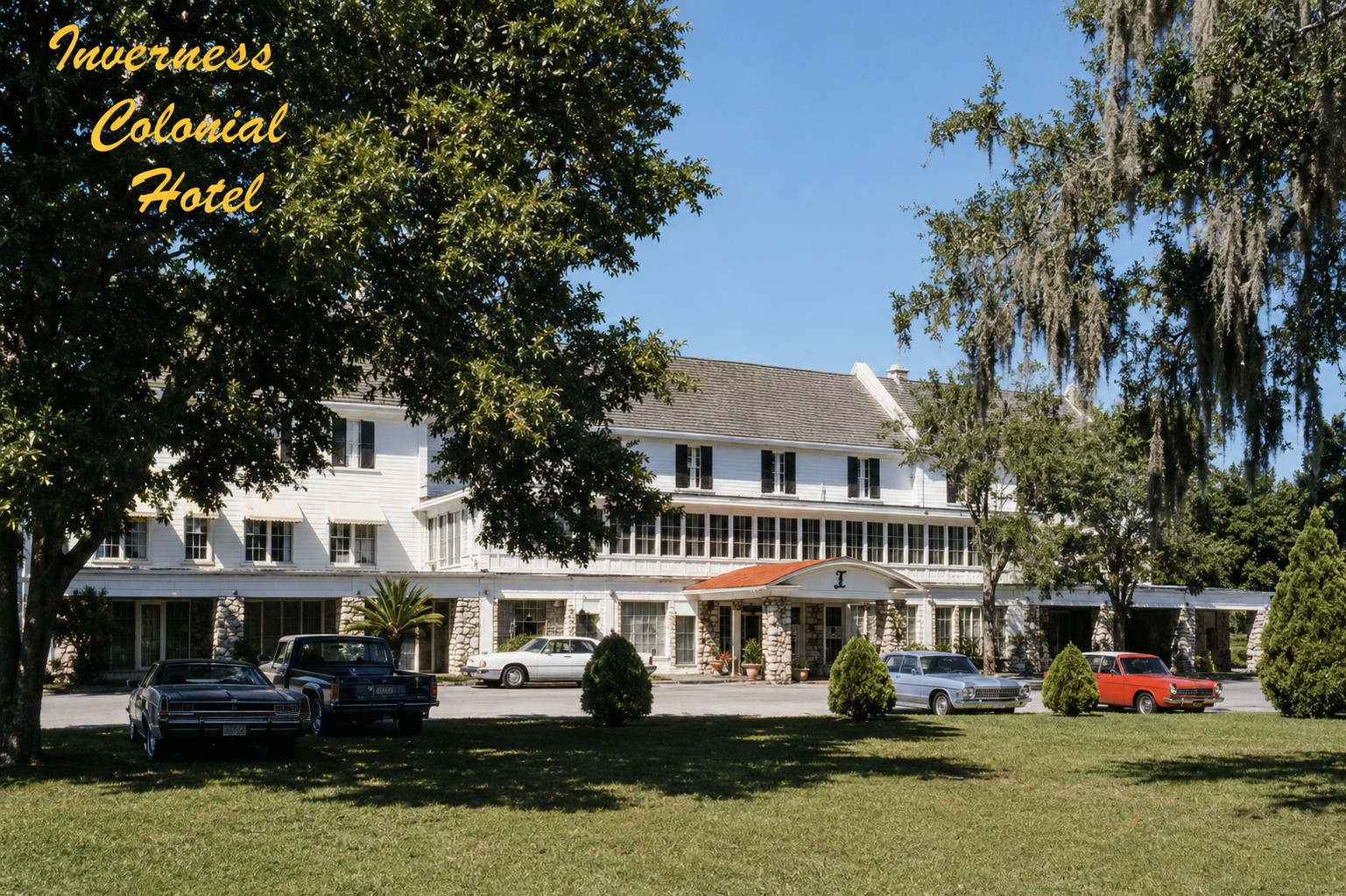
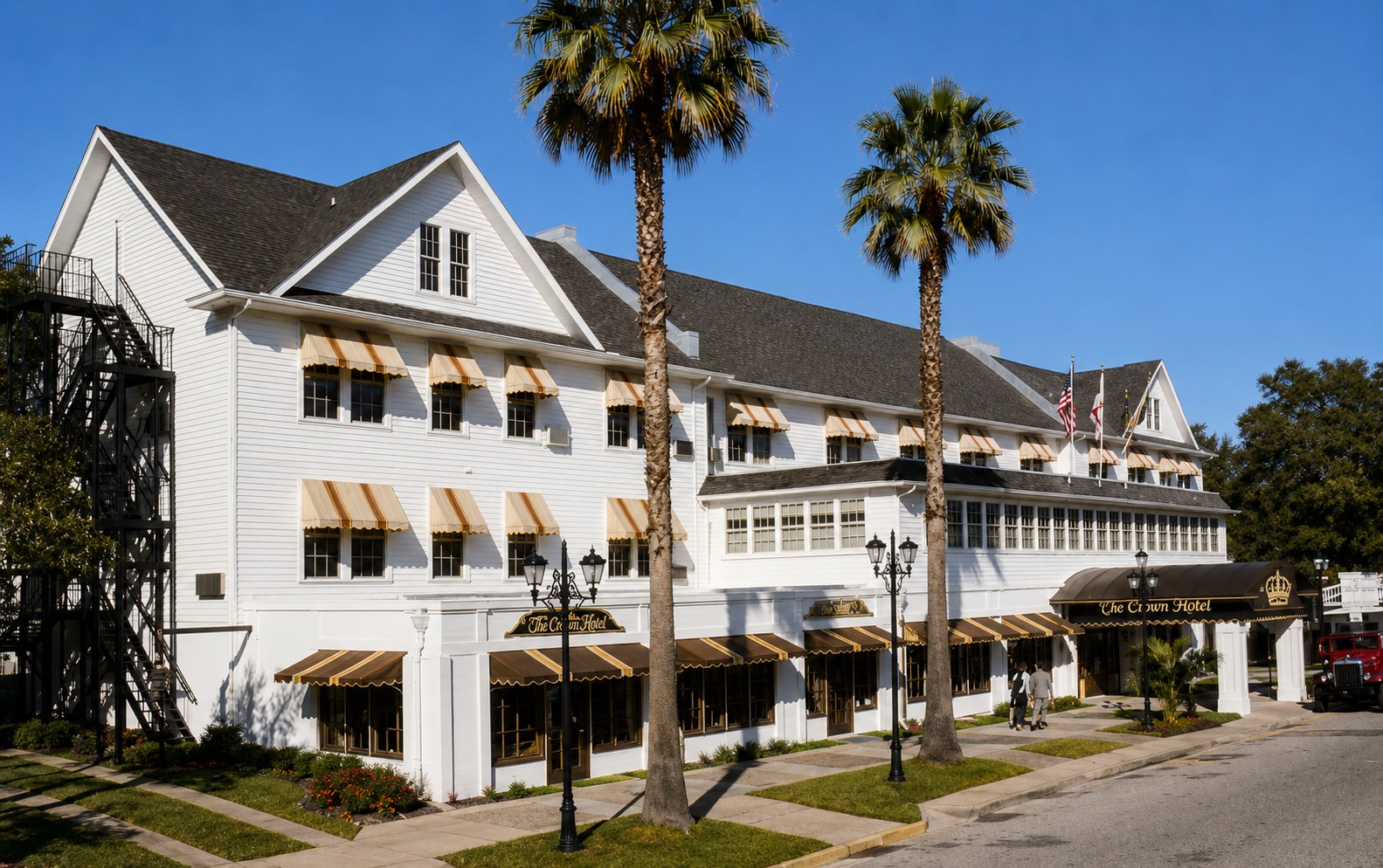
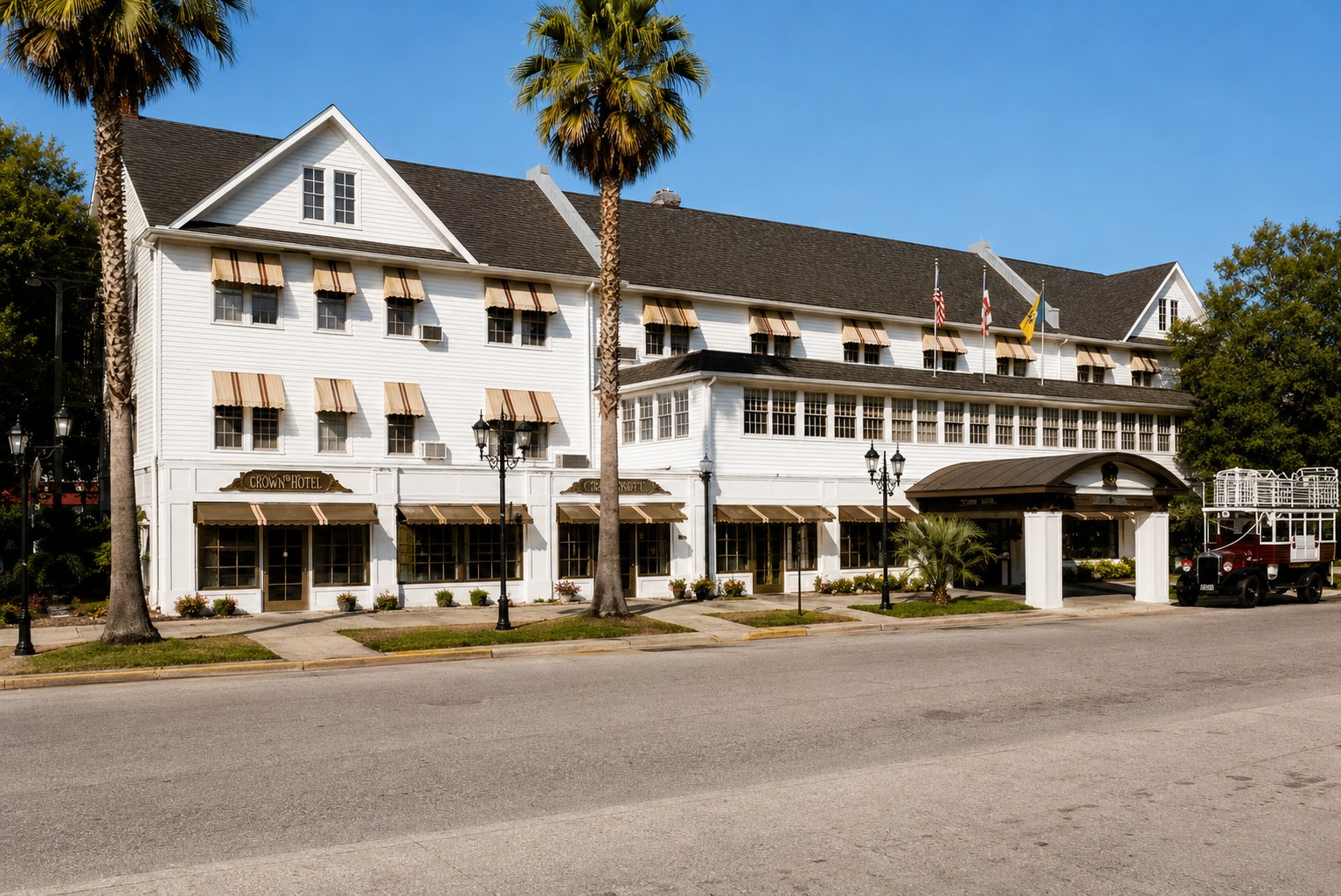
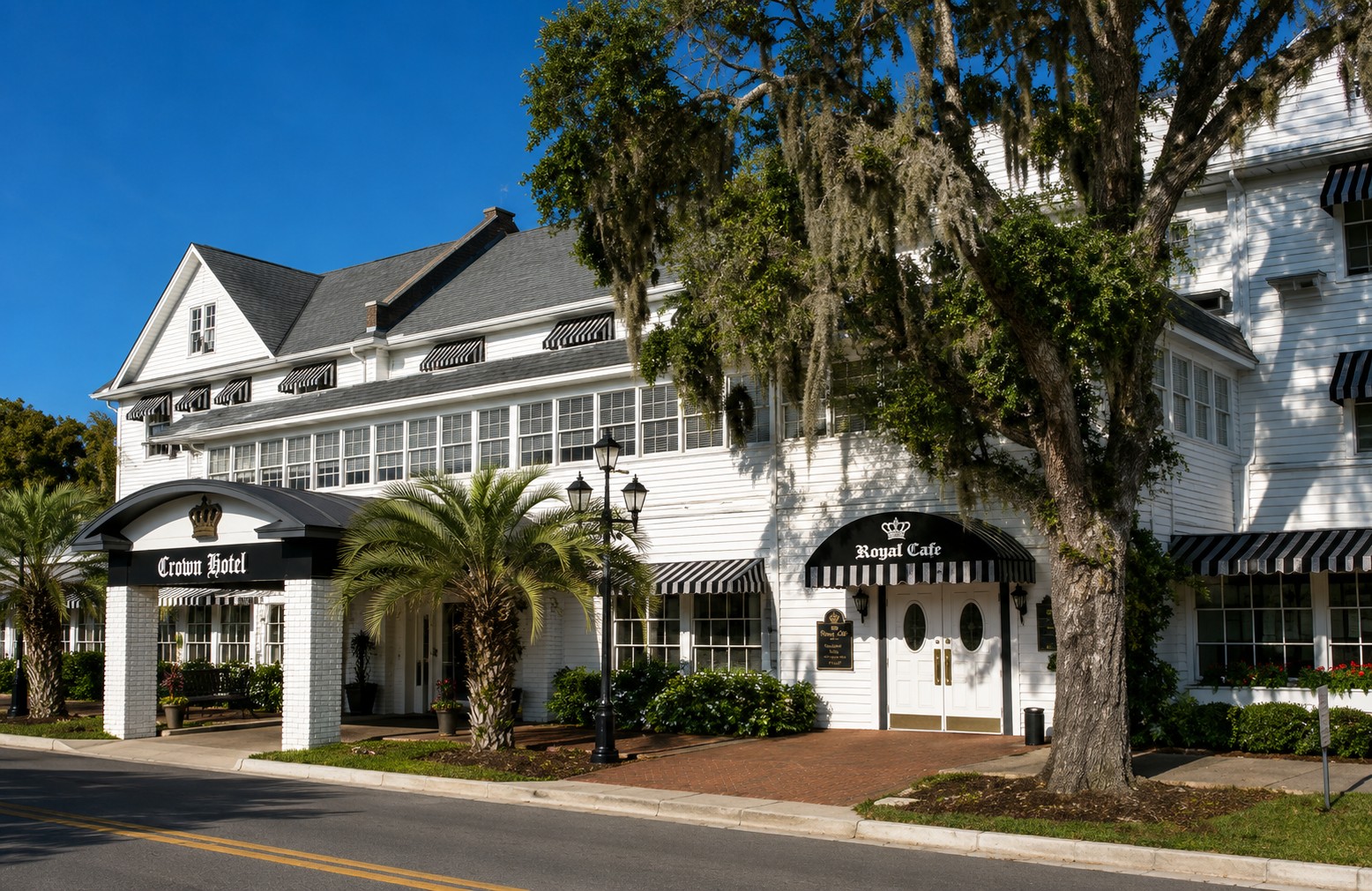
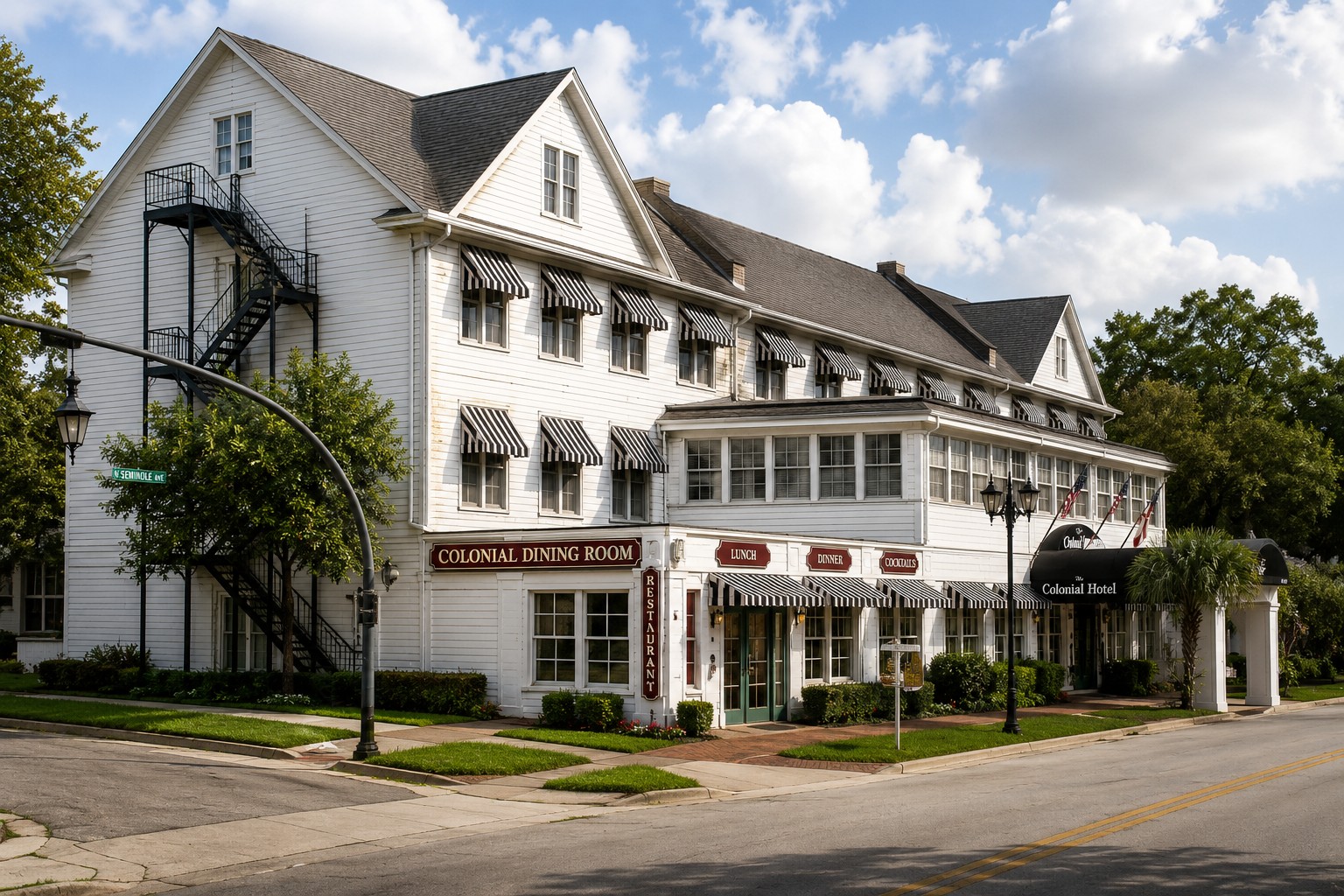
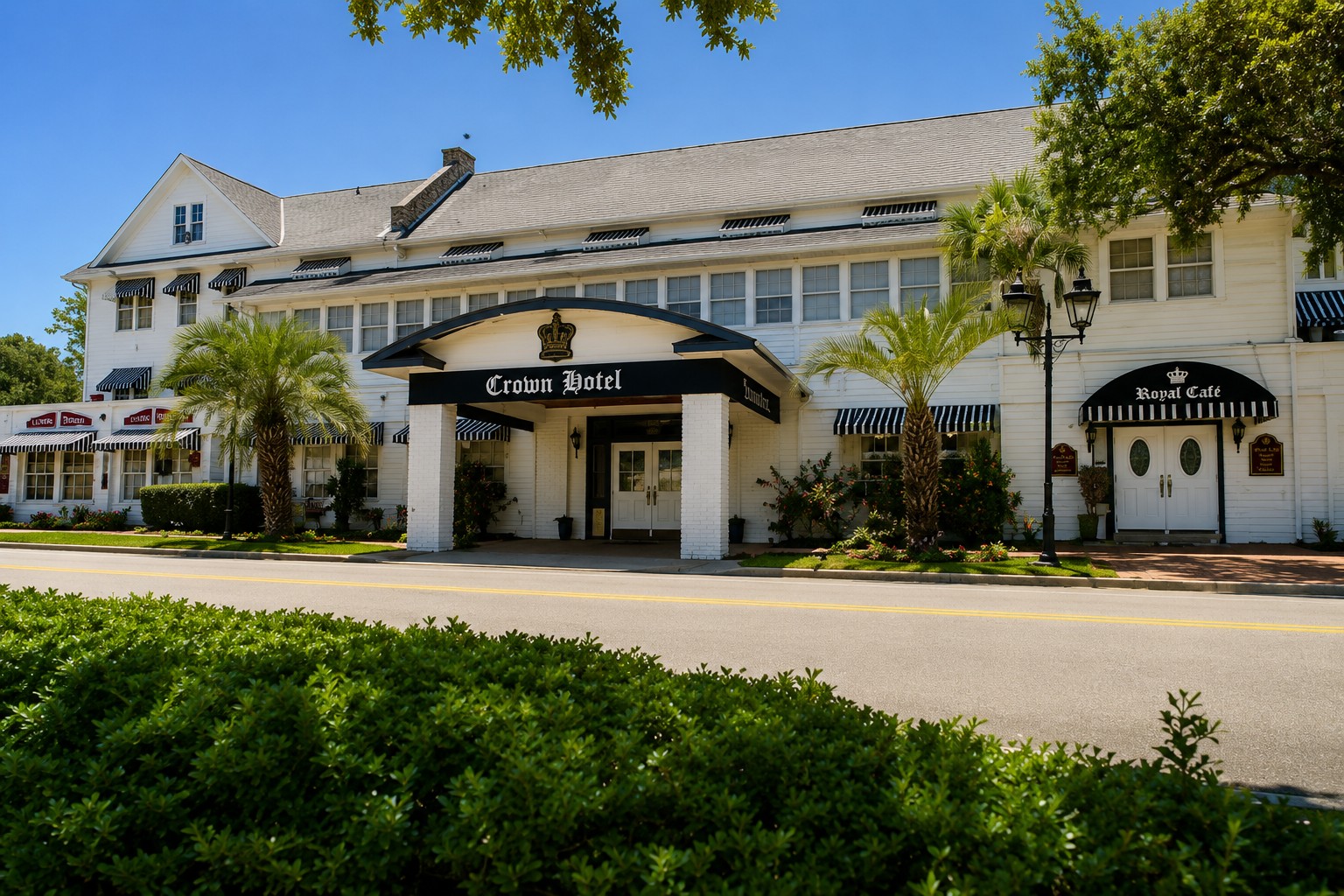
Meals shared, catches shown off, lazy afternoons poolside, and pints by the dartboard — for 136 years, this corner has been where people came together.
AI-assisted restorations & reconstructions · Produced under HCPS v1.1
Jacked, Tented & Rebuilt
Remade, Again & Again
Hoisted onto a new floor, tented for the largest fumigation in county history, and rebuilt room by room — the building reinvented itself across the decades.
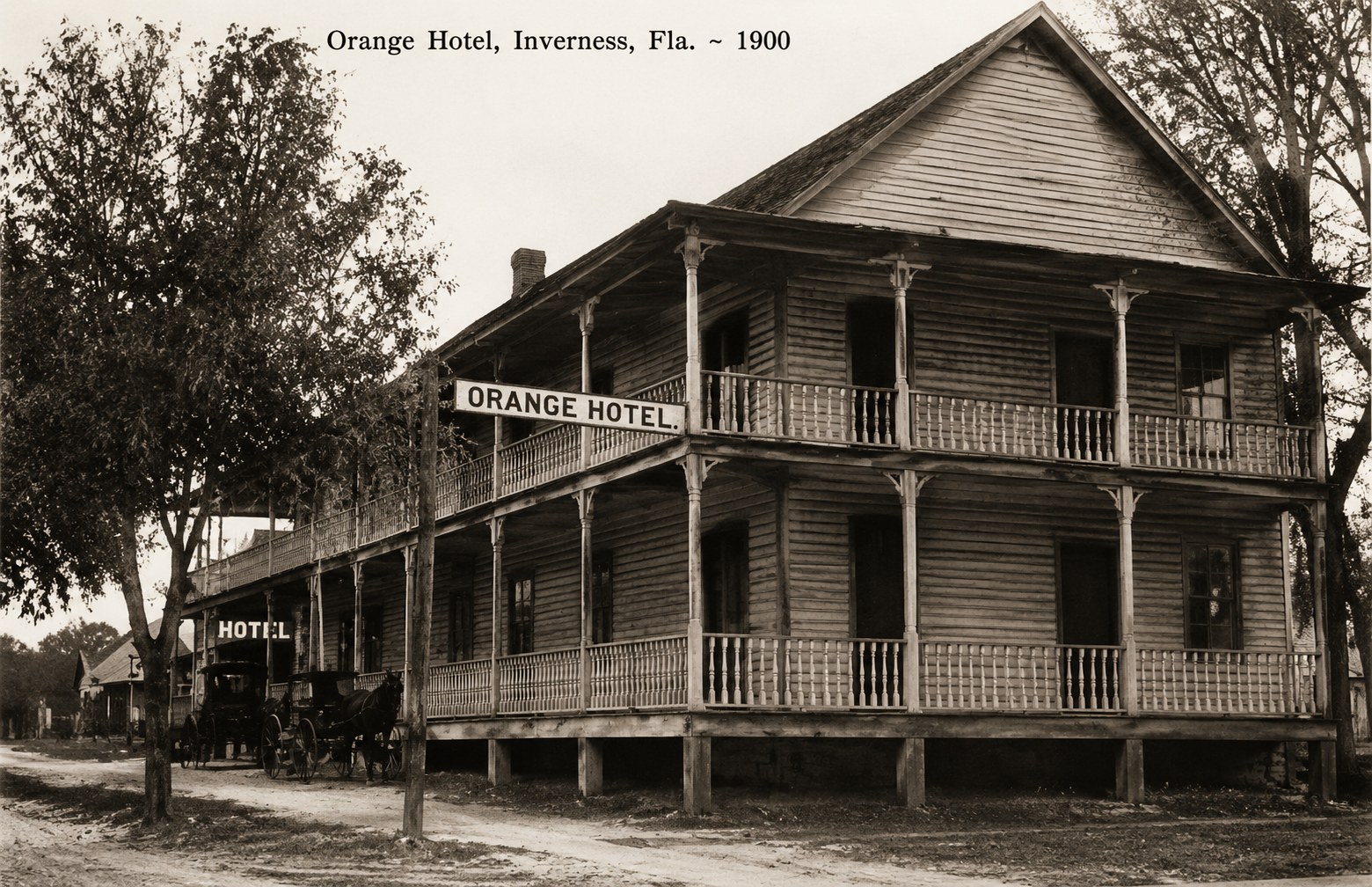
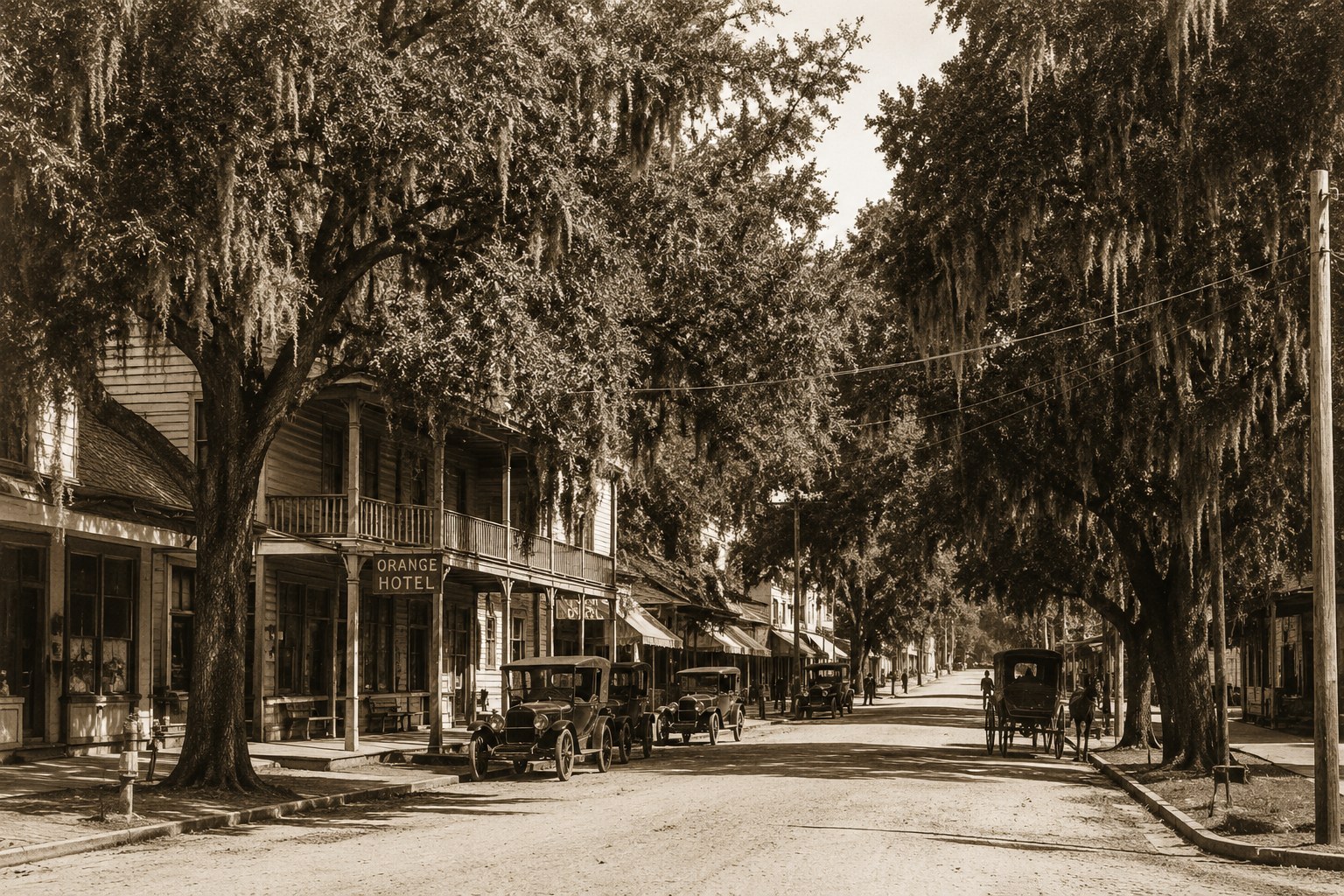
An AI illustration evoking the original Orange Hotel as it faced Main Street, Inverness, c. 1900.
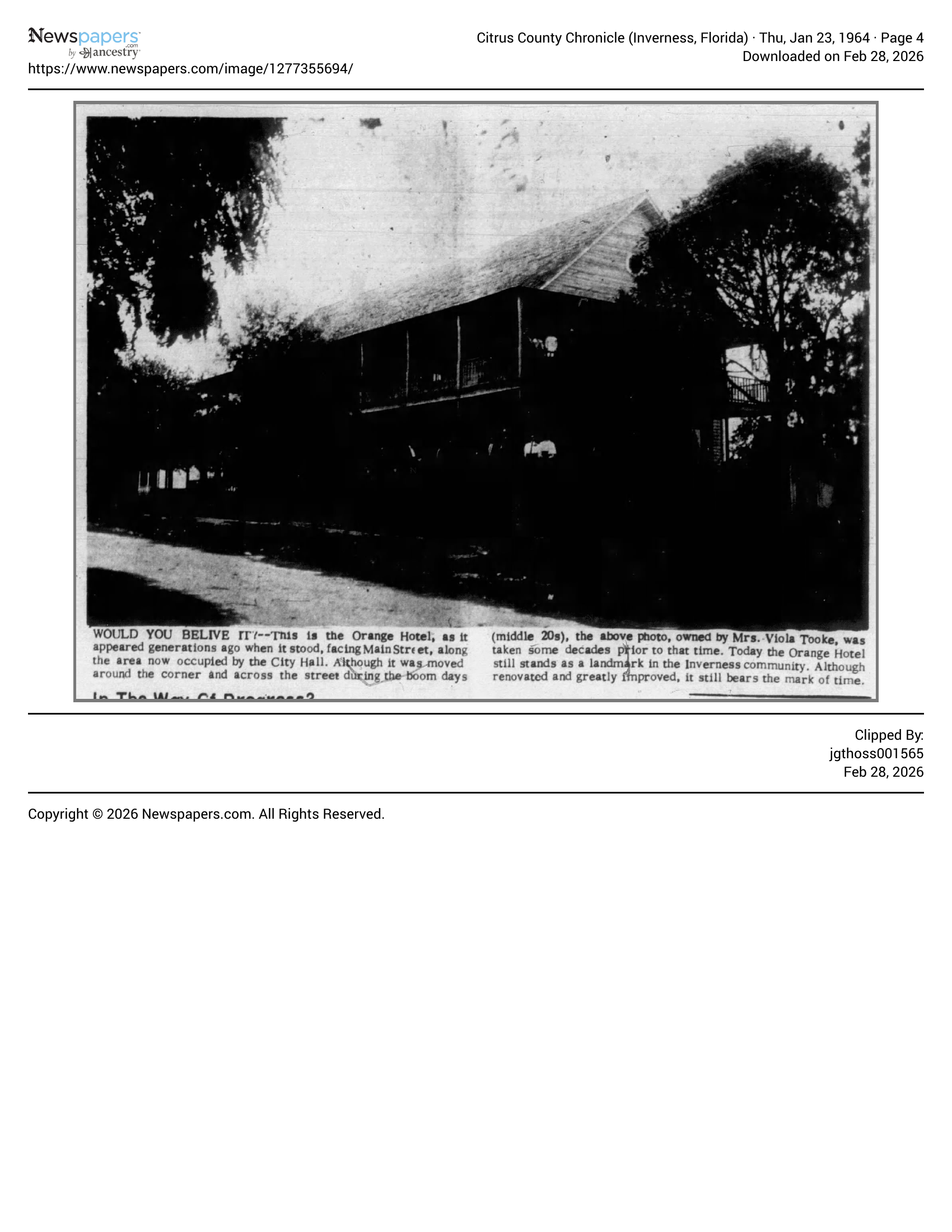
The building which would one day become the “crown jewel” of the town of Inverness, Florida, began simply as a general store. Originally constructed at the corner of Line and Bay Street in the 1890s by Francis M. Dampier, it was the first general store in Inverness. At the turn of the century, the store was moved to Main Street and the building was turned into the Orange Hotel.
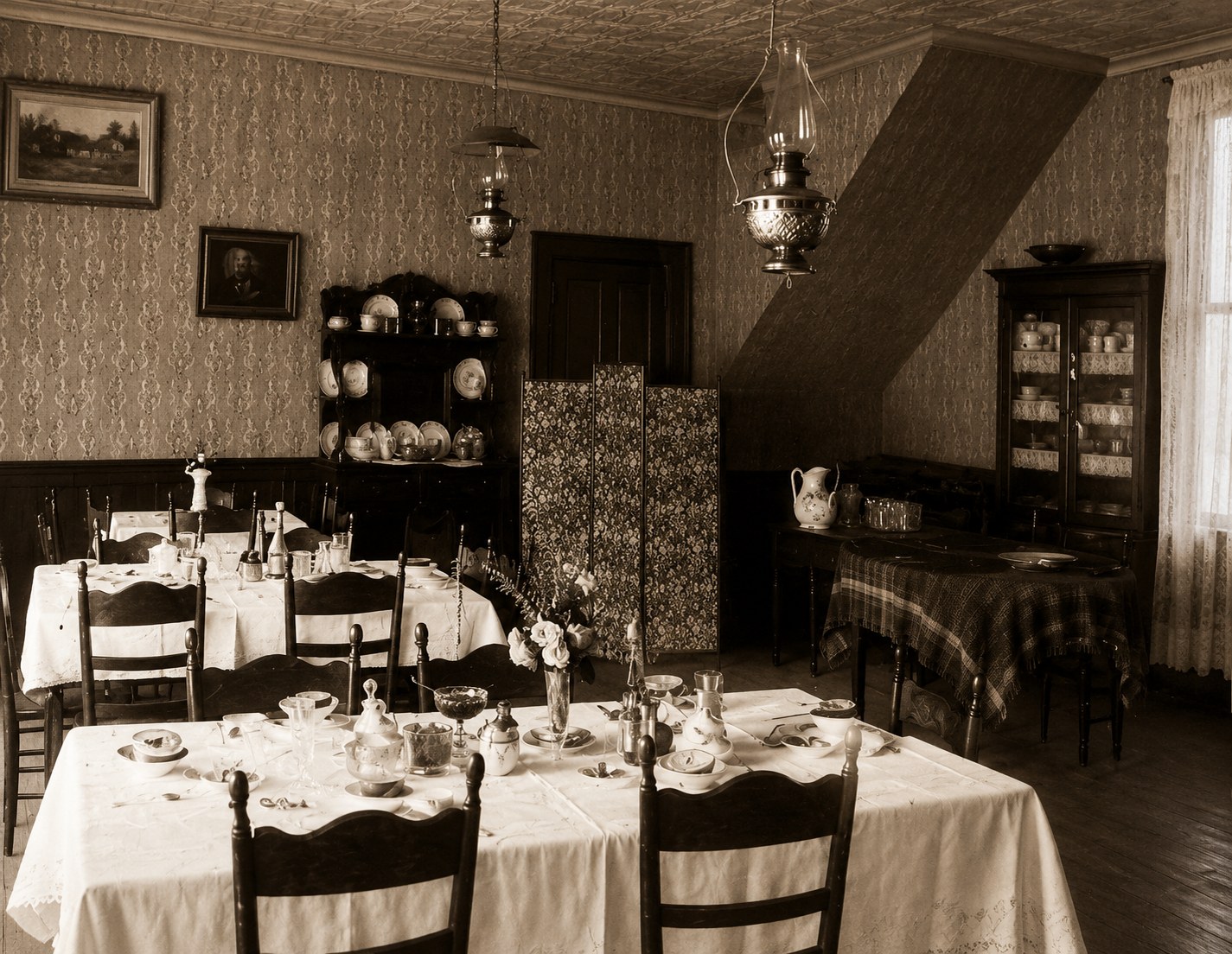
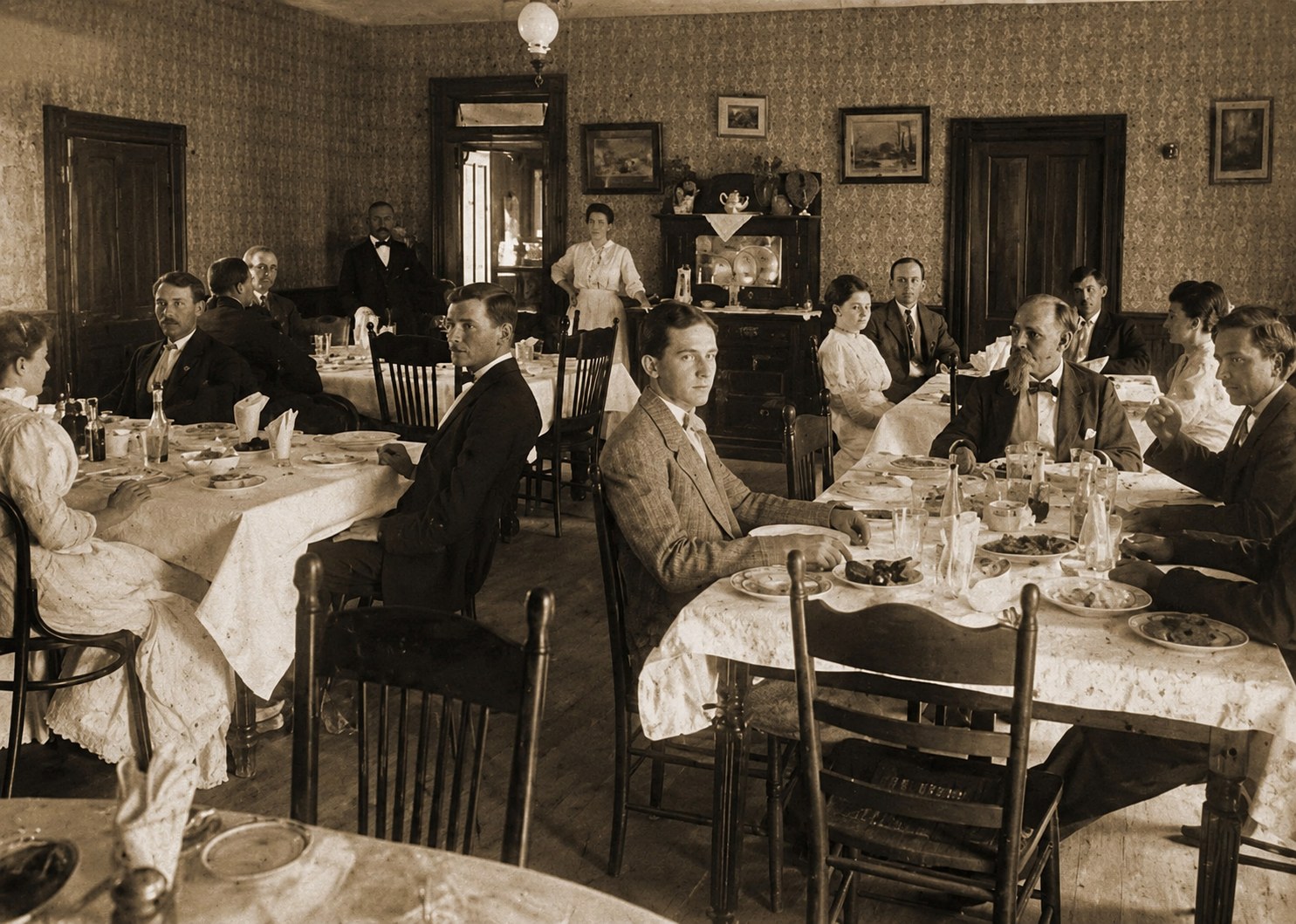
An AI illustration evoking the Orange Hotel dining room, c. 1900.An AI illustration evoking boarders gathered for a meal in the Orange Hotel dining room, c. 1900.
But a hotel is only as strong as the people running it. And the Orange Hotel might have never succeeded without Aunt Tom.
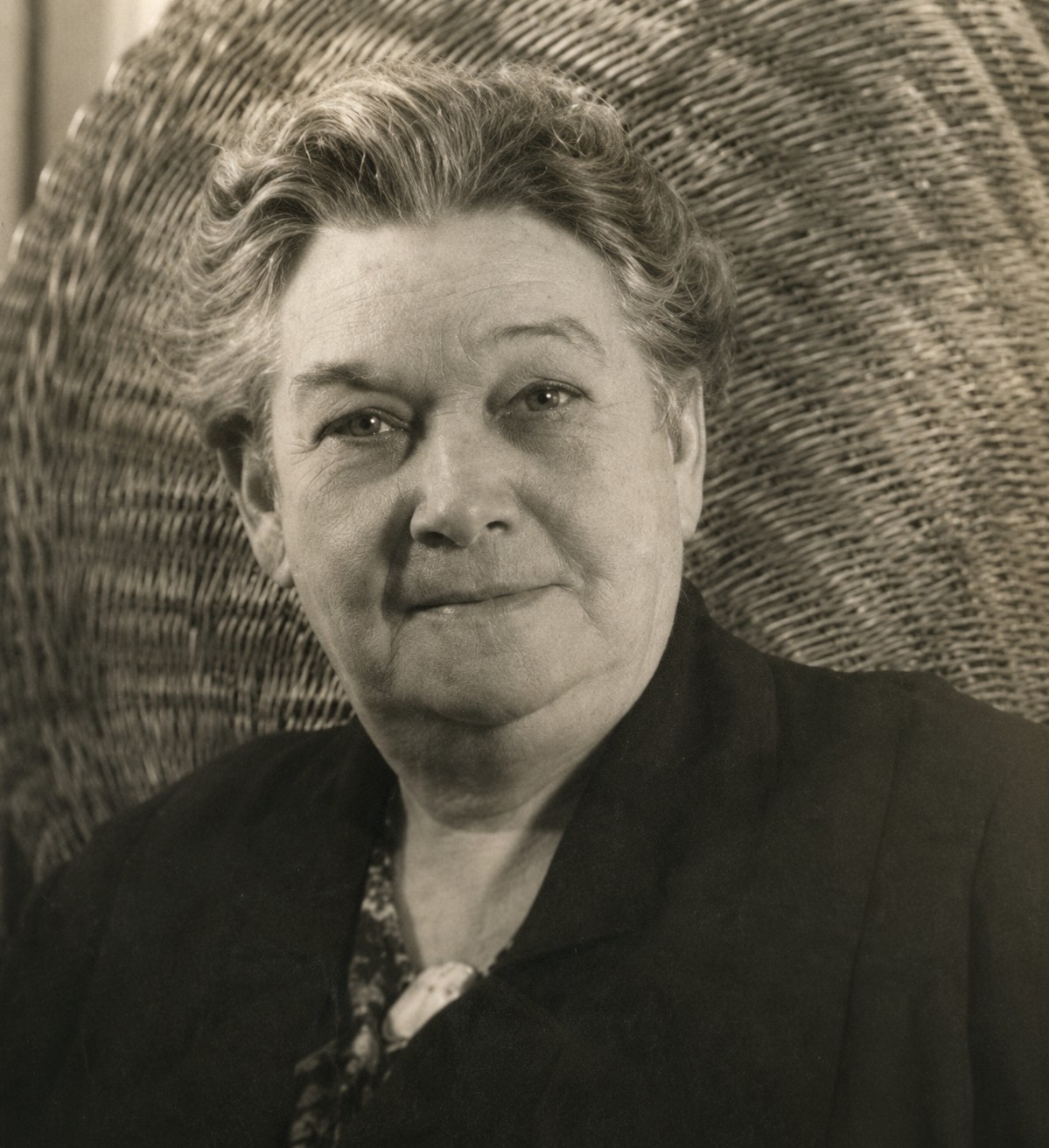
Tommie Lou Waits was born to Samuel and Emma Waits on March 12, 1875 in Hawthorne, Florida. Eventually, Aunt Tom, as she was affectionately known in later years, became Citrus County’s most successful hotelier.
But Tommie Lou’s path to hotel proprietorship took some unexpected turns along the way. She married W. H. Johnson in 1896 but that marriage ended soon after with his passing. In 1900, census records show that, at the young age of 25, a recently widowed Tommie Lou Johnson had returned to living with her parents and siblings in the Windsor district of Alachua County.
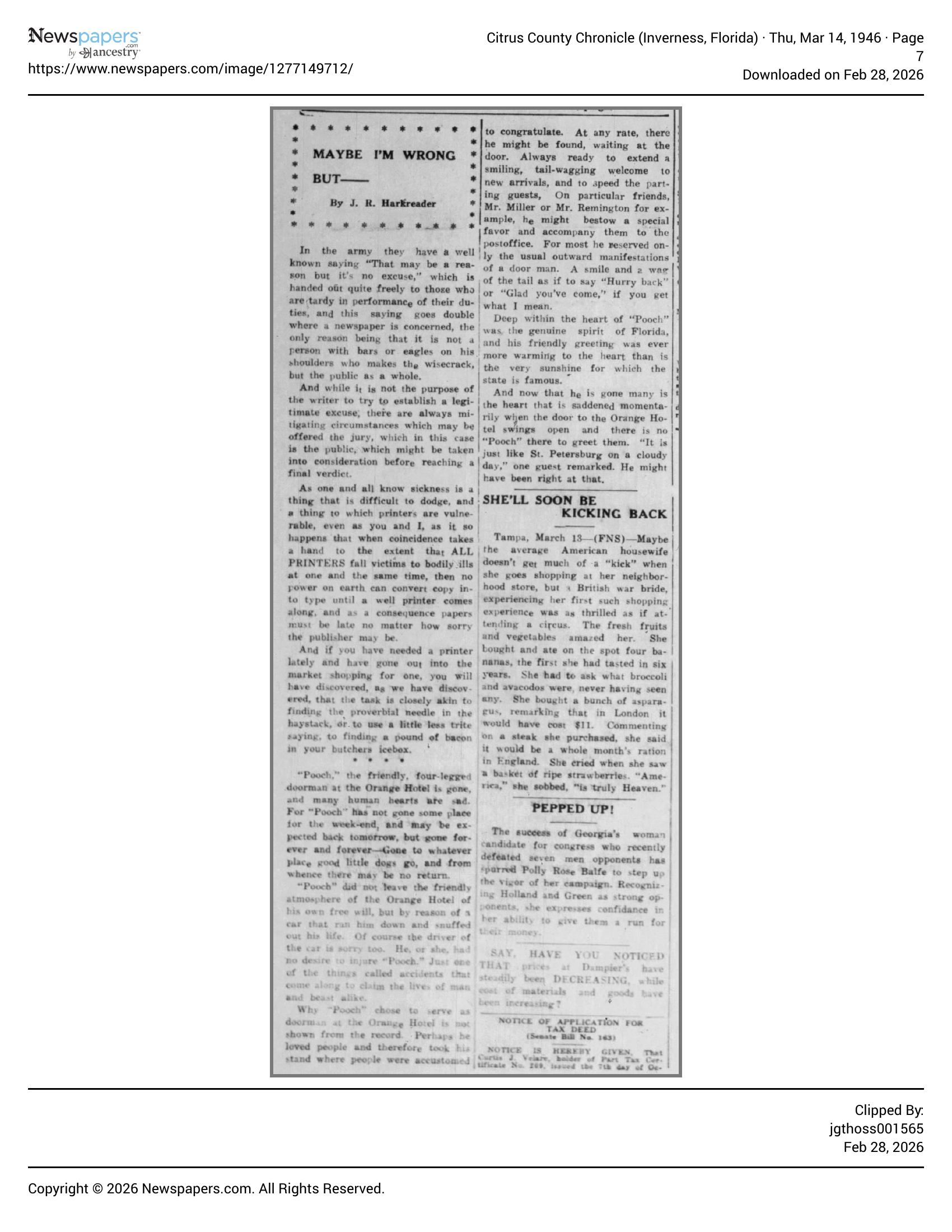
But on Valentine’s Day, 1908, Tommie Lou Waits-Johnson married William M. Maloy. Originally from Franklin County, Vermont, Maloy was a railroad engineer living in Jacksonville, Florida. He moved to Inverness after marrying Tommie Lou.
While it is believed they purchased the hotel shortly after their marriage in 1908, the exact date and means by which William and Tommie Lou acquired the Orange Hotel is not well documented. But by 1910, census records show that the couple was living in an Inverness building with four lodgers, the first of which was Tommie Lou’s niece, Ethel Waits.
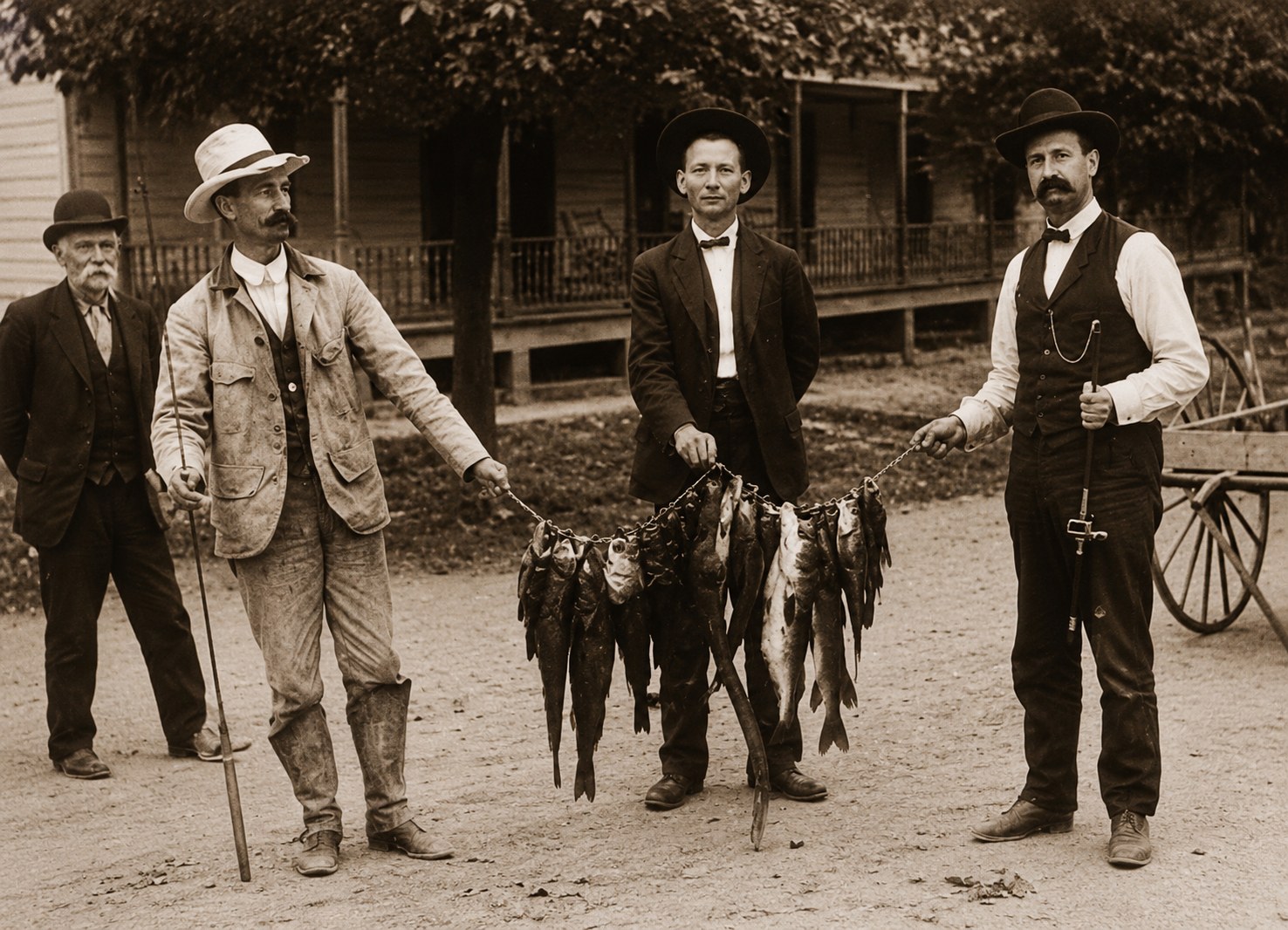
An AI illustration evoking fishermen proudly displaying their catch in front of the Orange Hotel, c. 1900.
By 1920, the Orange Hotel was proving to be a successful enterprise for the Maloys. Tommie Lou transitioned fully into the role of a hotelkeeper — managing no less than ten boarders — while William continued his work for the railroad.
A travel guide published previous to 1923 listed the services and rates of the hotel:
THE ORANGE HOTEL — INVERNESS, FLA.
W. M. Maloy, Proprietor
Per Day$2.00
With Bath$2.50
Reasonable rates by week or month · The leading commercial hotel of the city
In the early 1920s, Florida was booming, and soon land men and speculators would make their way to Citrus County, Inverness, and even the Maloys’ modest Orange Hotel.
An AI illustration evoking the Orange Hotel on a moss-draped Main Street, Inverness, early 1920s.
❖ ❖ ❖
Chapter Two
The Hotel Inverness
1925 – 1927
In early 1925, Mr. Alfred Olson of Baltimore, MD sought to build a new hotel in Citrus County — a hotel he planned to name Hotel Inverness. Mention of it was made in the Extra edition of the Citrus County Chronicle:
Citrus County Chronicle — Monday, March 23, 1925
New Hotel Started
Work on the new Hotel Inverness has been started. It will be of Spanish architecture and the grounds will be beautified with Palms, Magnolia Trees, Tennis and Roque Courts. Winding drives will lead up to its entrance. Come to the BOOSTERS MEETING at the COURTHOUSE TONIGHT, and see the Beautiful hand painted perspective which will be shown, advises Mr. Olson.
Show your confidence in Florida, in Citrus County and the future of Inverness by lending your attendance by your subscription to the small amount of stock necessary to bring capital to the County.
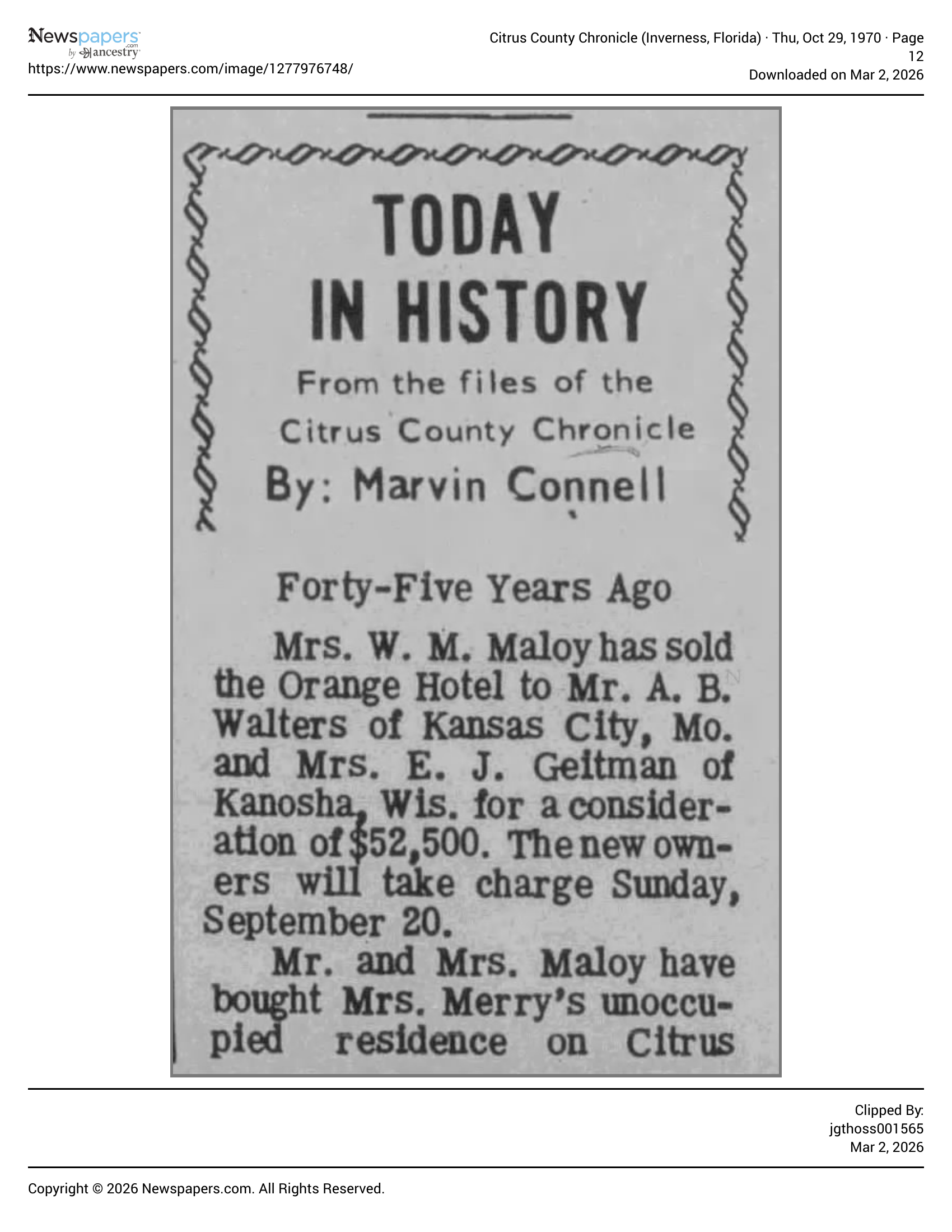
But for reasons unknown, Mr. Olson’s vision for his Spanish style hotel was never realized. By May 1, 1925 he partnered with Albert B. Walter, a “land man” from Kansas City, MO. Together they purchased the Orange Hotel from Tommie Lou and William Maloy for $52,500.
According to the Citrus County Chronicle, the Olson-Walter plan for the hotel included immediate expansion. The present frame building, with 162 feet of frontage on Main Street, was to be swung around at right angles so that another wing of similar length could be built, with a block of sixteen stores replacing the original structure. An additional $150,000 was to be spent to supply a long-felt want in the city for a combination tourist and commercial hotel, with an arcade between the two wings and 100 rooms in all.
But just four and a half months later, plans had changed and a new player was introduced. Mr. Olson was out — replaced in the Orange Hotel deal by Mr. Edwin J. Geittman, a former lawyer and banker from Kenosha, WI. On September 18, 1925, the Chronicle announced “Deal Closed” on the Orange Hotel purchase, with the new owners to take charge on Sunday, September 20th.
Mr. A. B. Walter and Mr. E. J. Geittman formed the Walter-Geittman Corp., a development company with ambitious new plans for the expansion of the Orange Hotel — plans which dwarfed those announced just months earlier.
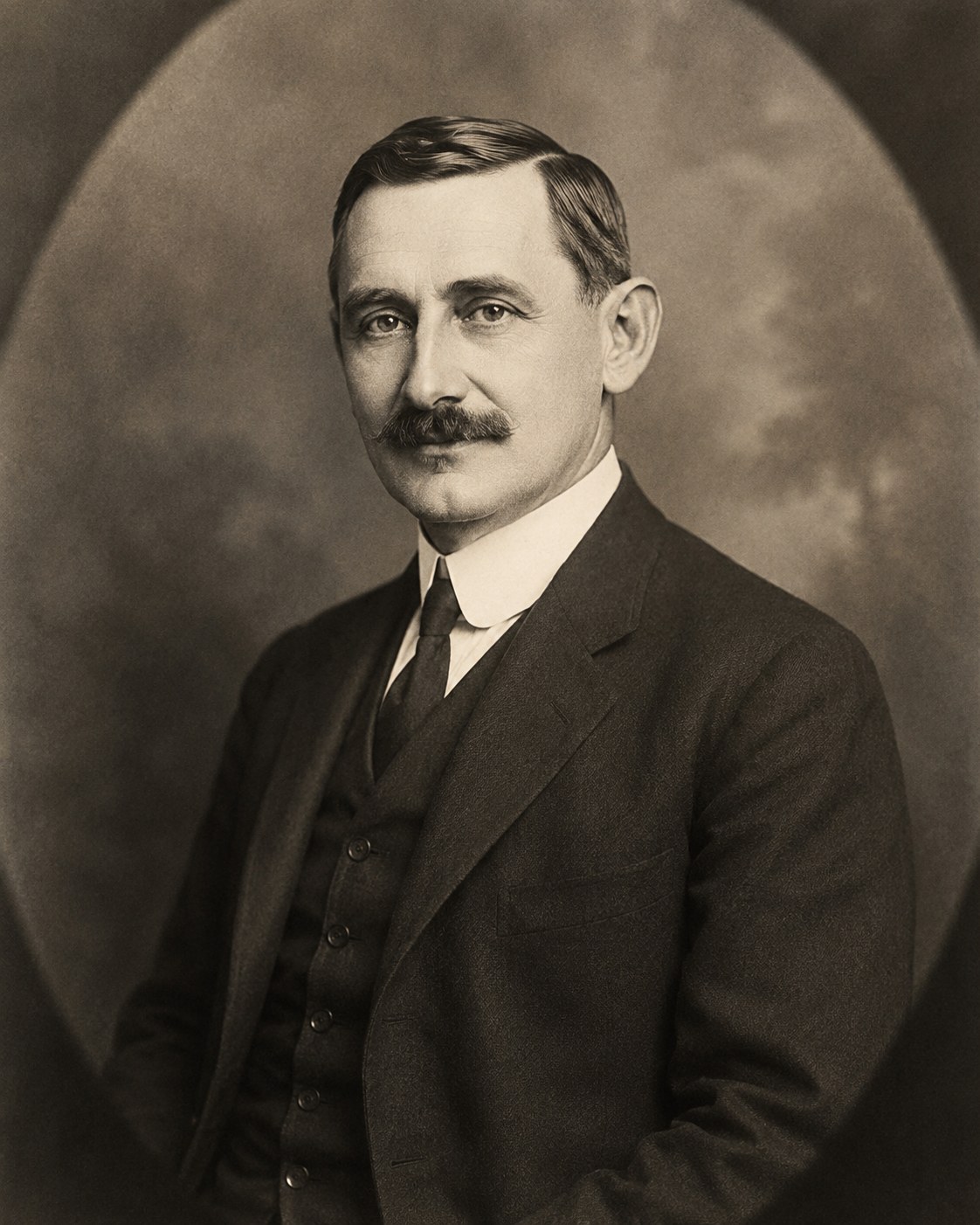
A period-style AI portrait representing Edwin J. Geittman, the lawyer and banker behind the Hotel Inverness.
Citrus County Chronicle — December 4, 1925
Plans Ready for $500,000 Hotel and Business Block at Inverness Seminole-Tompkins Corner to be Hub of Inverness
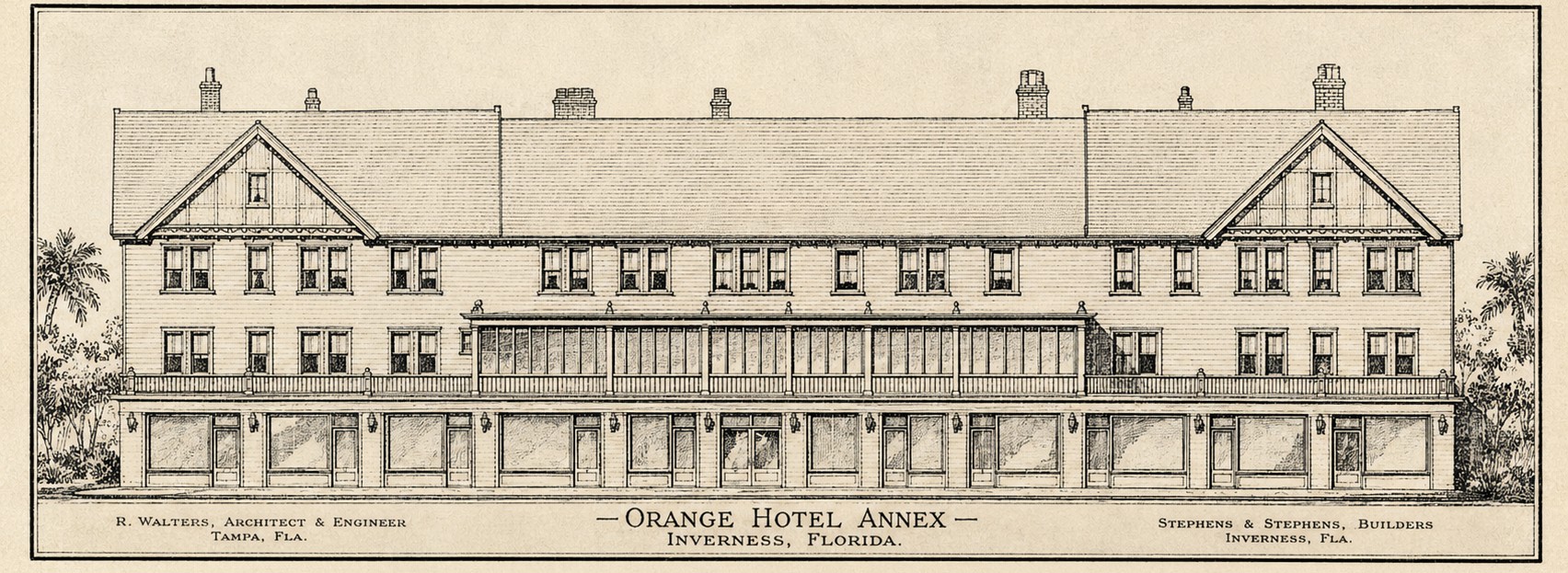
Startling and infinitely progressive changes are to take place in and around that intersection in this city known as Seminole and Tompkins streets. Fronting on Seminole, the imposing new Orange Hotel annex now being moved will stand three stories in height, with a handsome 177-foot sun porch, beneath which will be built fifteen modern and attractive stores and shops, leases for which are now being made.
Architectural rendering of the planned Orange Hotel Annex, Inverness, c. 1926. Historical Reconstruction · Produced under HCPS v1.1.
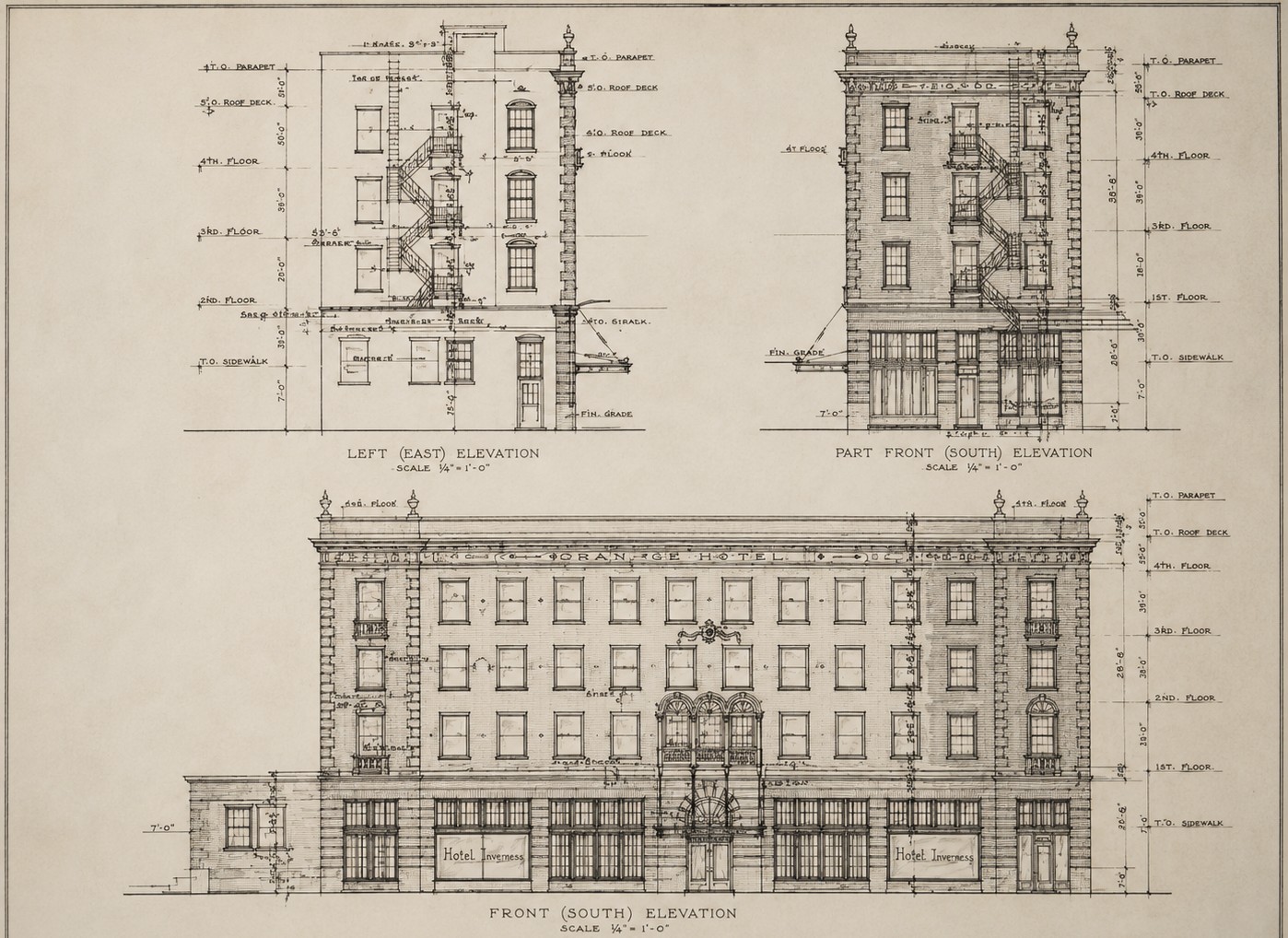
Across from this, the new fireproof Orange hotel will rise four stories at first and later six or eight stories as the need demands — and will contain 90 of the finest, most attractive and comfortable rooms to be found in any hotel in Florida, according to its builders. The new Orange hotel front will be of brick and stone and every room will have an adjoining bathroom.
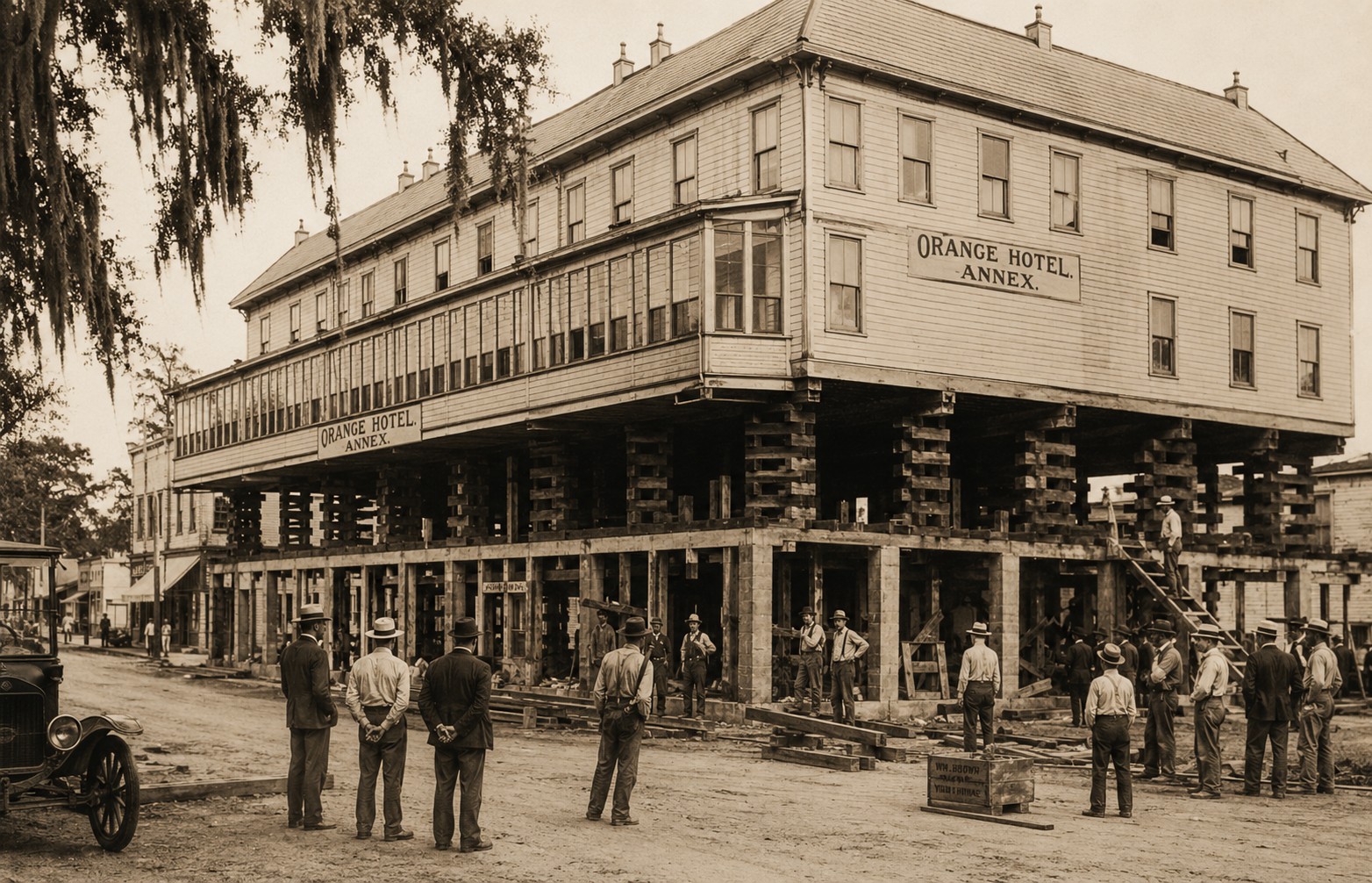
Period architectural elevations of the Orange Hotel Building, Inverness, c. 1925. Interpretive Illustration · Produced under HCPS v1.1.The “Grand Move” of 1926 — the original Orange Hotel raised on stacked timber cribbing while a new first-floor lobby was built beneath it, watched by a crowd of onlookers. Historical Reconstruction · Produced under HCPS v1.1.
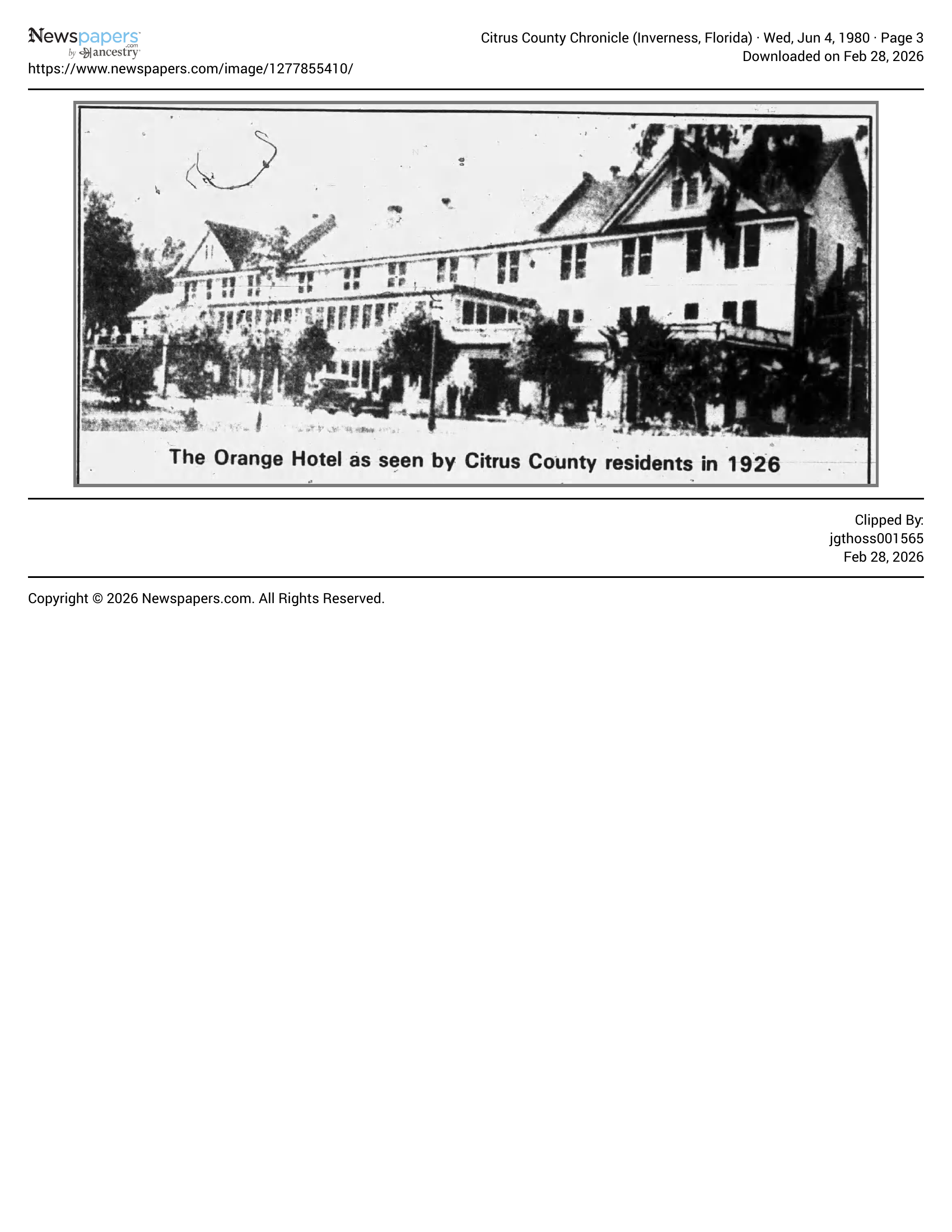
The annex expansion in more detail: The building was enlarged in 1926 when it was moved to its present resting place on Seminole Avenue. The two-story structure became three when the original two floors were moved from Main Street and hoisted into the air on top of a new first-floor lobby. The guest room count was expanded to 40 when wings were built on both the North and South ends. The center section — between two brick walls that protrude through the roofline — is the original Orange Hotel.
Despite the fact that construction of the new annex was far from complete, by January 8, 1926 the Walter-Geittman Corp. was already placing ads in the Chronicle announcing the opening of the hotel dining room.
Citrus County Chronicle — Friday, January 15, 1926
Geittman Makes Stirring Speech
One of the most inspiring speeches ever delivered before Inverness business men was made yesterday noon before members of the Inverness Kiwanis club by E. J. Geittman, former Kansas banker and one of Inverness’ greatest city builders, Orange hotel proprietor.
It was the roaring twenties in America. Walter and Geittman had come into Citrus County with a bang. But on Sunday, March 14, 1926, a little less than three months before the official opening of the new annex, everything changed. Forty-four-year-old Geittman suffered a sudden stroke and died.
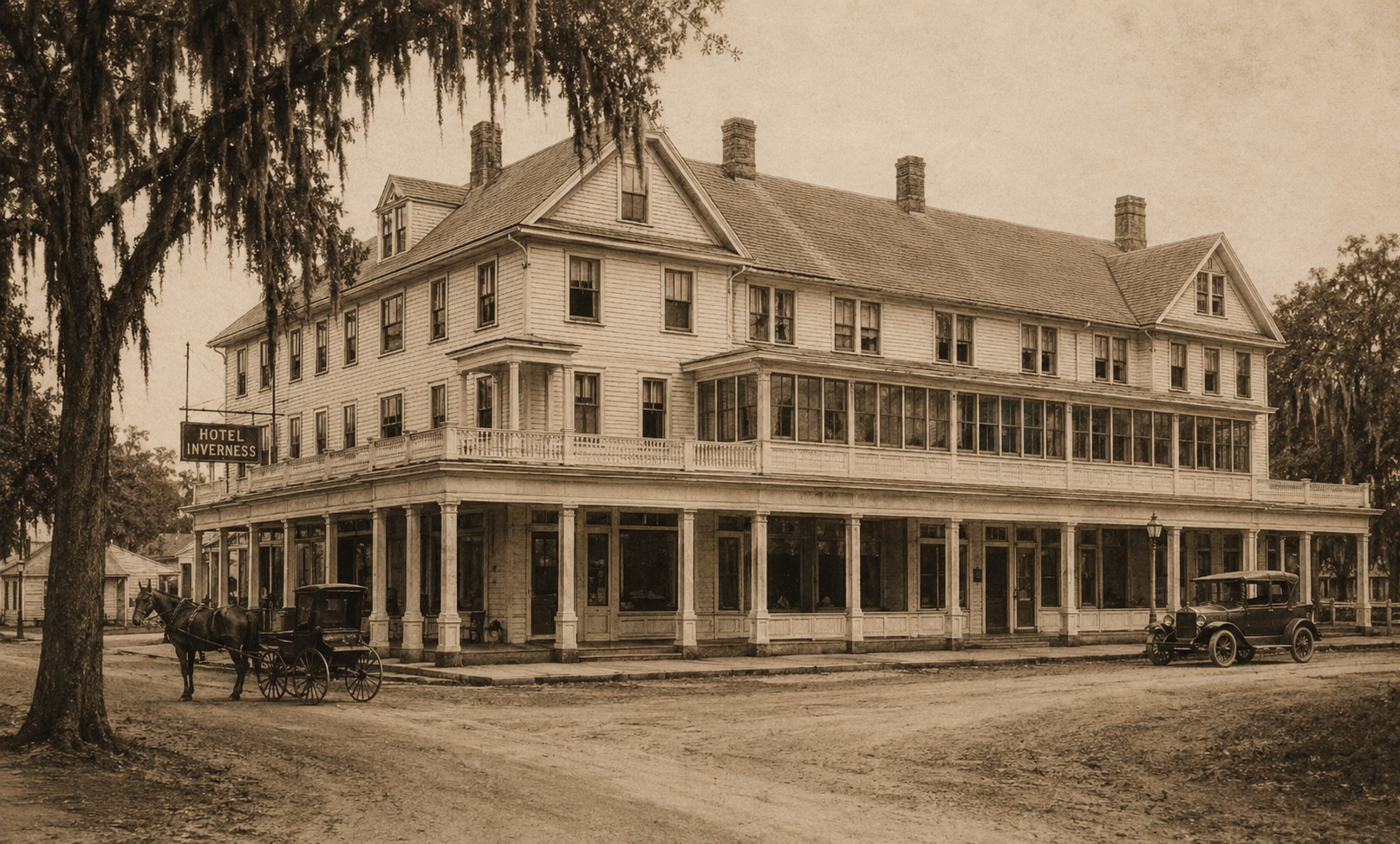
Left to helm the corporation alone, Mr. Walter vowed work would continue without interruption — but his idea for the development changed yet again. Plans to build the new fireproof hotel across Seminole were scrapped. Now, the “Orange Hotel Annex” would, in fact, be the complete new hotel. Looking into his not-too-distant past for a name, Walter chose a new one. On June 4, 1926, Inverness celebrated the opening of a brand new hotel — the Hotel Inverness.
The Hotel Inverness, late 1920s — the corner view with its wrap-around veranda, glassed sun porch, and the “Hotel Inverness” sign on the corner. AI-assisted restoration · Produced under HCPS v1.1.Another AI illustration of the Hotel Inverness from the street, its verandas overlooking a moss-draped Seminole Avenue.
Citrus County Chronicle — Friday, June 4, 1926
Inverness’ Handsome New Hotel Completed
The city of Inverness, with many guests from surrounding towns, will join tonight in appropriate festivities to celebrate the completion and opening of the new Hotel Inverness, just completed by the Walter-Geittman corporation. The Citrus County Chamber of Commerce and the Kiwanis Club have co-operated in the staging of an elaborate banquet to be held tonight in the hotel dining room.
Perhaps no more beautiful and luxurious a hotel can be found in the state of Florida. The structure is three stories and has been built for the accommodation of one hundred guests. On the second floor is located one of the chief attractions of the inn — the large sun parlor, eighty feet long and twenty-four feet wide, enclosed on three sides with glass. In the twinkling of an eye this charming room can be changed into an ideal ballroom.
All bedrooms are equipped with bath or connecting bath, telephone, steam heat and electric lights. The organization of the Walter-Geittman corporation is composed of A. B. Walter of Kansas City, president; George A. Maher of Detroit, vice-president; and E. B. Webb of Sarasota, secretary-treasurer.
Entering the winter season of its first year, the Hotel Inverness announced special rates — single with bath at $3.50 per day, double with bath at $5.00 per day — to attract guests from the north. It appeared the corporation was off to a healthy start. But the Great Depression was right around the corner, and by many accounts banks began failing early in Florida.
❖ ❖ ❖
Chapter Three
Tommie Lou’s Orange Hotel
1928 – 1959
The Hotel Inverness might not have been the success the Walter-Geittman Corp. and its investors had hoped for. By the end of 1927, just a year and a half after opening, big changes were once again underway.
Somehow, either through good business, good fortune or a little of both, William and Tommie Lou Maloy became the owners of the hotel again. By January of 1928, the society pages of the Chronicle were referring to the hotel once again as the Orange Hotel. With the Maloys back in charge, the Walter-Geittman corporation and the “Hotel Inverness” seemed all but forgotten.
A late 1920s view of the Orange Hotel after the original owners, Mr. & Mrs. Maloy, took charge again. AI-assisted restoration · Produced under HCPS v1.1.
The Maloys would operate their newly remodeled hotel together for a couple more years until William’s passing on January 2, 1931. After his death, Tommie Lou took charge of the business.
A late 1920s / early 1930s postcard view. AI-assisted restoration · Produced under HCPS v1.1.
But Tommie Lou wasn’t a single widow for long. In 1932 she married Mr. Archie Scott in Hernando County. Mr. Scott, also a railroad engineer — from Franklin County, Vermont — was a longtime friend of her late husband William Maloy.
Tommie Lou Scott, a.k.a. “Aunt Tom.” AI-assisted restoration · Produced under HCPS v1.1.
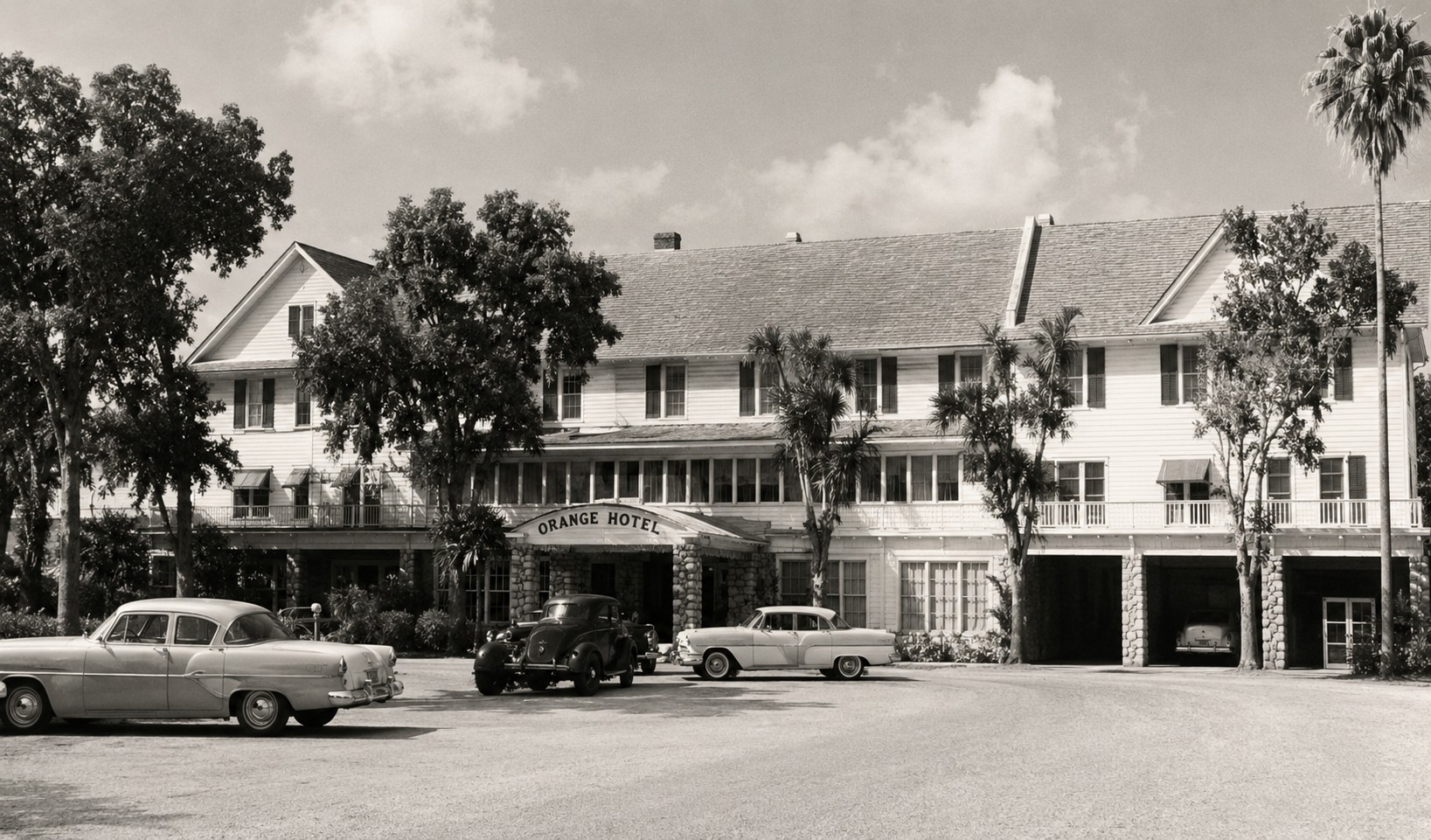
Under the ownership of Archie Scott and his wife Tommie Lou, the Orange Hotel boasted 40 rooms offered at reasonable rates as well as home cooking. Around 1935, the couple added the portico to the front of the building, giving the hotel a more pronounced entrance.
Circa 1939, with the added front portico. AI-assisted restoration · Produced under HCPS v1.1.From Main Street, looking North on Seminole Ave. — 1947. AI-assisted restoration · Produced under HCPS v1.1.
On June 6, 1942, at the age of 67, Tommie Lou became a widow for the last time when Archie Scott passed away at the age of 71. She never remarried.
The Orange Hotel — February 28, 1951. AI-assisted restoration · Produced under HCPS v1.1.
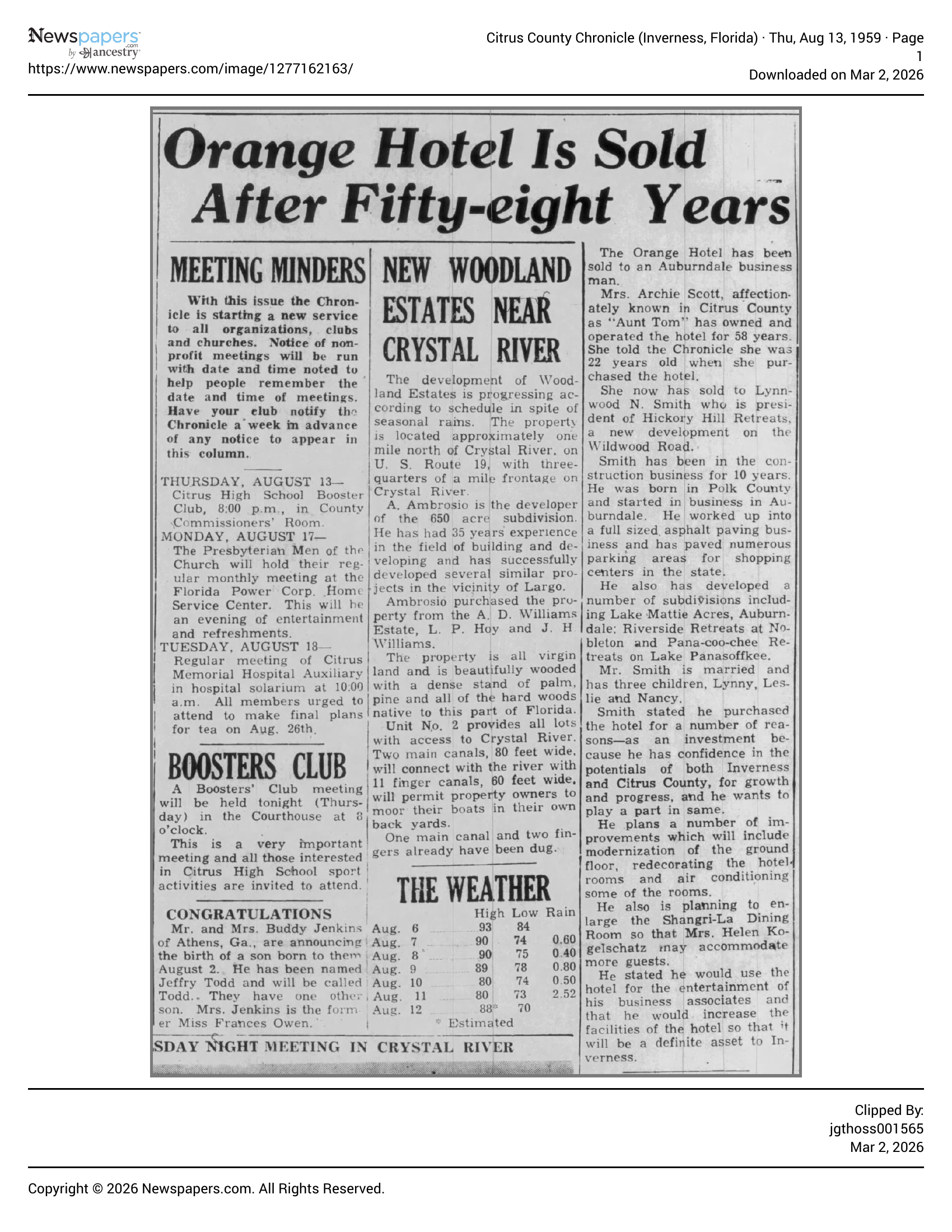
Tommie Lou continued to run her hotel on her own for 17 more years until August 13, 1959 when, at the age of 84, she finally decided to sell.
By most accounts, Tommie Lou owned and operated the hotel for over fifty years. In later years, she and her sister Jane both lived in duplicate houses right behind the hotel. She survived three husbands. And while she had an extended family of nephews and nieces (one named Tommie Lou after her), she never had children of her own.
Tommie Lou spent the majority of her life taking care of others, providing home-cooked meals and warm beds to strangers and friends alike. On September 14, 1960, just one year after serving her last guest, Tommie Lou passed away. She was 85 years old.
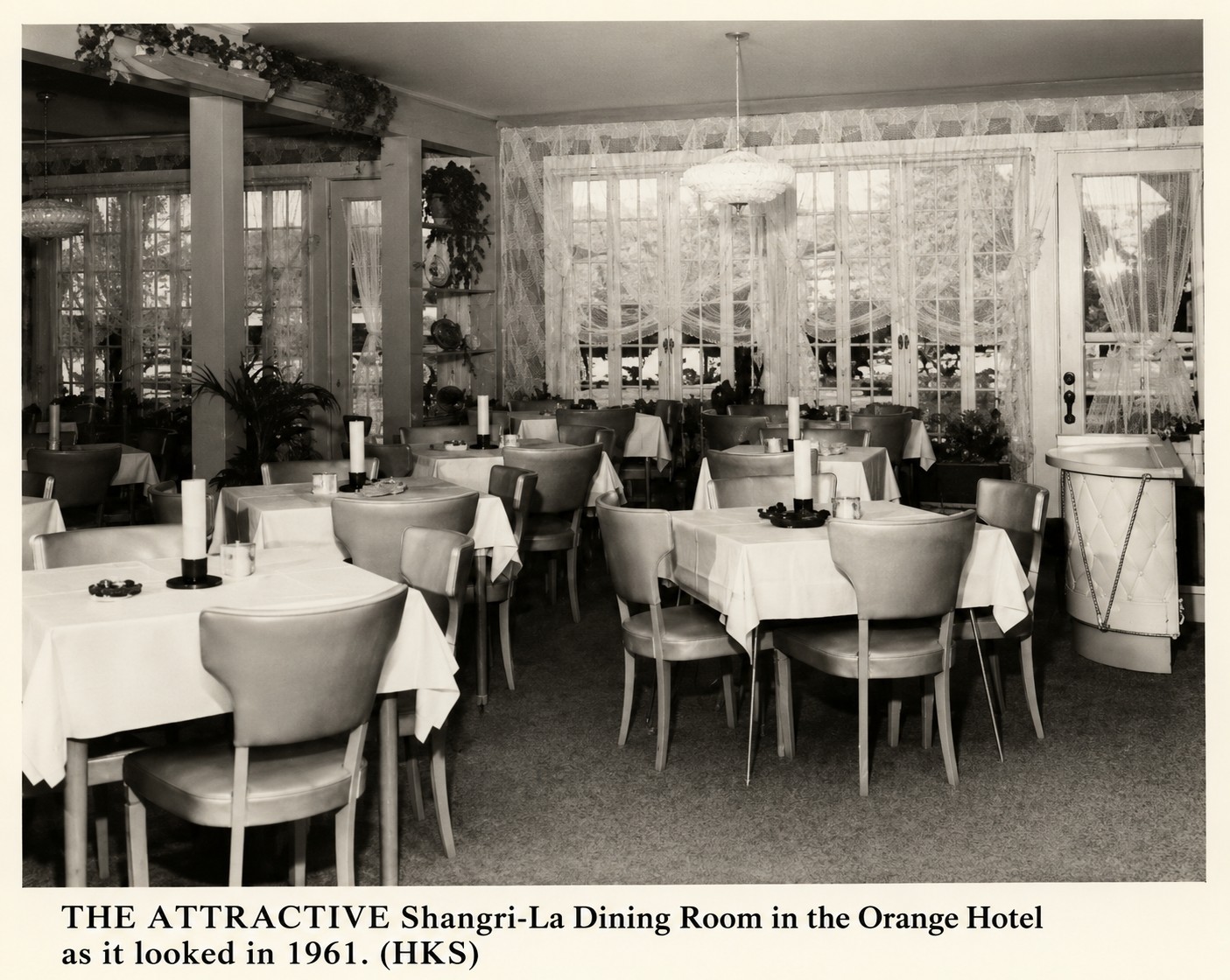
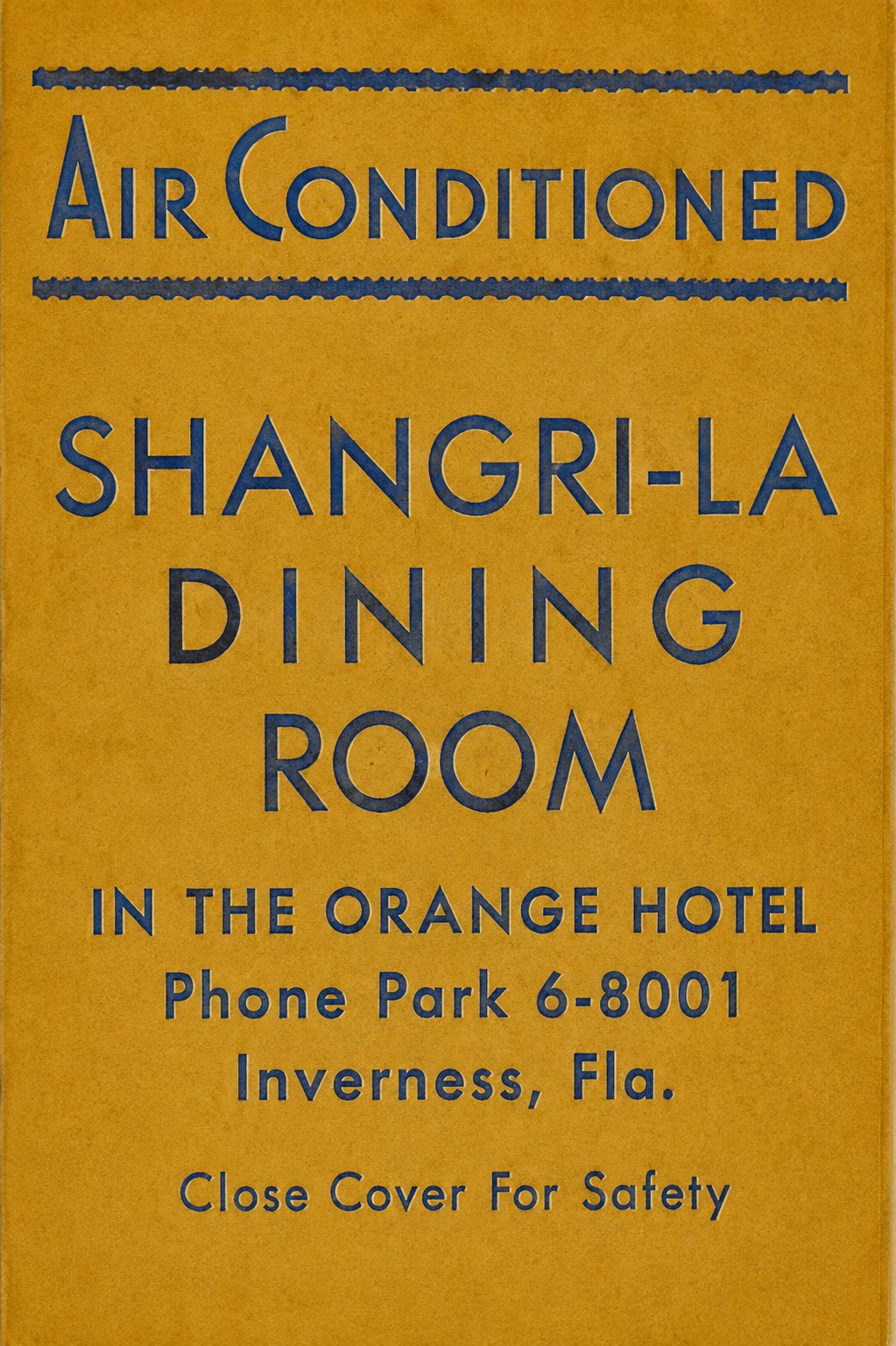
On August 13, 1959, the Citrus County Chronicle reported that Mrs. Archie Scott had sold the property to Lynnwood N. Smith, a local businessman responsible for creating several subdivisions. His plans included enlarging the Shangri-La Dining Room to accommodate more guests as well as modernizing the ground floor and redecorating and air conditioning some of the guest rooms.
The Shangri-La Dining Room. (“Back Home: A History of Citrus County, Florida” by Hampton Dunn, p. 451) AI-assisted restoration · Produced under HCPS v1.1.
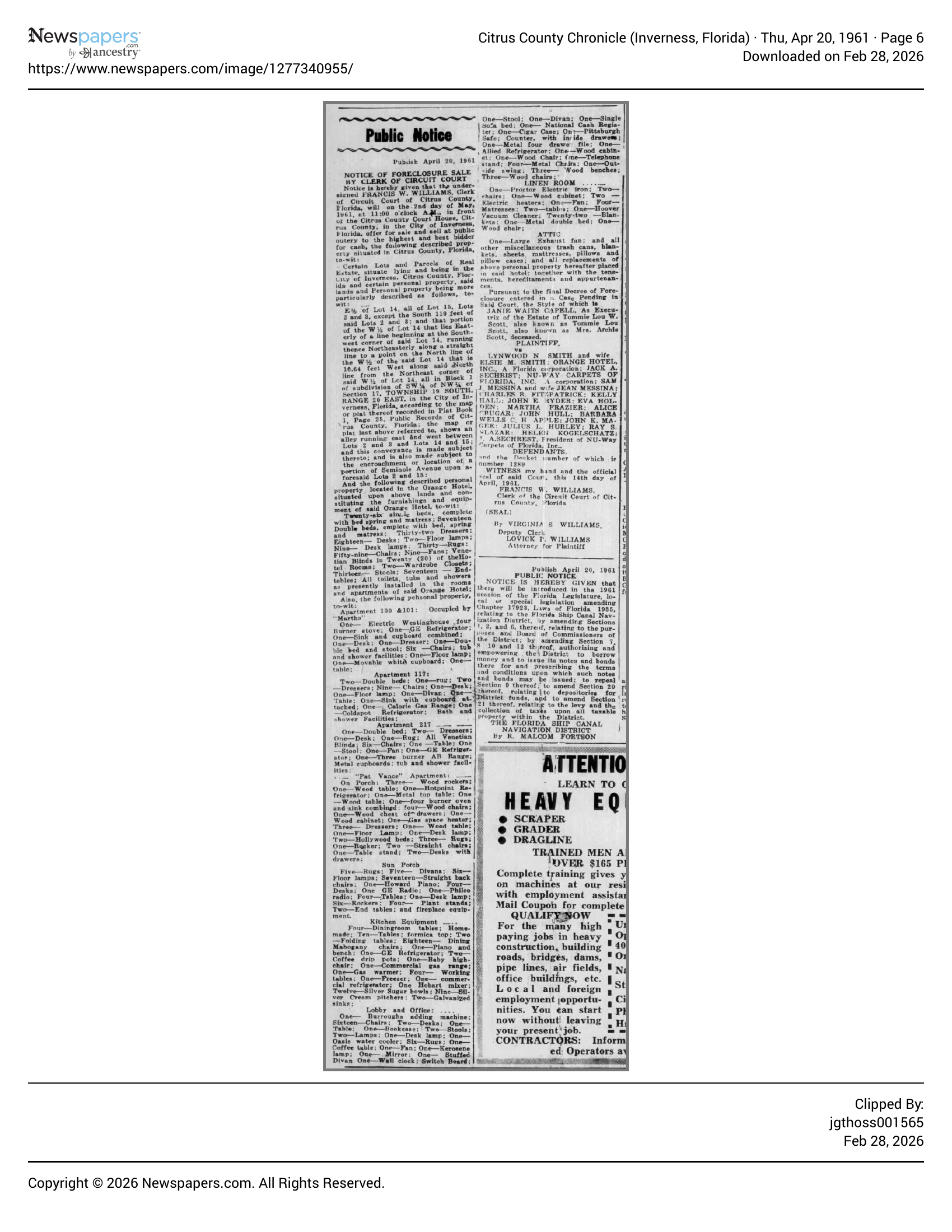
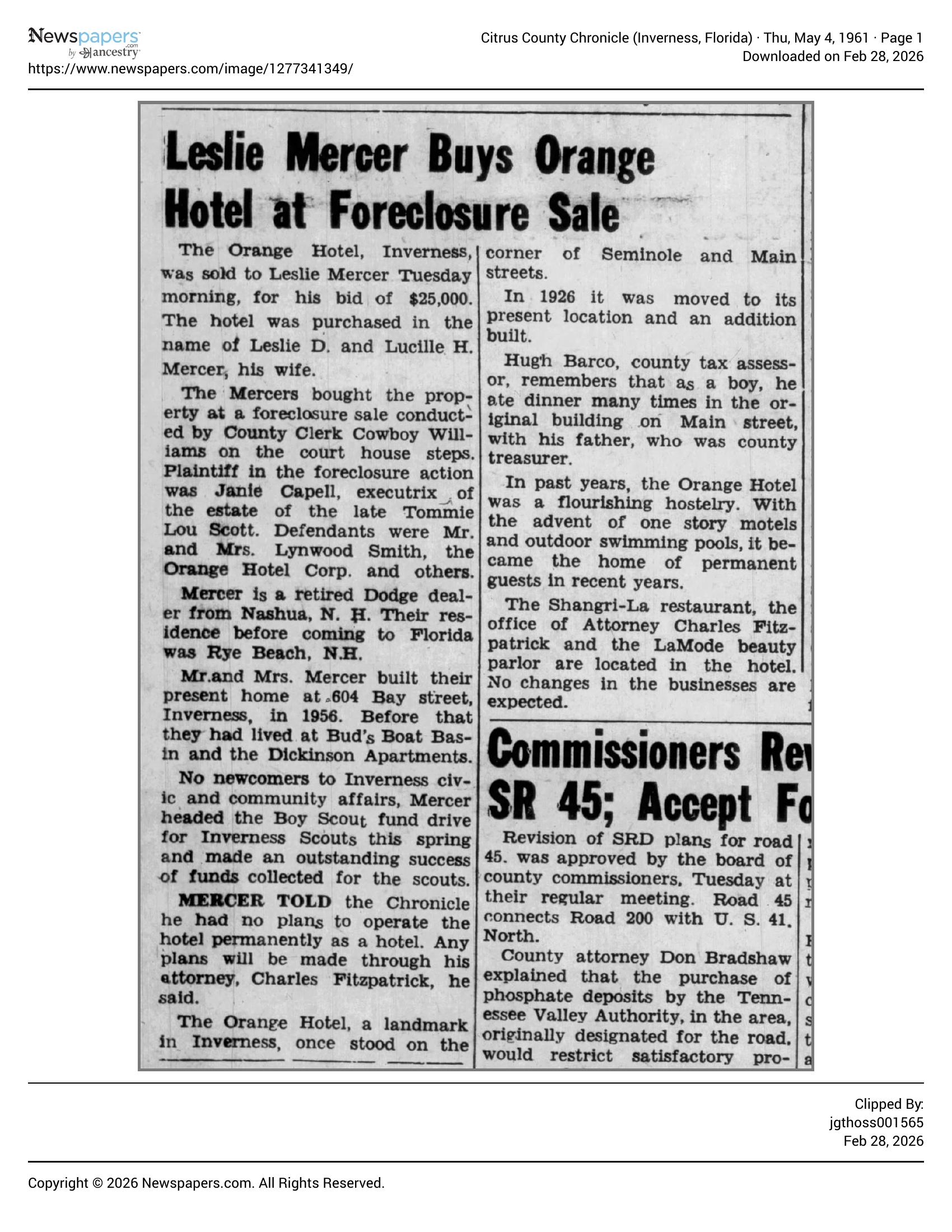
But Mr. Smith would not own the hotel for very long before succumbing to financial woes. On May 23, 1961, the New Hampshire newspaper The Nashua Telegraph reported:
Leslie Mercer and his charming wife, long winter residents of Inverness, Florida, have become hotel owners in that growing city. A recent story in the Citrus County Chronicle reports that the Mercers have bought the Orange Hotel at a foreclosure sale for $25,000. Mercer says he does not plan to operate the place permanently as a hotel. Knowing Les, one can be sure that something profitable will come from the venture.
Almost a year later, the Ocala Star-Banner reported he purchased the food and beverage side of the business as well:
Shangri-La Dining Room Bought By Mercer — April 27, 1962
Leslie D. Mercer, operator of the Orange Hotel here, has recently purchased the adjacent Shangri-La Dining Room and is in the process of remodeling and redecorating it. Mercer, a former New Hampshire auto dealer, has operated the hotel since last May.
The Orange Hotel in the early 1960s. AI-assisted restoration · Produced under HCPS v1.1.
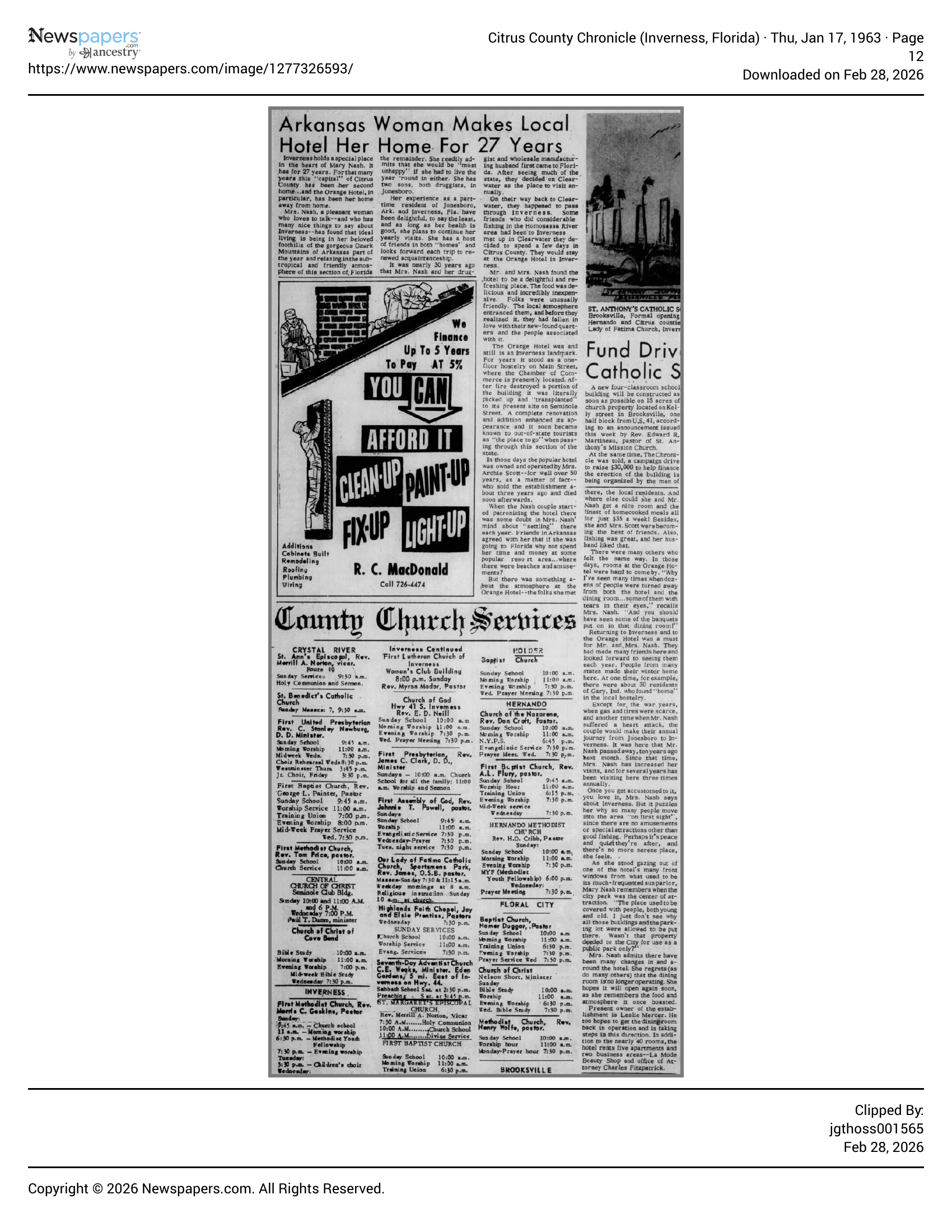
A January 17, 1963 feature in the Citrus County Chronicle revealed the allure of both the Orange Hotel and Inverness for guests who returned year after year. One of them, Mrs. Mary Nash, had been coming to the Orange Hotel for 27 years.
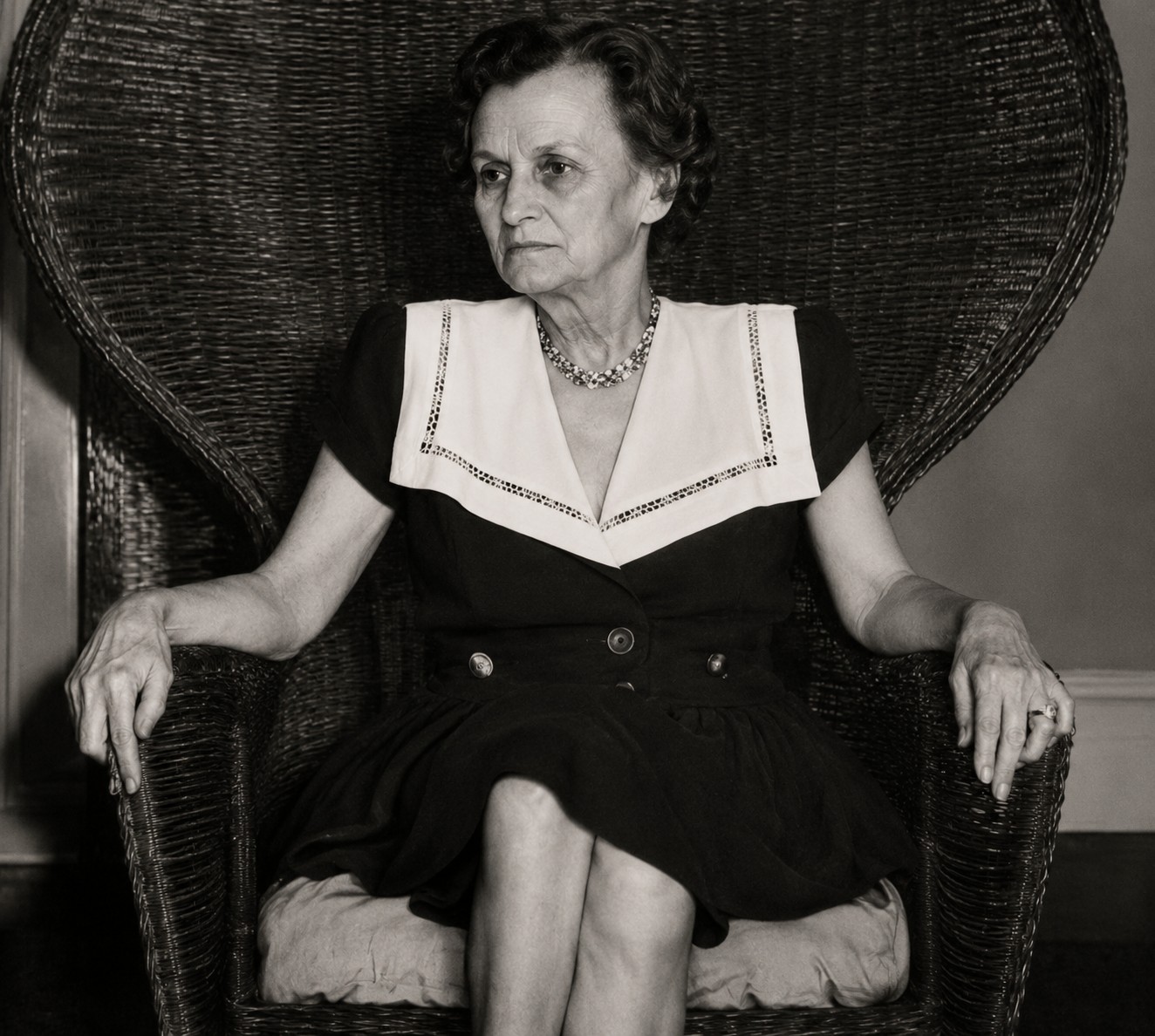
Mary Nash in her favorite “sun parlor” chair. AI-assisted restoration · Produced under HCPS v1.1.
Arkansas Woman Makes Local Hotel Her Home For 27 Years
Inverness holds a special place in the heart of Mary Nash. For 27 years this “capital” of Citrus County has been her second home — and the Orange Hotel, in particular, has been her home away from home. Mr. and Mrs. Nash found the hotel to be a delightful and refreshing place. The food was delicious and incredibly inexpensive. Folks were unusually friendly. Where else could she and Mr. Nash get a nice room and the finest home-cooked meals all for just $35 a week!
“Why, I’ve seen many times when dozens of people were turned away from both the hotel and the dining room… some with tears in their eyes,” recalls Mrs. Nash. “And you should have seen the banquets put on in the dining room!”
Committed to re-opening the restaurant, Mr. Mercer brought in new talent. On May 2, 1963, the Citrus County Chronicle announced that the popular Shangri-La Dining Room had re-opened under the direction of Mr. and Mrs. Wilbur Spafford and family, of Hernando, joined by their son Wilbur Jr., a trained chef freshly discharged from the Air Force.
A matchbook promoting the restaurant. AI-assisted restoration · Produced under HCPS v1.1.
But by the summer of 1965, after owning the hotel for just over four years, it seems Mr. Mercer was ready to divest himself of the hospitality business altogether. The following classified ad was placed in the St. Petersburg Independent on July 31, 1965:
HOTEL, 36 rooms, 5 apartments, 3 business rentals, beautiful air-conditioned 70-chair dining room, fully equipped kitchen, at new shopping center, just off U.S. 41, full price $55,000. Orange Hotel, Inverness, Fla. Phone 726-9939.
The latter days of the Orange Hotel. AI-assisted restoration · Produced under HCPS v1.1.
❖ ❖ ❖
Chapter Five
The Inverness Colonial Hotel
1965 – 1980
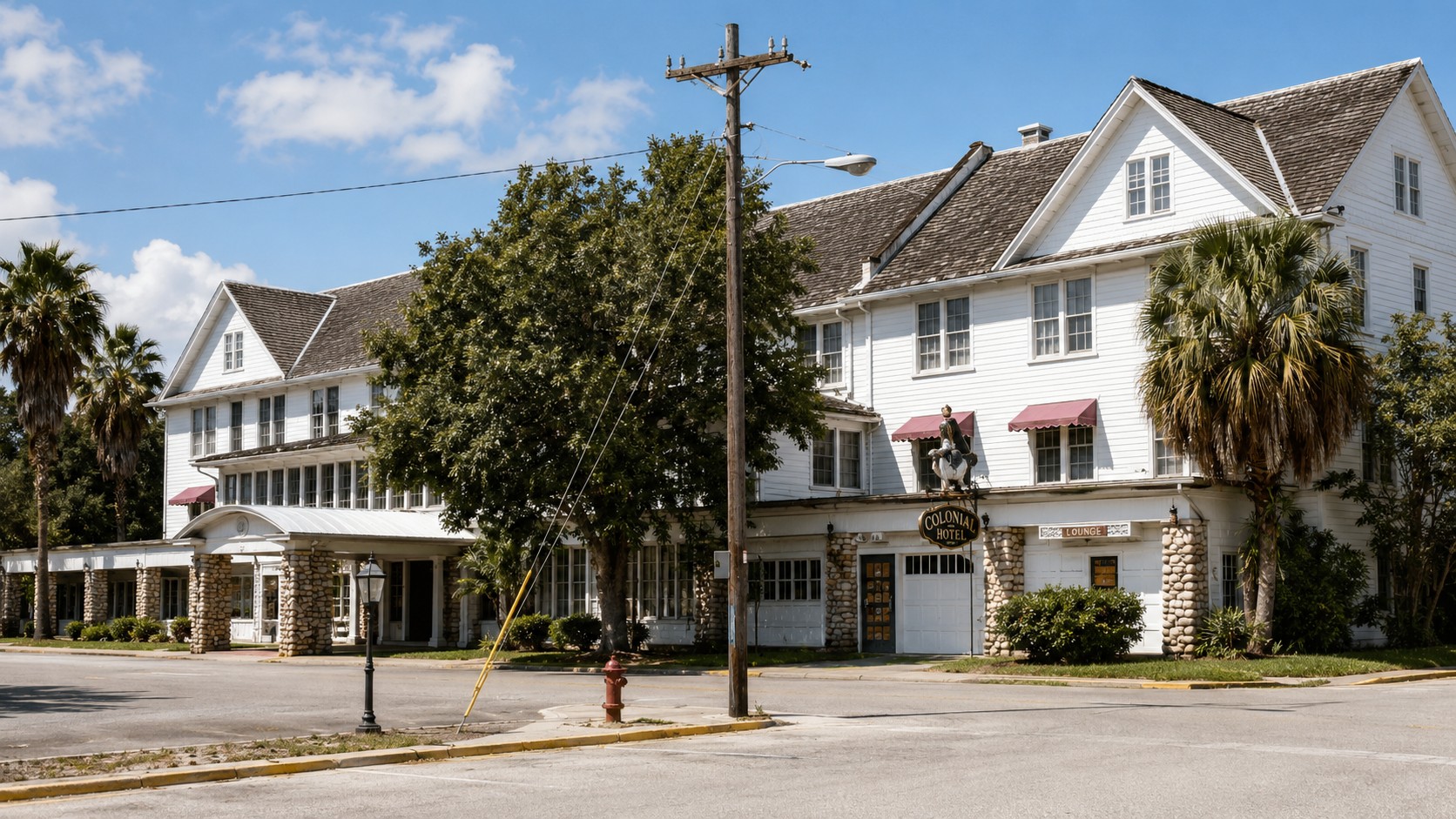
The Orange Hotel was purchased by Victor and Hermine Soto of New York. Born March 10, 1937 in Coamo, Puerto Rico, Victor Soto eventually made his way to New York City where he worked in the local hotel business. There, he met his soon-to-be wife, Hermine. They moved to Inverness in 1965 when they purchased the Orange Hotel from Leslie Mercer for $50,000.
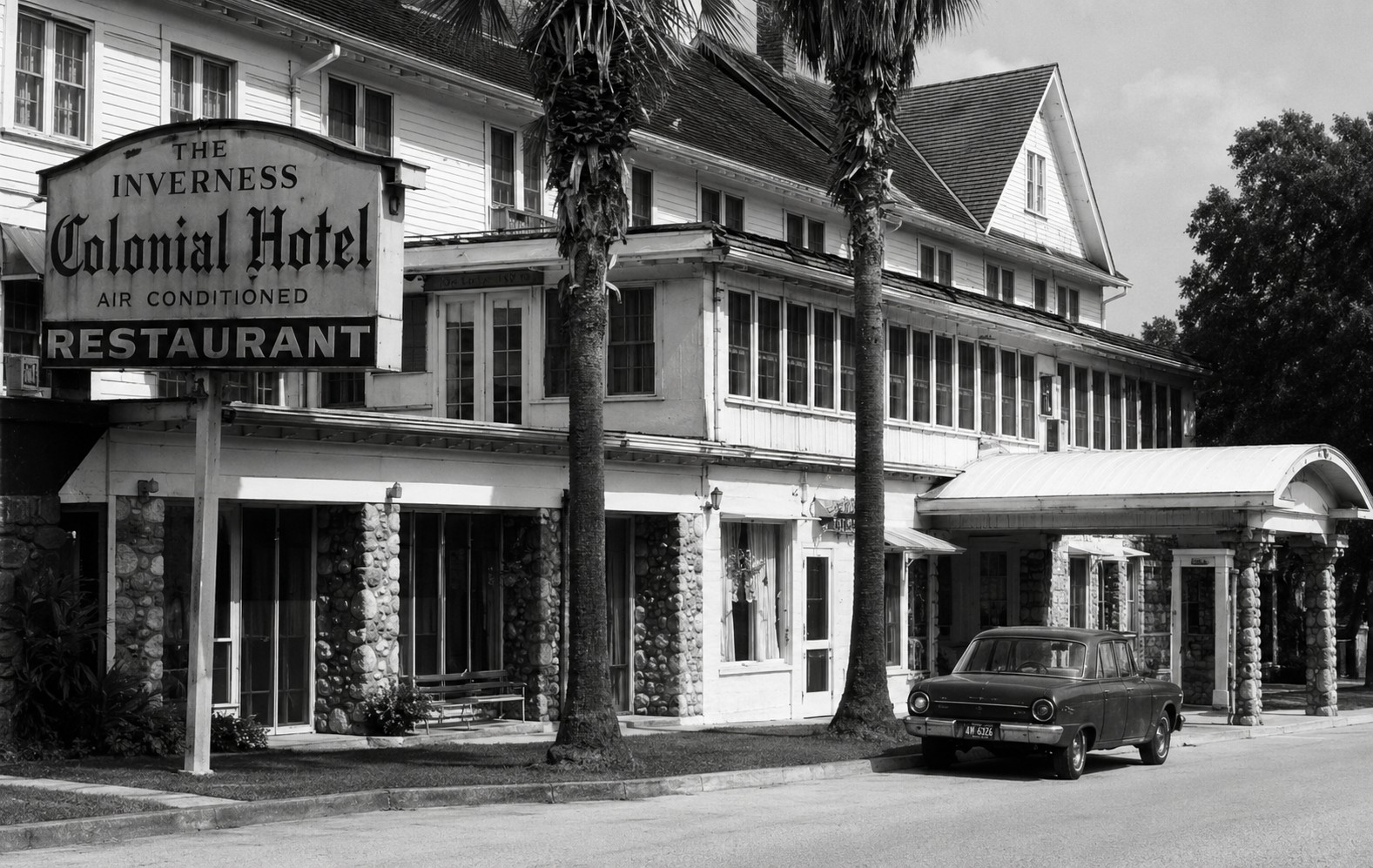
Upon taking ownership, Hermine thought it best to keep the hotel’s original moniker, the Orange Hotel. But Victor believed the Colonial Hotel was more befitting “a property of that size and beauty.”
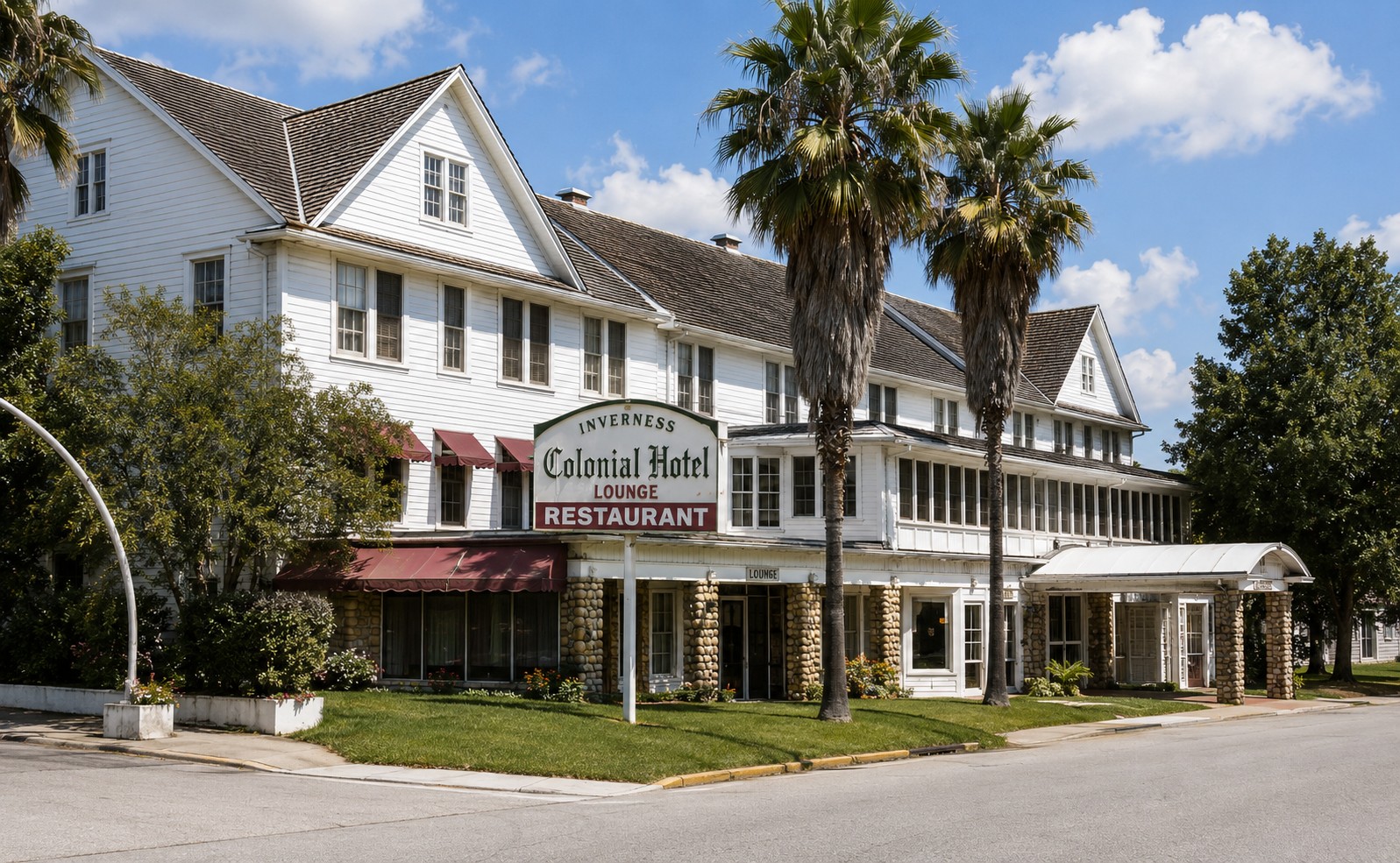
A new name required new postcards. An early postcard of the Colonial Hotel. AI-assisted restoration · Produced under HCPS v1.1.
In their first years, the Sotos sought permission from the Inverness City Council for improvements — greater lighting in the parking area opposite the hotel (December 1966), and a beer, wine, and eventually full liquor license for a new cocktail lounge (1969).
But in four years, the stress of running a hotel, coupled with working sixteen-hour days, seven days a week, had taken its toll on their marriage. By March of 1969, Victor and Hermine divorced and Victor re-married Wilma Rogers, a waitress in the hotel. Leaving the hotel to Hermine in the divorce, Victor moved with his new wife Wilma and her two teenage sons, Ed and Danny, to Ponce, Puerto Rico in June of 1969.
According to Ed Bowman, son of Wilma Rogers and stepson of Victor Soto, leaving the Colonial Hotel behind was a very difficult choice, “because he loved it. He had a sense of loss leaving the hotel but he looked forward to going back to Puerto Rico and starting over with people who loved and cared about him.”
Ed, also a former employee, has great memories: “I painted every room in the hotel the summer of 1967. What a way for a 15 year old to spend his summer.” The Colonial, he says, was THE place to work for high school students. “I think probably half the kids that attended Citrus High School during the mid to late 60’s worked for Victor at one time or another as waiters, waitresses, maids, bell hops, busboys, gardeners, painters, and general handymen.”
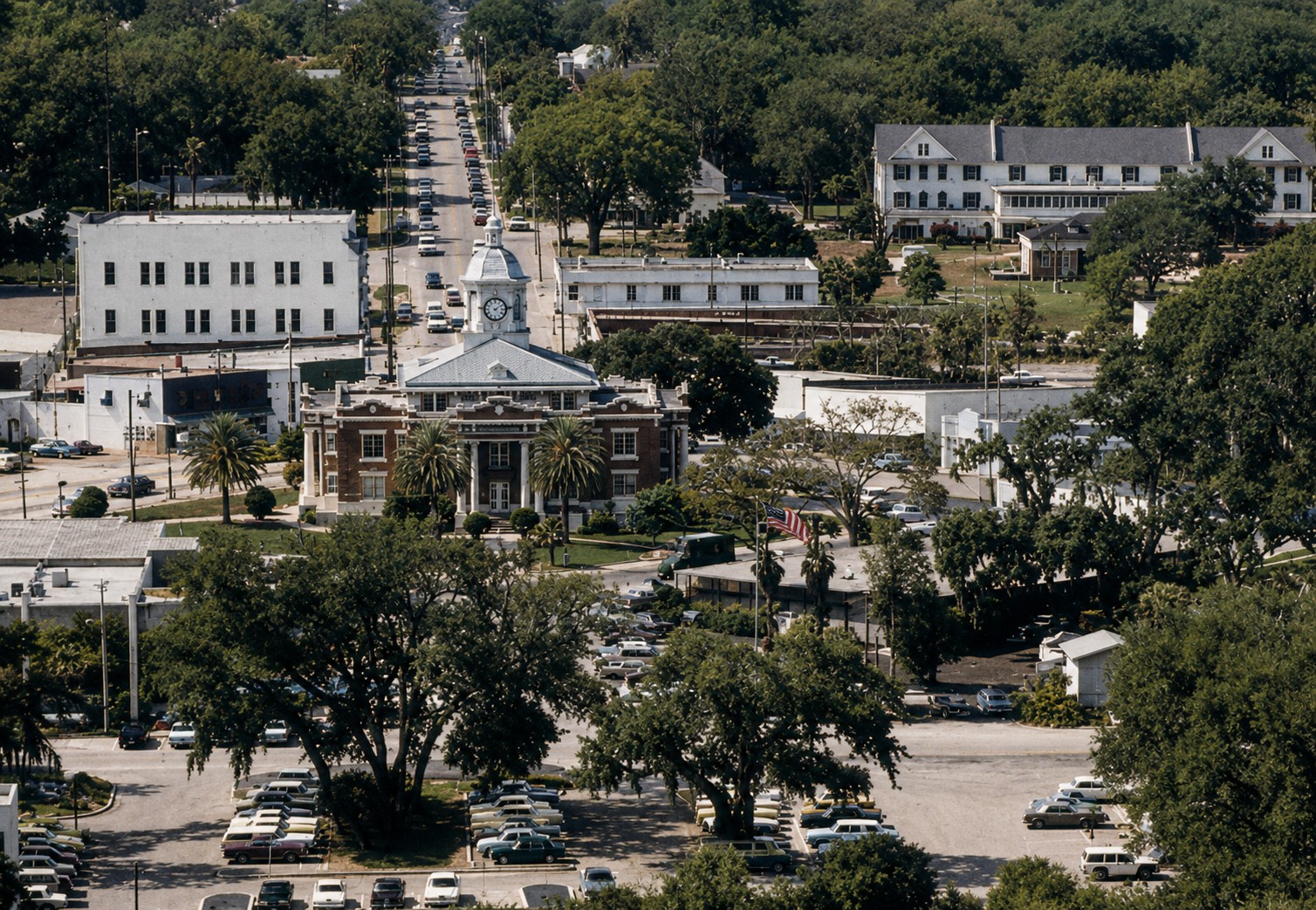
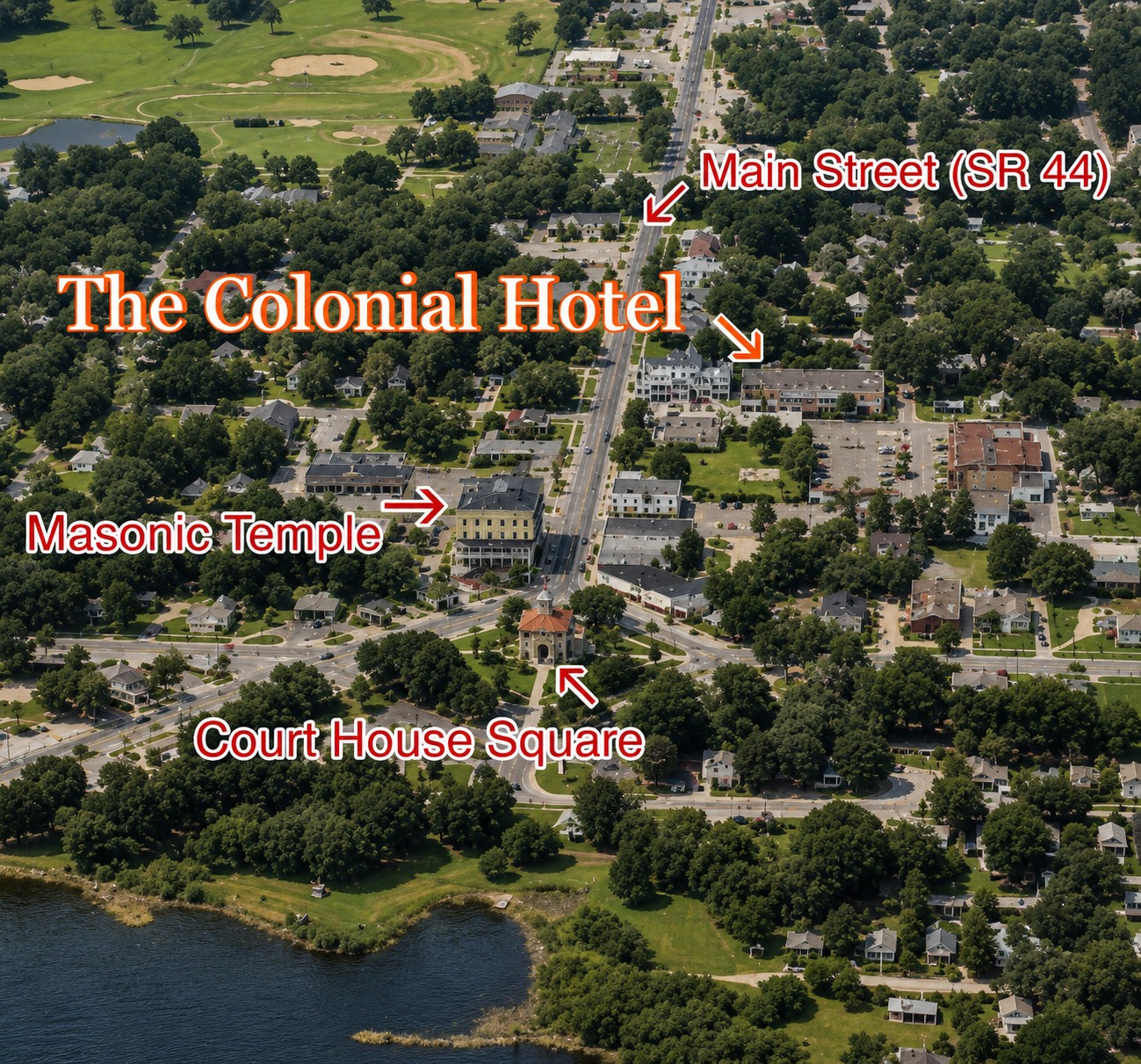
A late 1960s aerial view of downtown Inverness shows where the hotel is located in town. AI-assisted restoration · Produced under HCPS v1.1.
After the divorce, Hermine Soto was left as sole proprietor. She advertised for a management team and offered the restaurant for lease, but by the end of 1970 she had had enough of the hotel business. On January 1, 1971, the Ocala Star-Banner reported she had sold the Colonial Hotel to Mr. & Mrs. Bill Shannon, formerly of Webster, Massachusetts, who obtained a full liquor license and retained the name.
In the spring of 1986, Victor and Wilma Soto moved back to Inverness to care for an ailing grandparent. Victor Soto passed away on February 23, 1990. Wilma remained in Inverness and still resides there.
After purchasing the hotel, Bill and Theresa Shannon expanded the business, adding a cocktail lounge with dancing and live music on Friday and Saturday nights. In March of 1972, they asked the city council to permit the lounge to stay open until 2 a.m. on weekends. Their request was granted.
The Shannons’ Colonial Hotel in the late ’70s. Notice the gold “Shannon’s” sign painted near the entrance of the lounge. AI-assisted restoration · Produced under HCPS v1.1.
❖ ❖ ❖
Chapter Six
A Royal Make-Over
1980 – 1981
By the late 1970s, the Shannons’ Colonial Hotel had become a dilapidated boarding house. Around the end of 1979 to early 1980, John Brierly was looking for investment properties in Florida when he happened to drive through Inverness. Once he saw the deteriorated hotel, its potential was clear to him.
Wasting no time, in May of 1980, Brierly and Inverness City Attorney Michael Kovach established Epicure Investments, Ltd., which purchased the property from Bill and Theresa Shannon on May 21, 1980 for $105,000. Shortly thereafter, Epicure began ambitious renovations.
The Colonial Hotel as featured in The Ocala Star-Banner, June 3, 1980. AI-assisted restoration · Produced under HCPS v1.1.
Inverness’ Colonial Hotel Sold — Landmark brings $105,000
The aged Colonial Hotel on North Seminole Ave. was bought May 21 by an investment firm headed by Michael Kovach, city attorney and president of Epicure Investments, Ltd. “The entire place will be renovated into the style of a British pub,” Kovach said. “When we re-open, the Colonial will be a Hotel, not a rooming house.”
A companion article that day, “Hotel’s Origins A Mystery,” noted that there were no registered blueprints for the wooden structure and that county records trailed off near the turn of the century. The earliest reference of any kind was found in Hampton Dunn’s book Back Home, which described the 1959 sale by Mrs. Archie Scott, “Aunt Tom,” owner since 1901.
Note: That 1980 article erroneously reported that Mrs. Scott sold to an Auburndale businessman named “William H. Malloy.” In fact, that businessman’s name was Lynwood N. Smith. William Maloy (one L) was actually Mrs. Scott’s second husband, with whom she originally bought and ran the hotel. Mr. Maloy died in 1931.
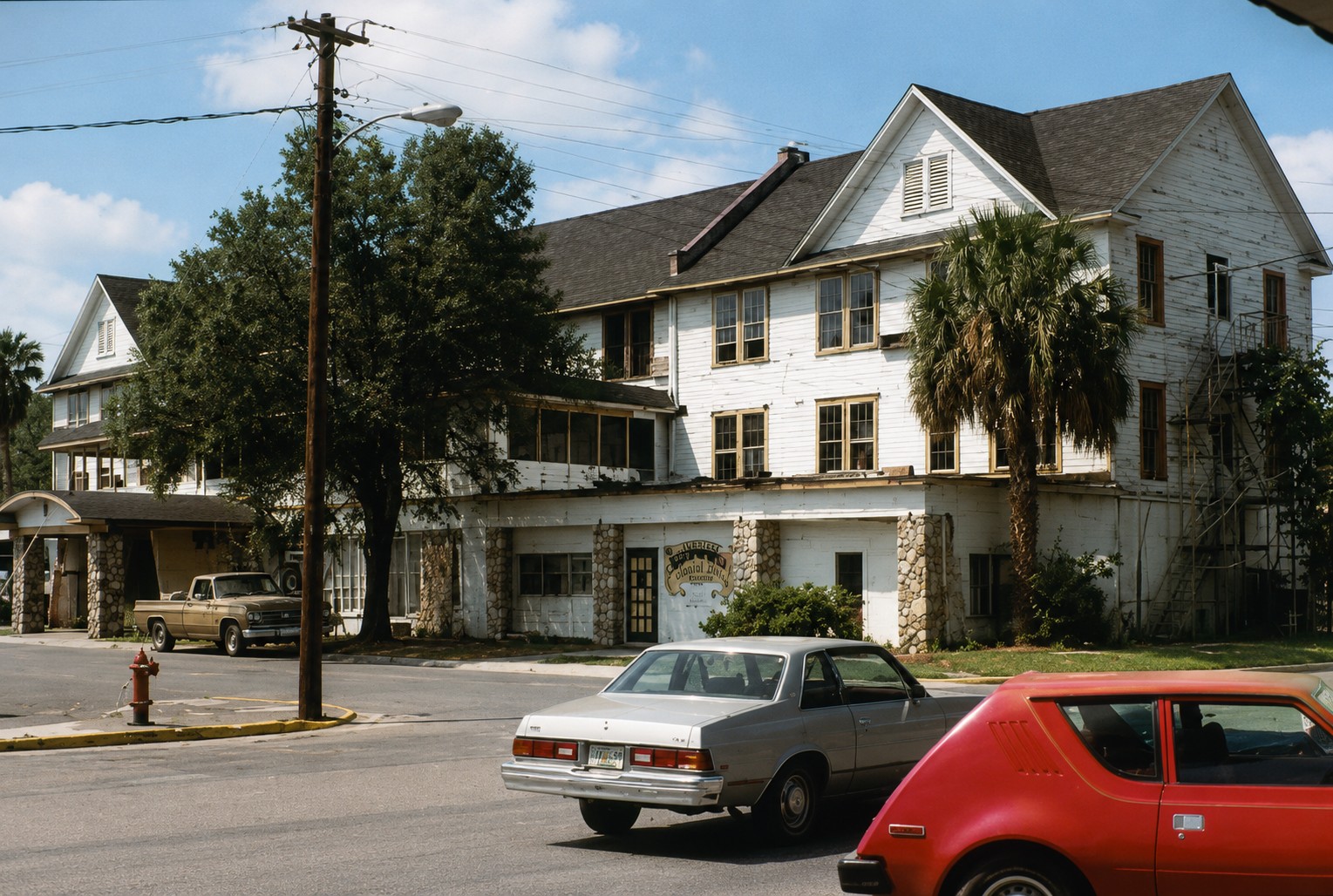
A late 1970s view of the Colonial Hotel shortly before renovations began. AI-assisted restoration · Produced under HCPS v1.1.
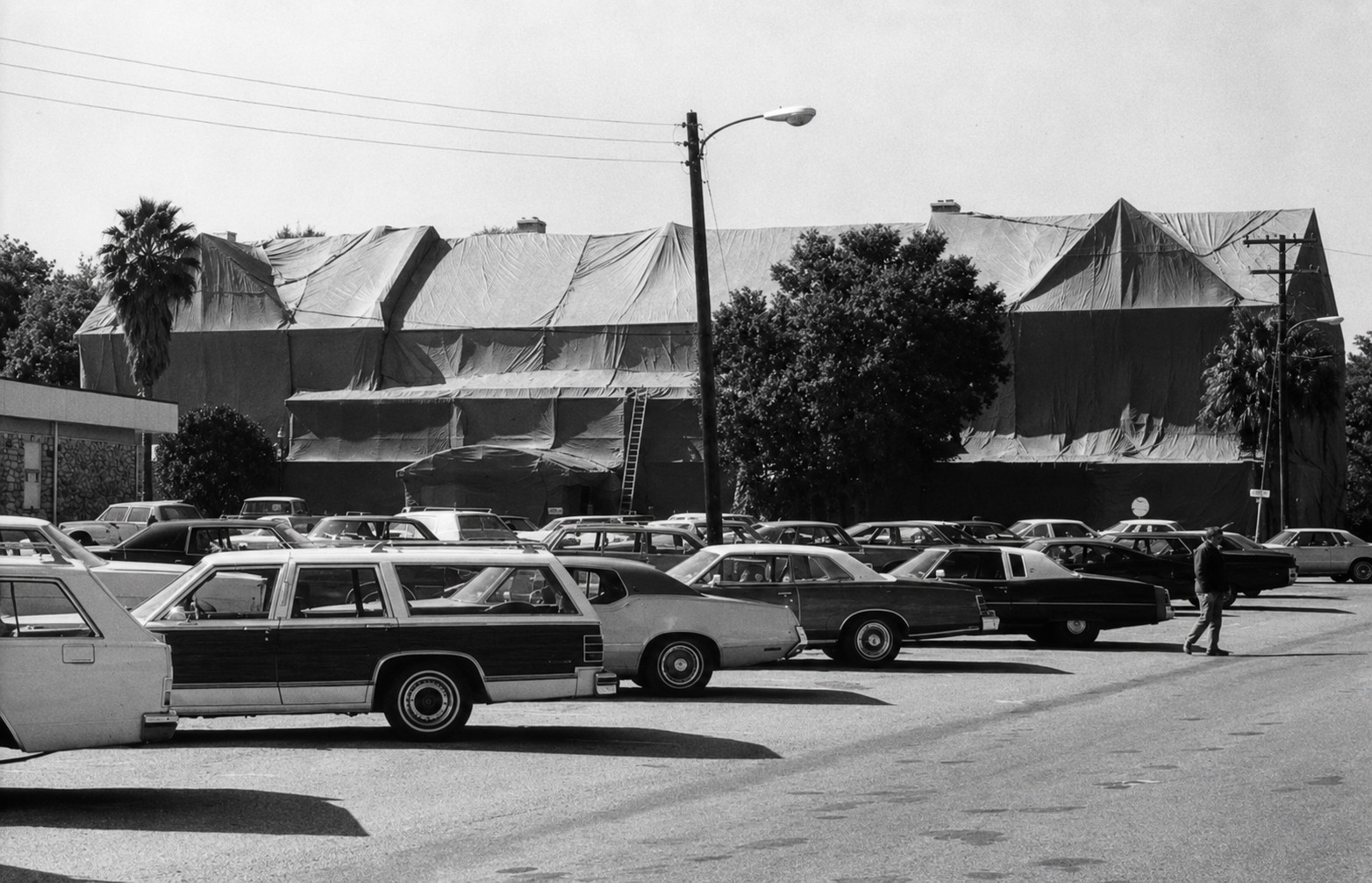
The first physical stage of renovation was dramatic. On December 8, 1980, the St. Petersburg Times documented what was called the largest fumigation job in Citrus County’s history: the entire hotel was draped under a 600,000-cubic-foot tent for dry-wood termite fumigation. “Sidewalk superintendents” watched the three-day procedure with interest.
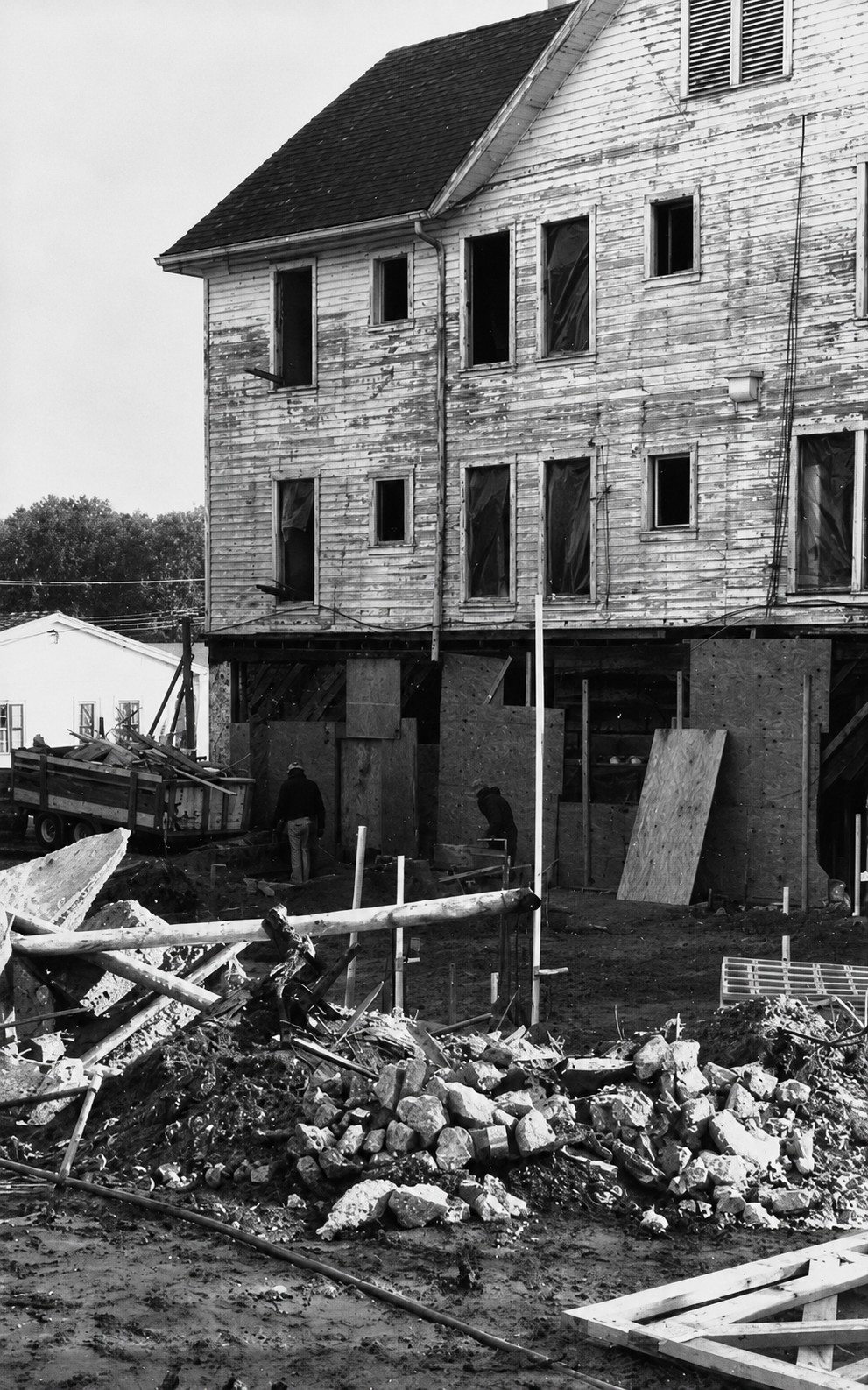
The largest fumigation job in Citrus County history, on the Colonial Hotel. Citrus Times — Hank Cohen. AI-assisted restoration · Produced under HCPS v1.1.Construction of the large commercial kitchen added to the rear of the hotel. AI-assisted restoration · Produced under HCPS v1.1.
Key artisans in the remodel included architect Frank Kalinski, contractor Doug Puterbaugh, interior designer Marilee McIntyre, and glass works by V. L. Berthelsdorf.
The hotel’s transformation well underway. AI-assisted restoration · Produced under HCPS v1.1.
On July 19, 1981, the Ocala Star-Banner reported construction well underway — still calling the hotel by its former name, the Colonial, even at this late date.
Hotel To Bring A Little Of Britain To Inverness
Come September, Inverness residents and tourists will be treated to a little class with the opening of the Colonial Hotel. According to those involved, the hotel will reflect a British atmosphere complete with English-accented cocktail and restaurant waitresses. “That’s where the dart board is going,” the bearded general contractor Doug Puterbaugh said. “And this here… this will be the bar — genuine copper-top.” He estimated the overall renovation bill at about $800,000. “But you can’t cheat on class.”
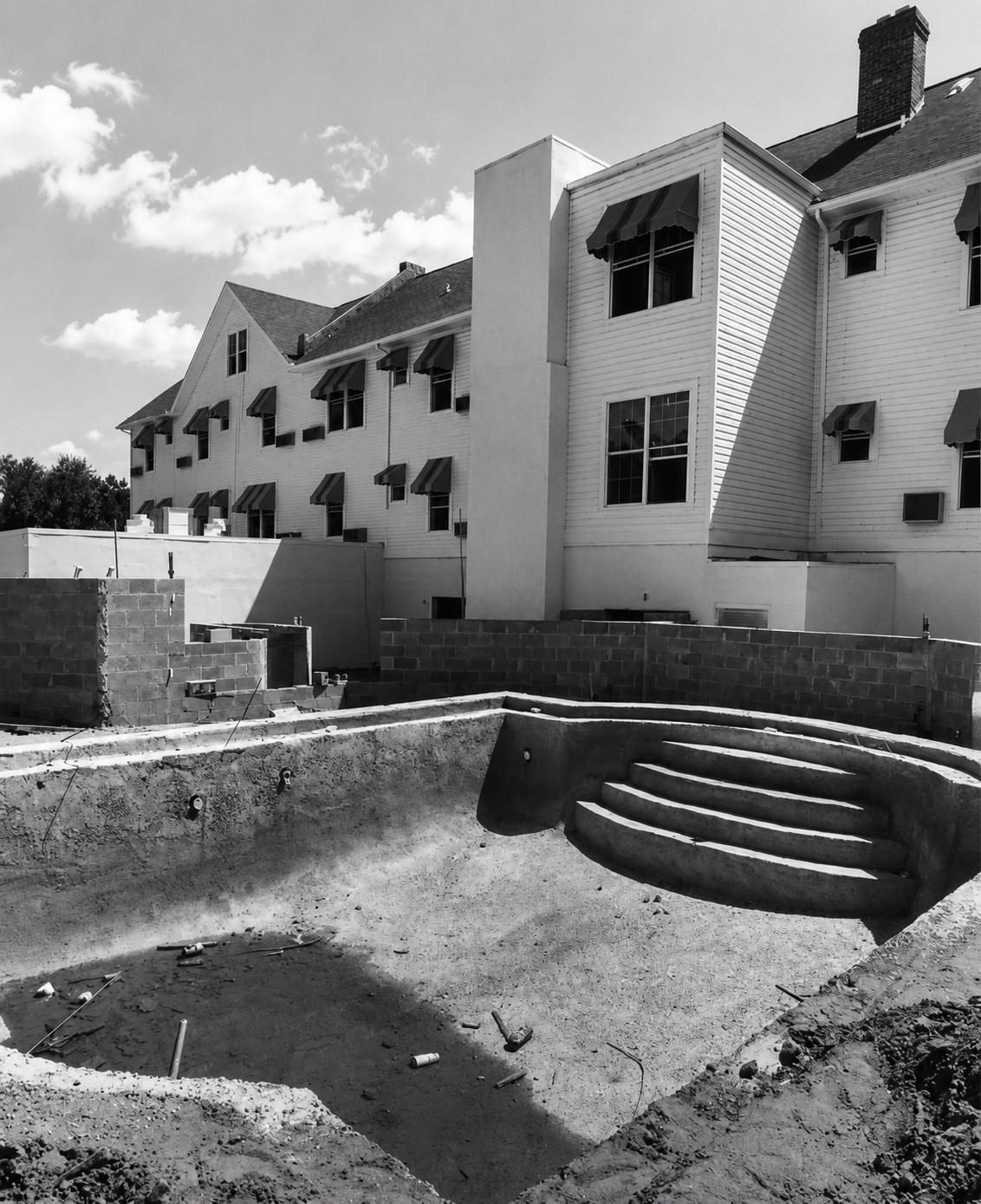
August 12, 1981. The rear of the hotel, looking over the pool construction. Citrus Times — Bob Moreland. AI-assisted restoration · Produced under HCPS v1.1.
By December 24, 1981, the project was nearing completion but would miss perhaps its most important deadline: the new Crown Hotel would not be open for the holidays. General Manager Jade Rivers was training staff — more than 400 applications had been received for service jobs — and an early-to-mid-January opening was anticipated.
In the end, Epicure Investments spent 18 months and an estimated $2 million creating what would in time prove to be the seminal figure in the revitalization of downtown Inverness.
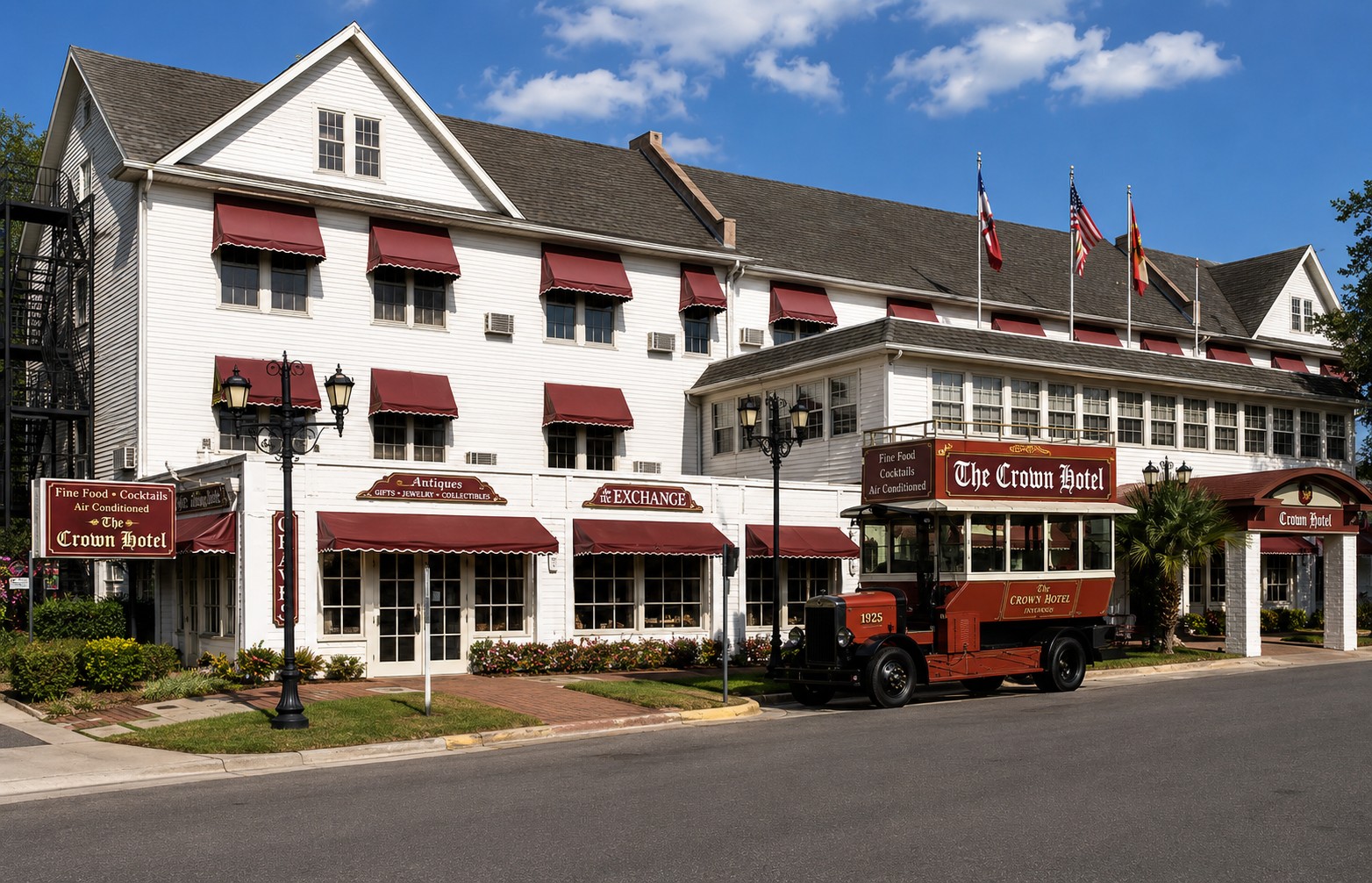
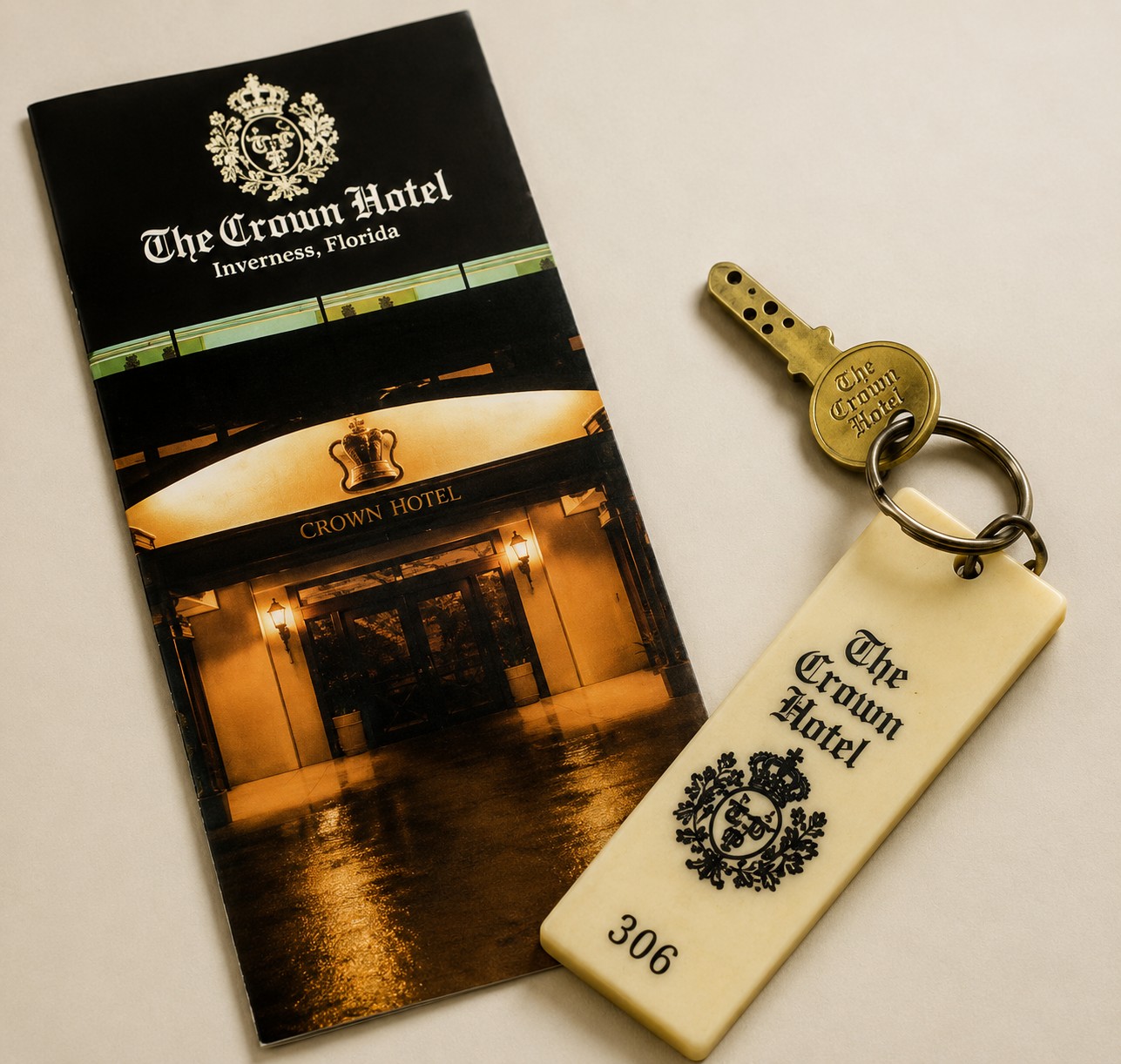
The brand new Crown Hotel as featured in its brochure. AI-assisted restoration · Produced under HCPS v1.1.
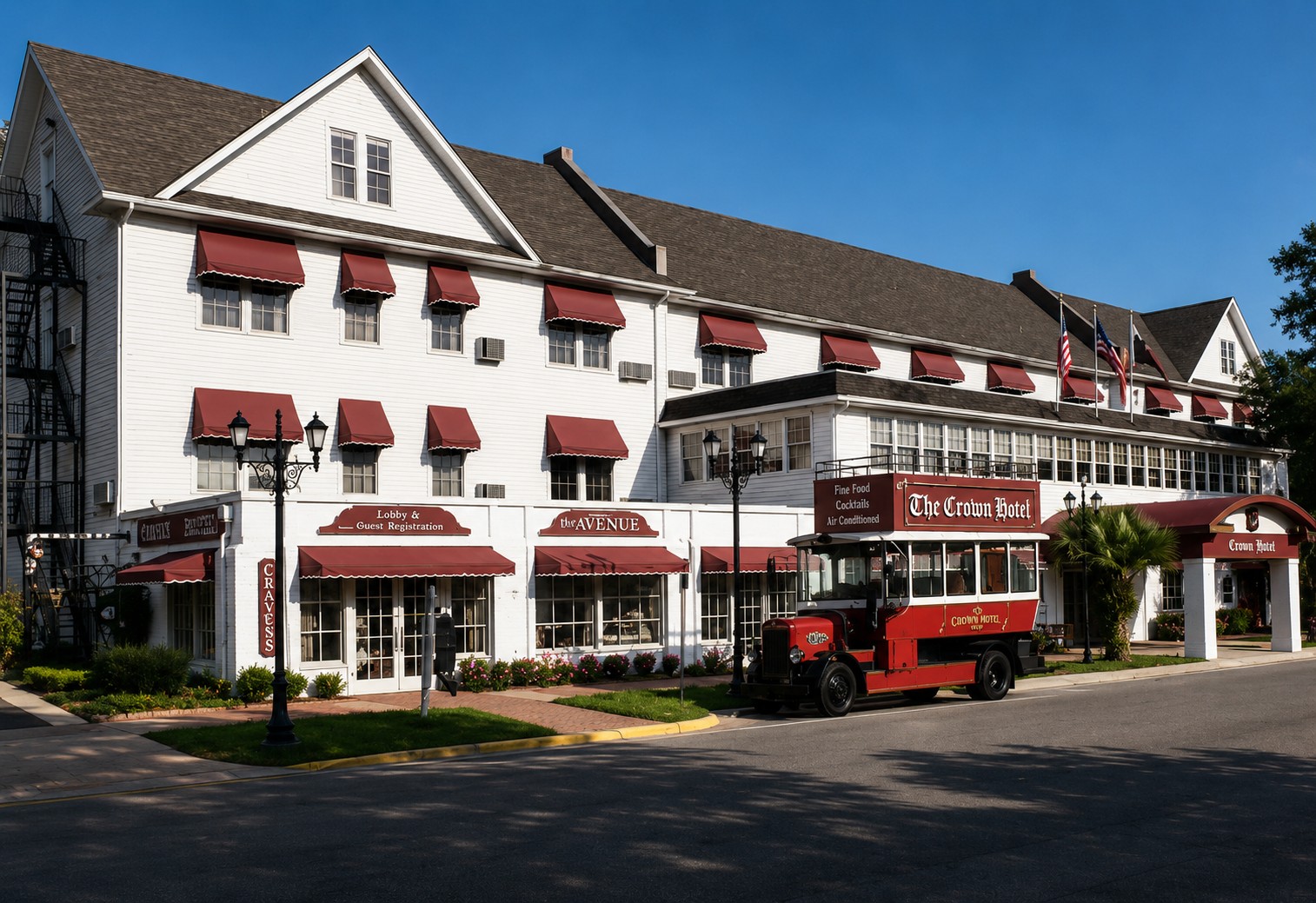
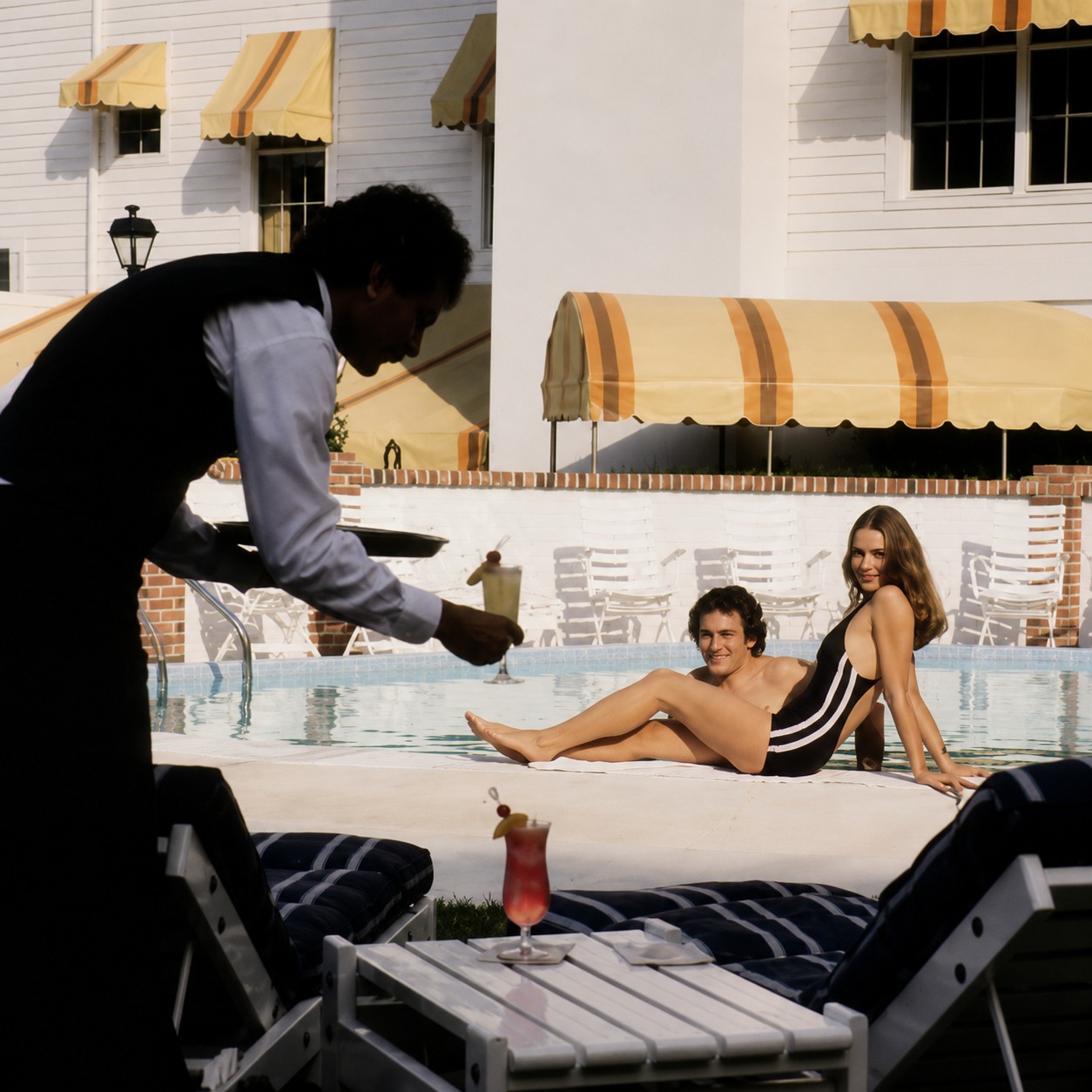
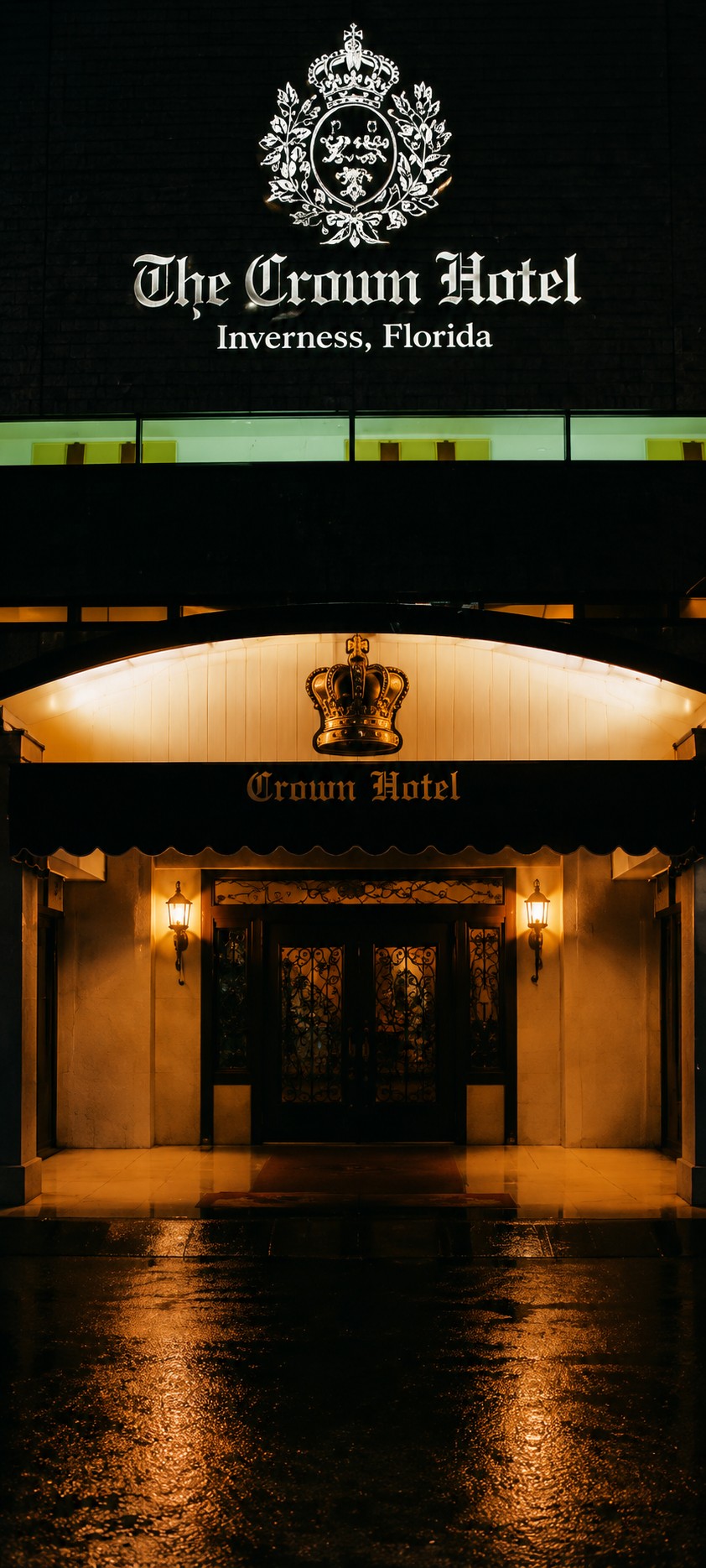
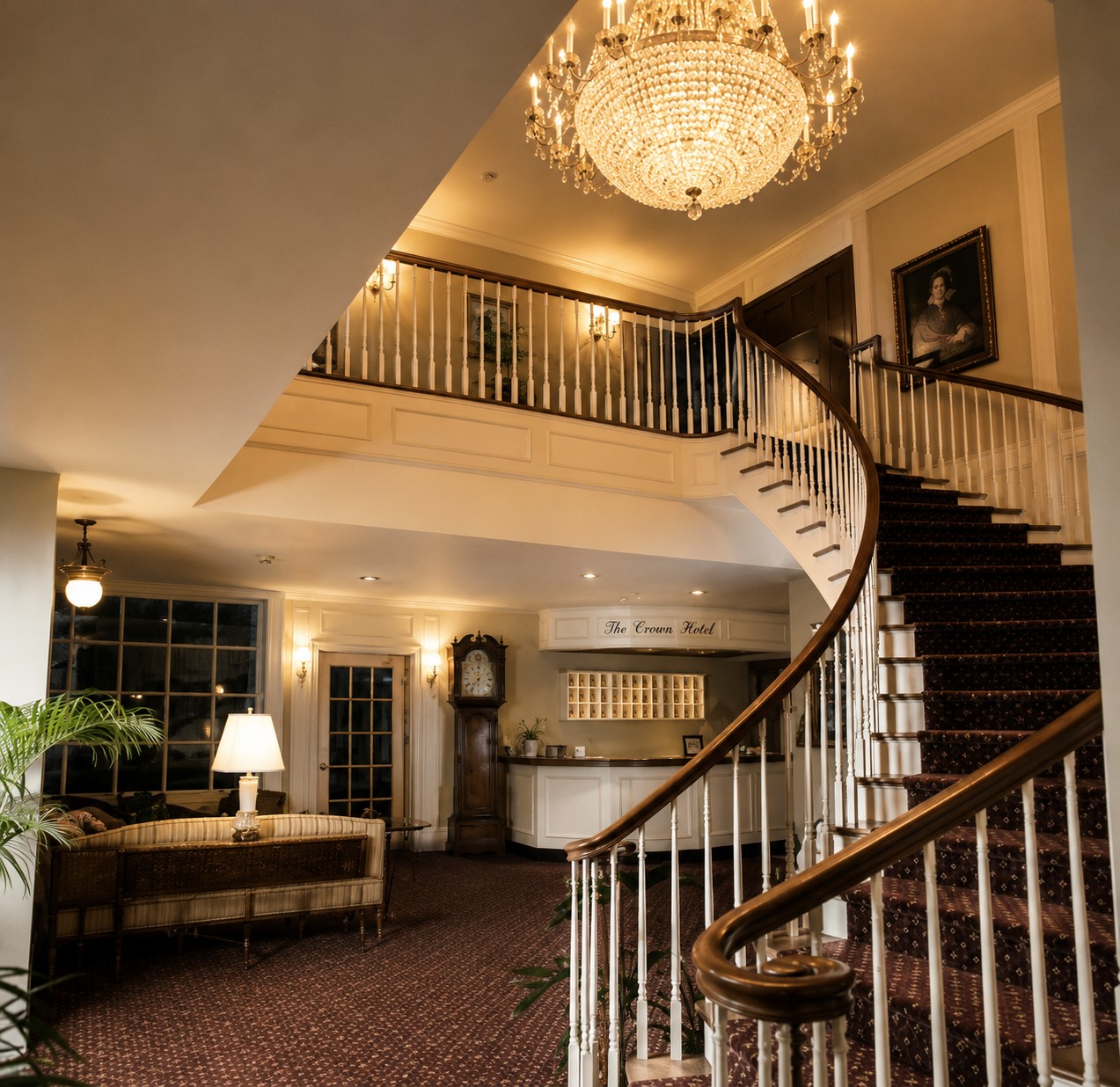
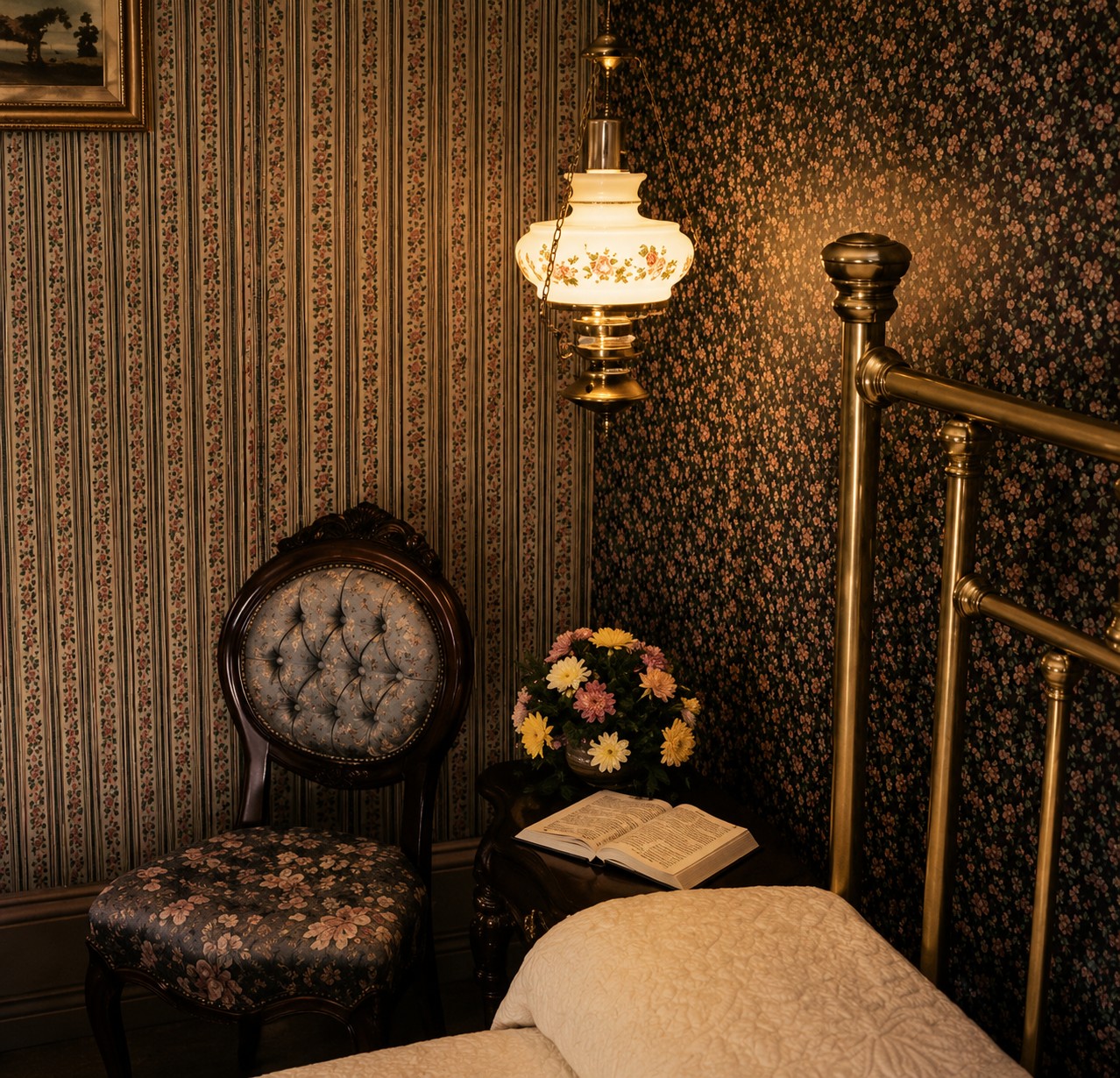
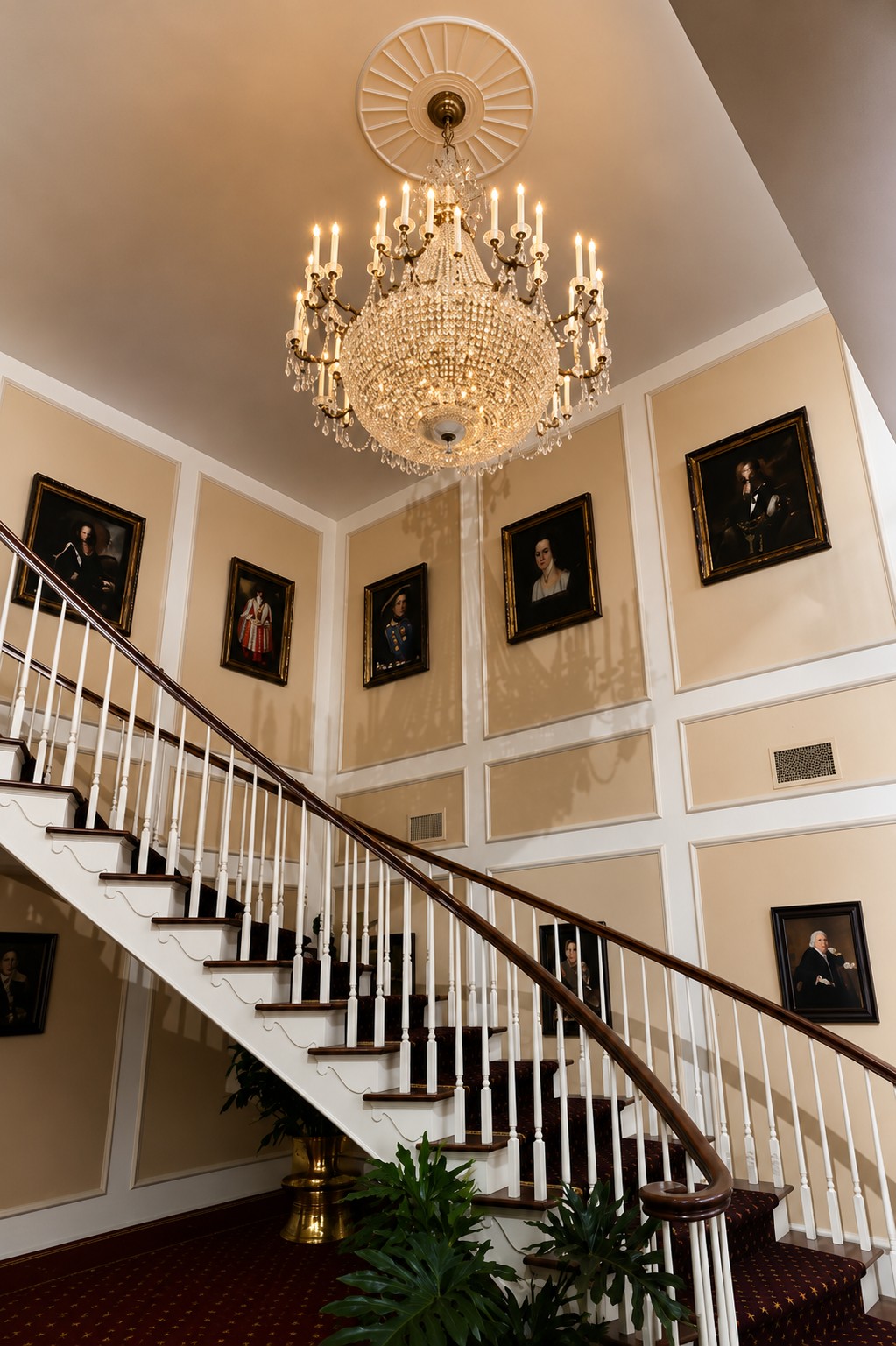
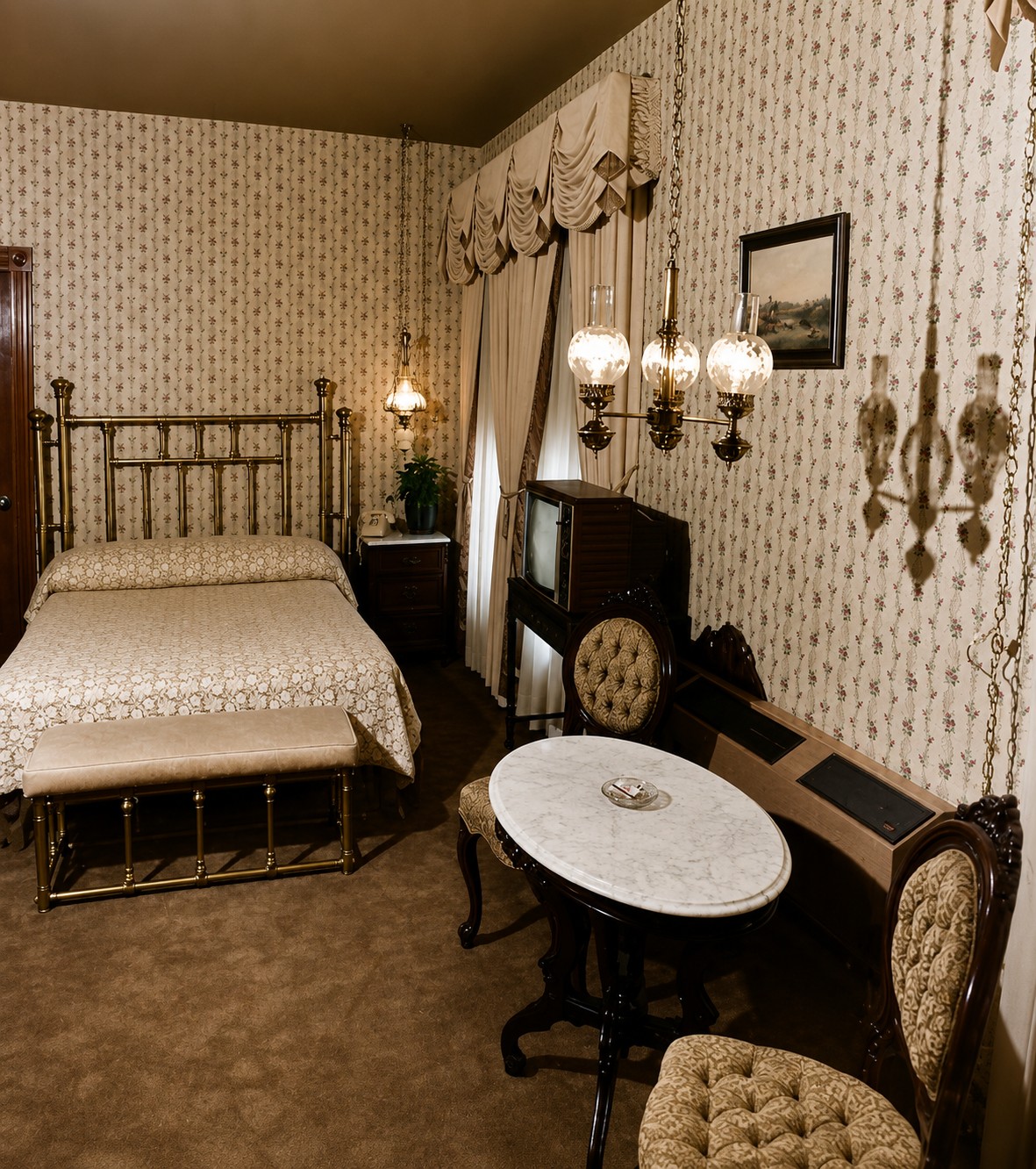
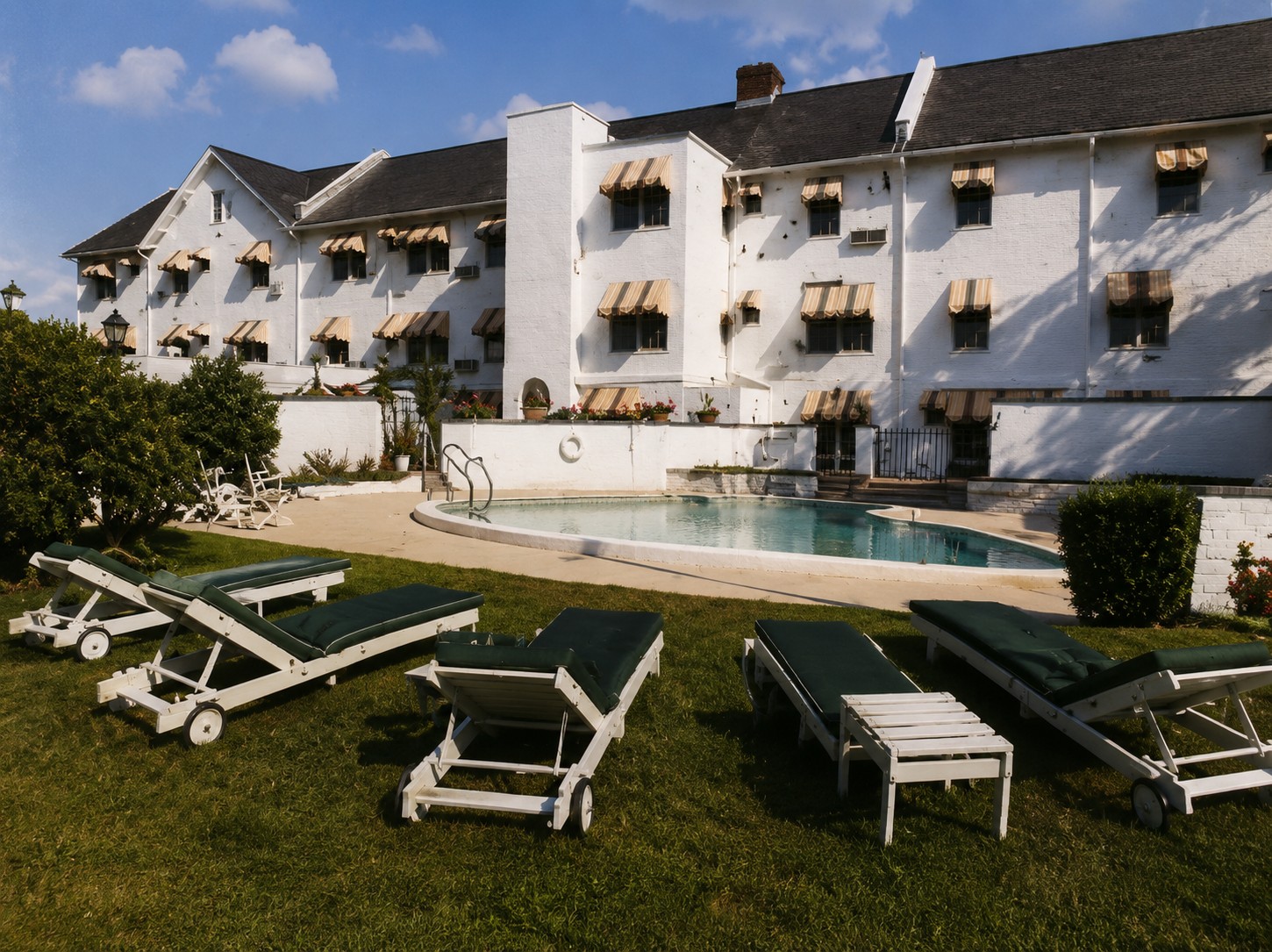
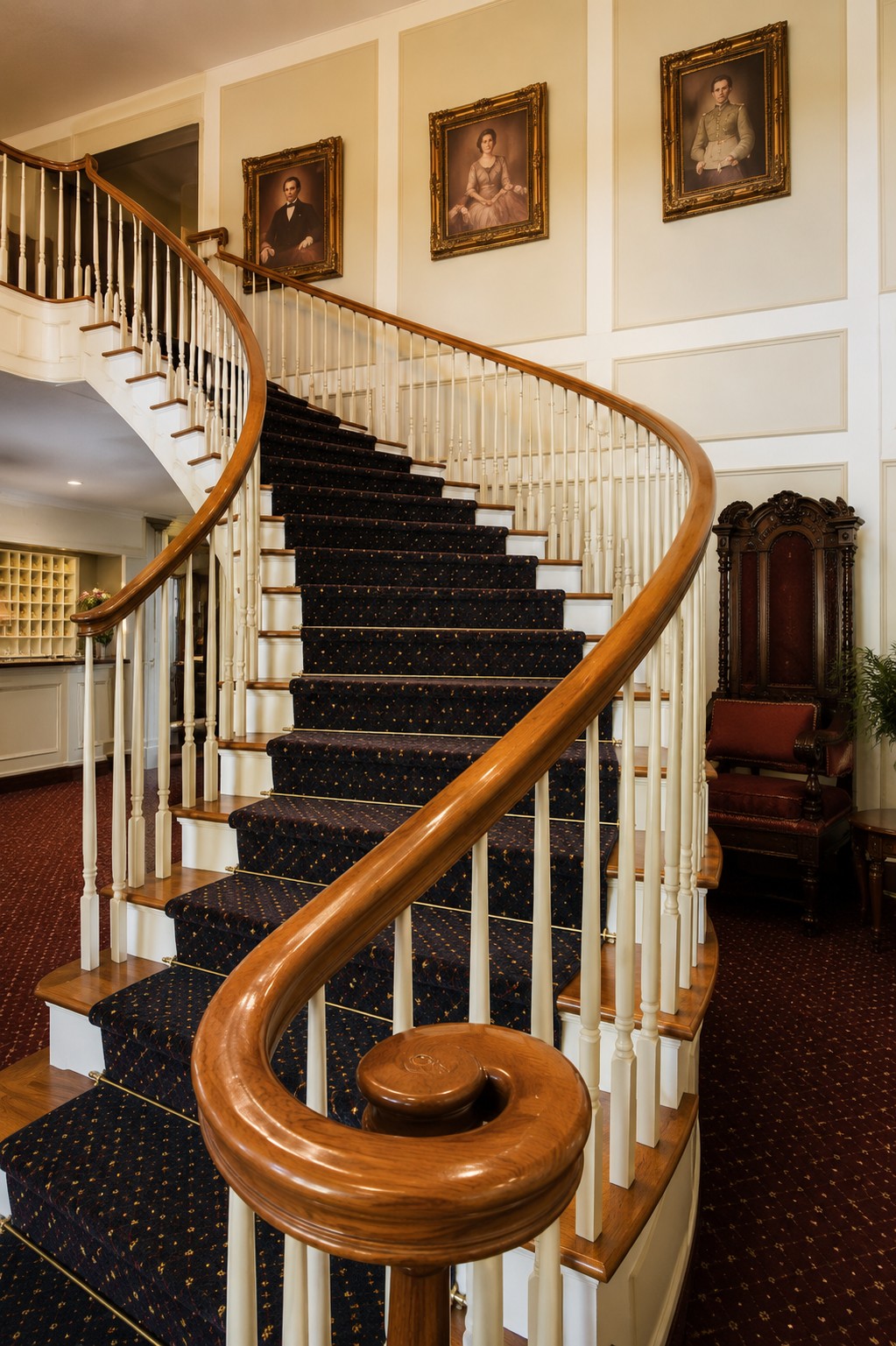
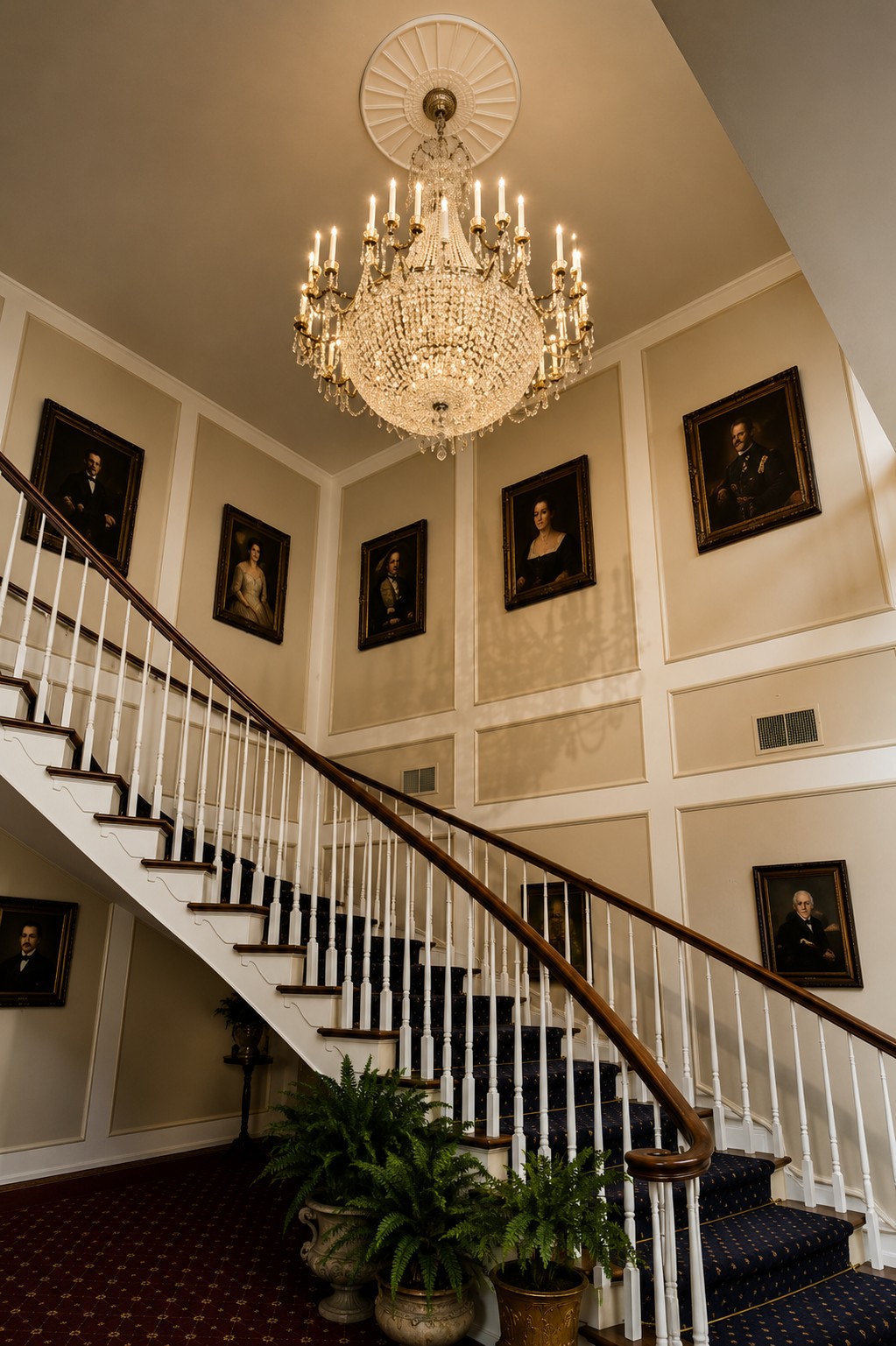
The Crown Hotel opened for business Tuesday, January 5, 1982. It proudly featured 34 individually decorated guest rooms complete with brass beds, antique-styled furnishings and private baths. Renovations also included the addition of a sweeping, suspended spiral staircase in the lobby, a swimming pool and a guest elevator.
The Crown’s lobby and guest reception. AI-assisted restoration · Produced under HCPS v1.1.One of 34 individually decorated guest rooms. AI-assisted restoration · Produced under HCPS v1.1.The new swimming pool. AI-assisted restoration · Produced under HCPS v1.1.
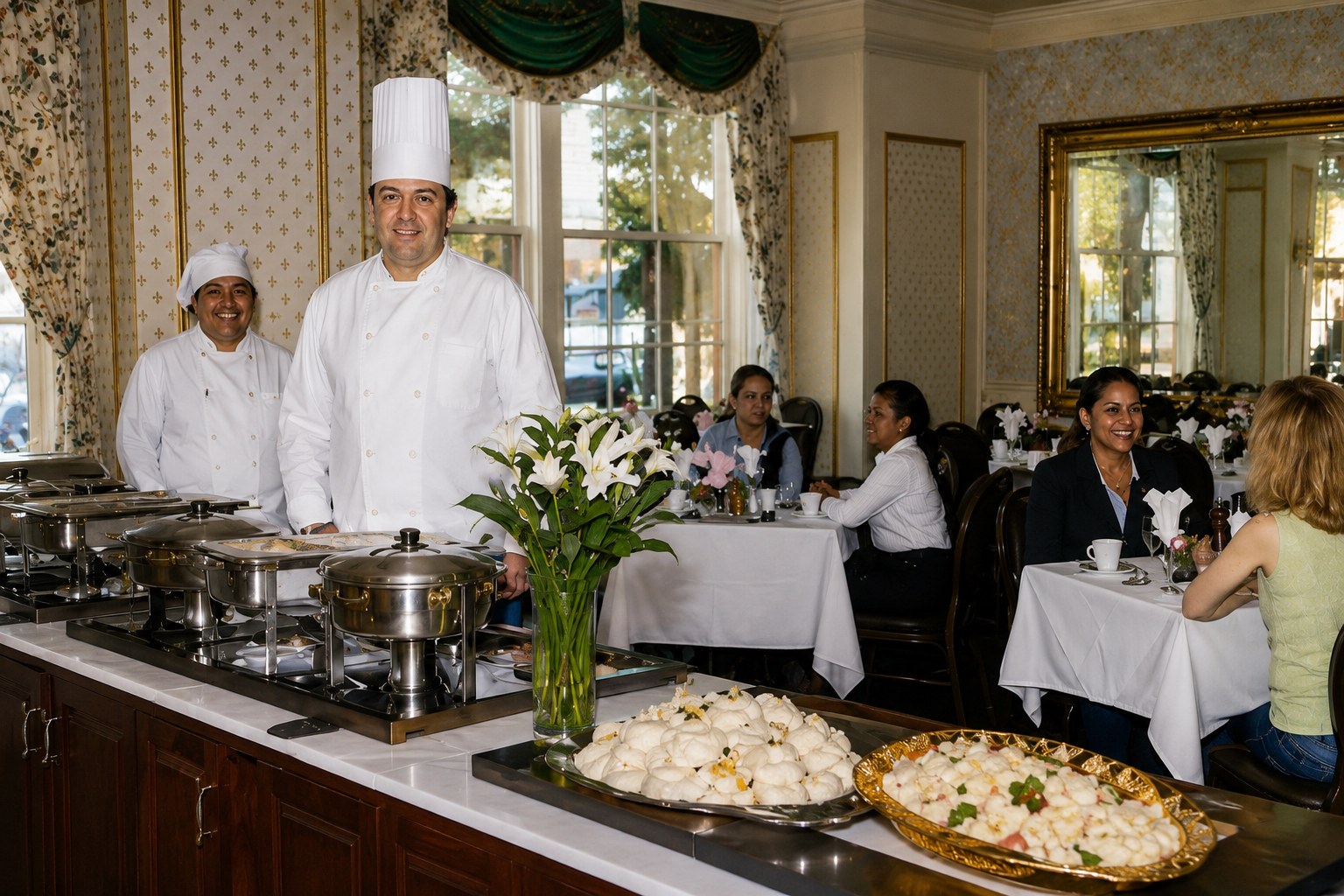
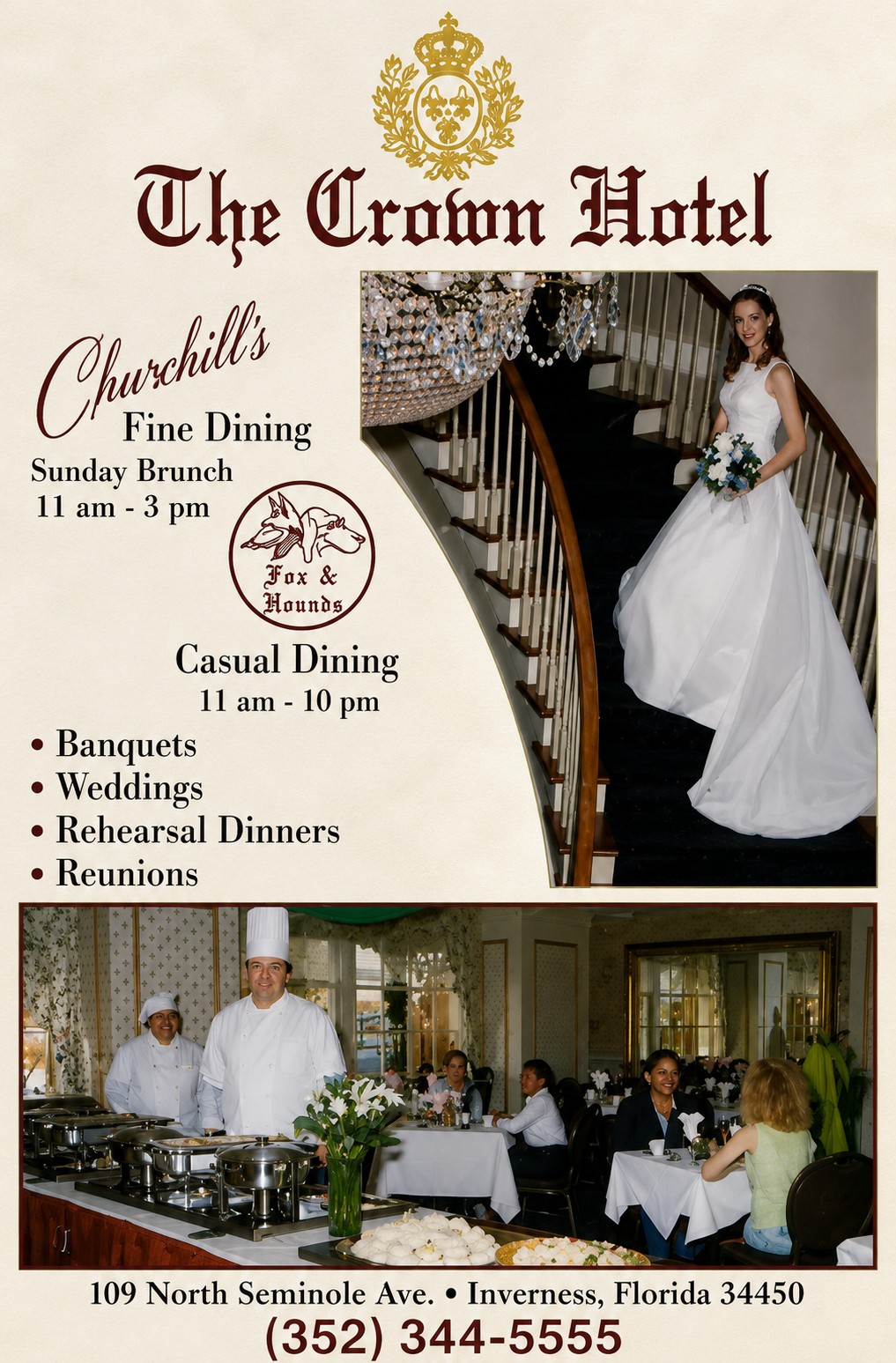
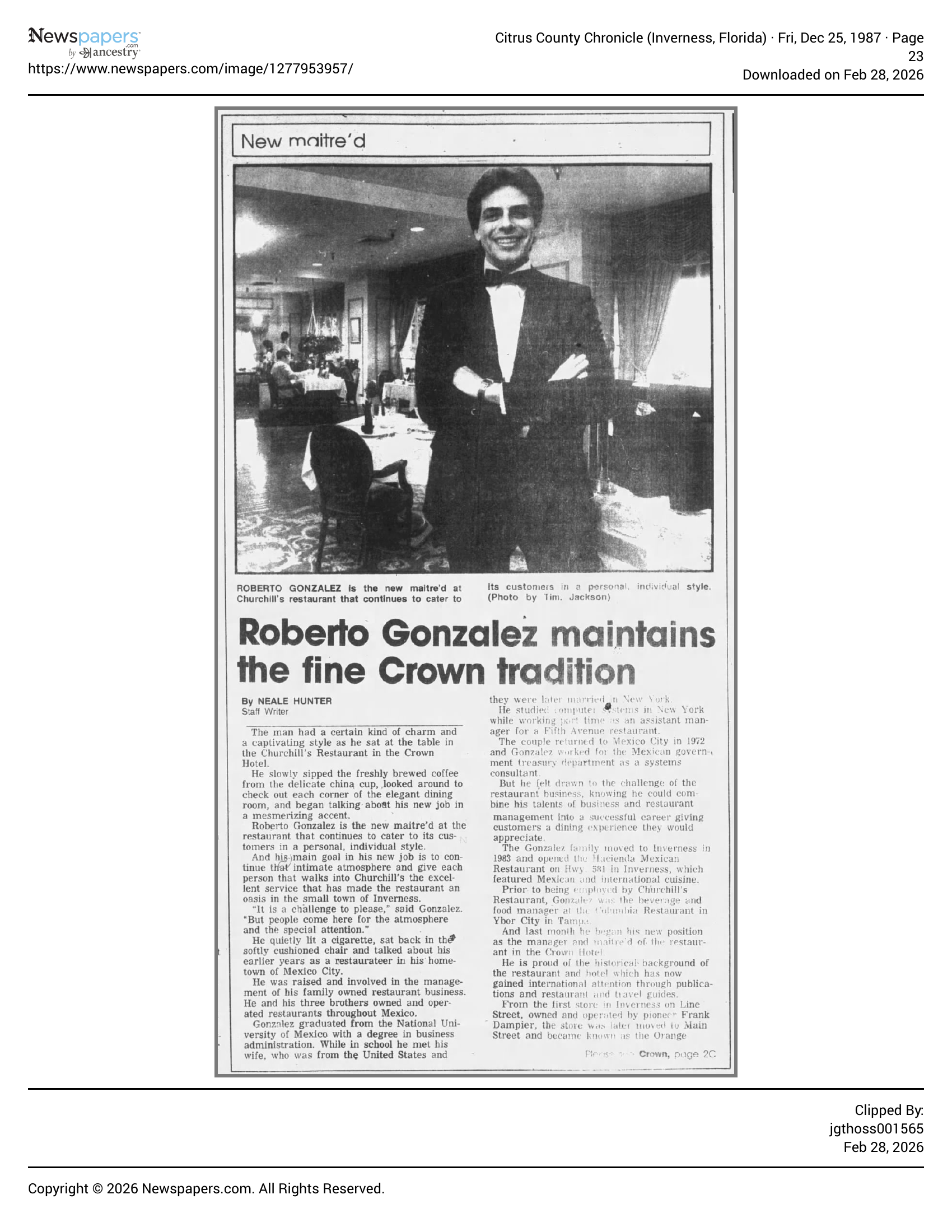
Two new dining outlets — the upscale Churchill’s restaurant and an English pub called The Fox & The Hound Tavern — required the addition of a state-of-the-art commercial kitchen.
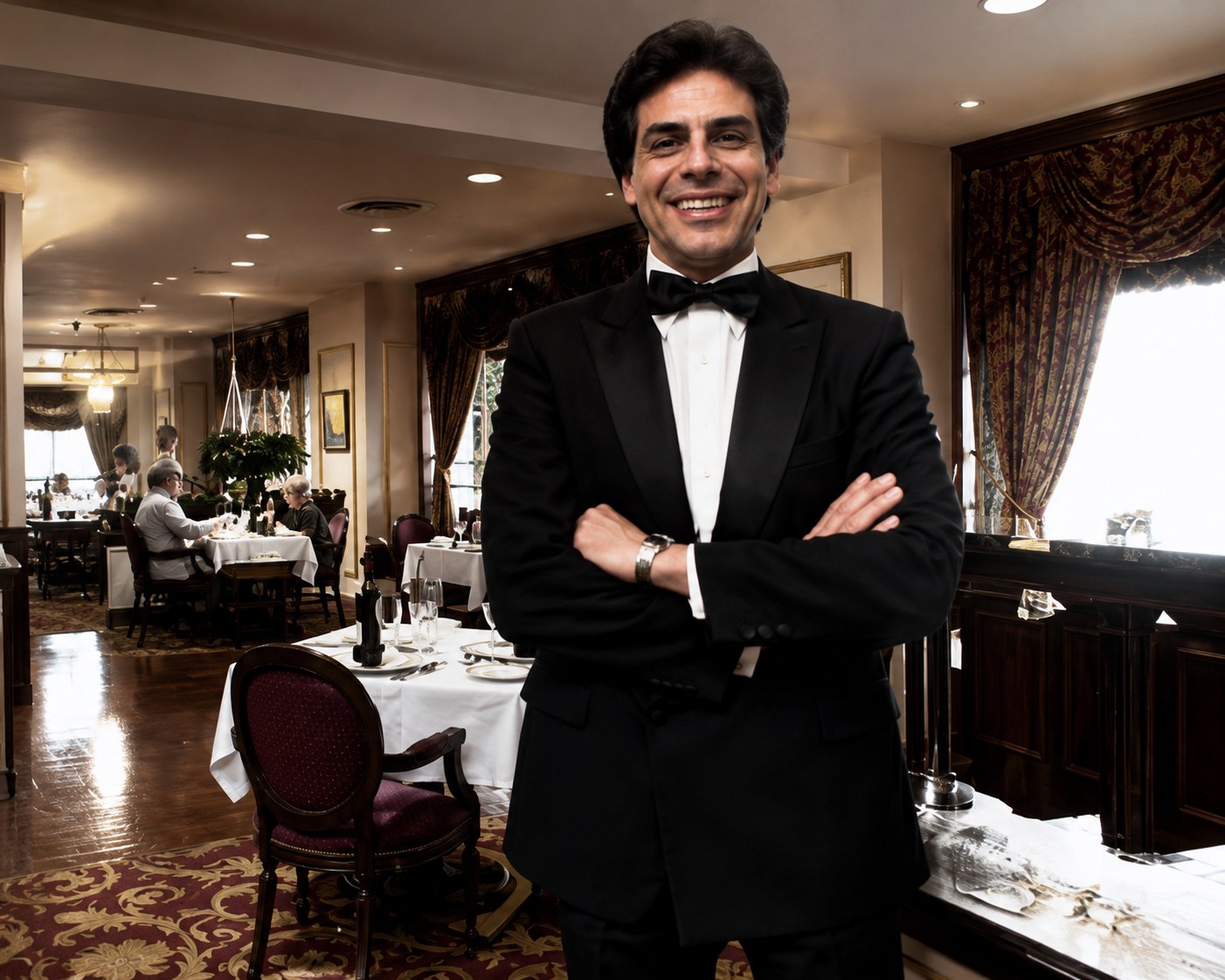
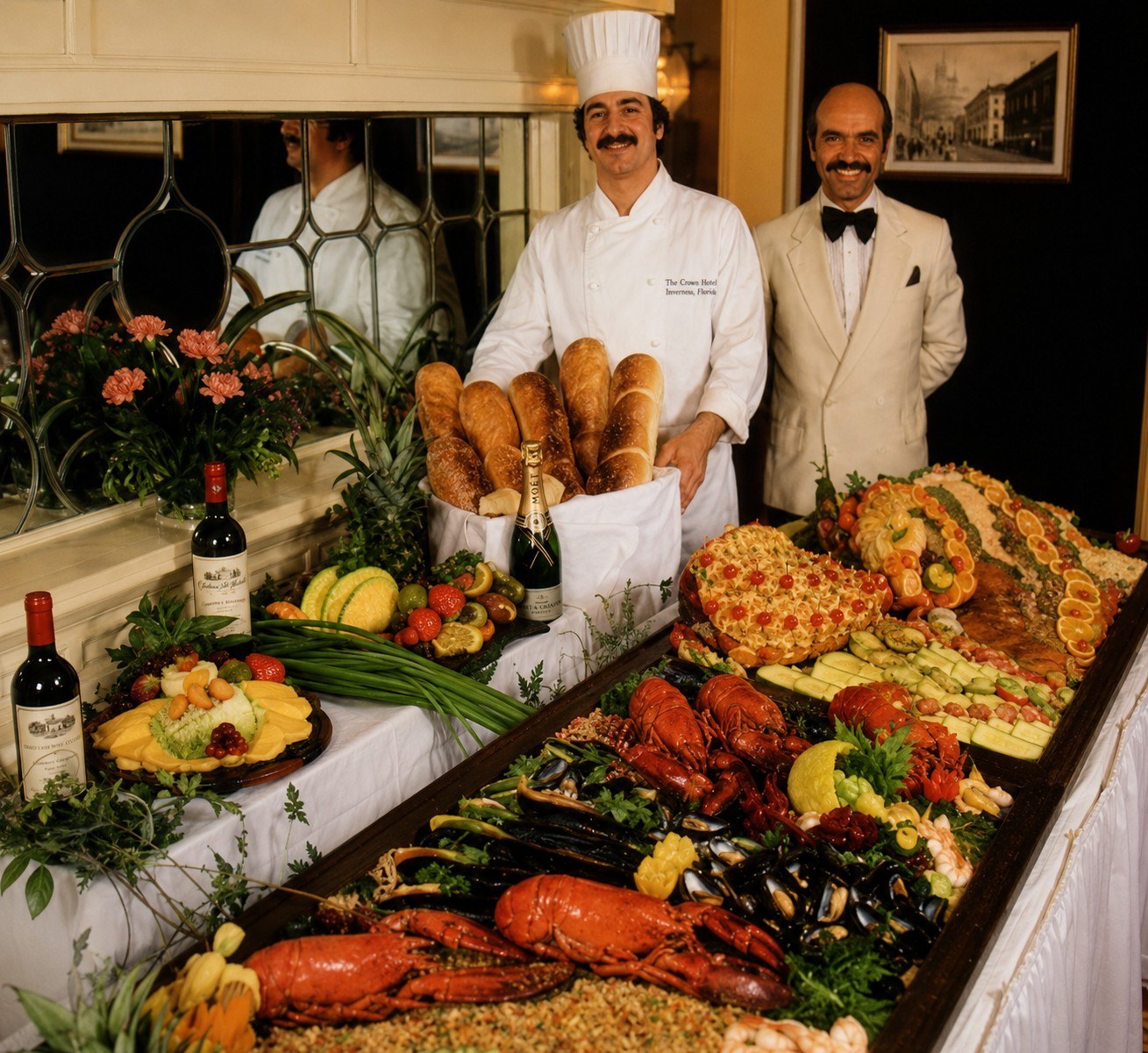
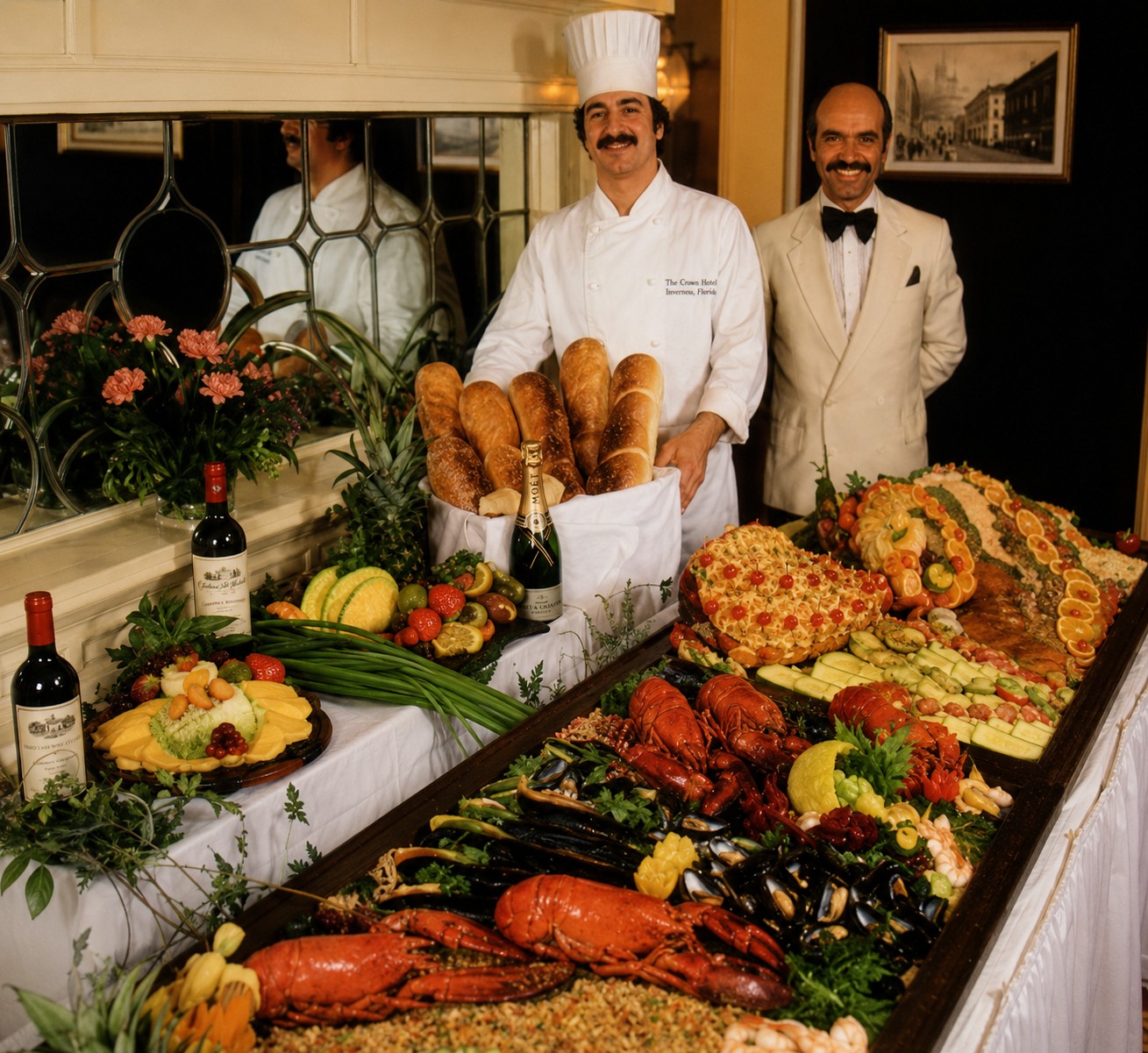
The Fox & Hound Pub. AI-assisted restoration · Produced under HCPS v1.1.Churchill’s Chef, Dennis Malone, and Maître d’, Salvatore Vaccarino. AI-assisted restoration · Produced under HCPS v1.1.
For weddings and community events, two banquet rooms known as The Windsor and The Buckingham could accommodate up to 25 and 80 guests respectively. Reproductions of the renowned Crown Jewels were displayed in the lobby.
Reproductions of the renowned Crown Jewels were displayed in the hotel lobby. AI-assisted restoration · Produced under HCPS v1.1.
And finally, to complete the look, Epicure purchased a red 1909 double-decker bus at a London auction, shipped it across the Atlantic, and parked it just outside the hotel’s entrance.
The Crown opened with an original management team of four: General Manager Jade Rivers, Assistant Manager Ian Young, Chef Dennis Malone, and Maître d’ Salvatore Vaccarino. Around 1983, Jade Rivers became Managing Director and Ian Young was promoted to General Manager.
THE CROWN HOTEL — TARIFF SCHEDULE
Small Single Room$37.50 / night
Single Room$55.00 / night
Double Room$65.00 / night
Suite (two rooms)$110.00 / night
Rates remained fairly consistent for the 20-plus years the Crown was in business (plus 6% sales and 2% tourist tax).
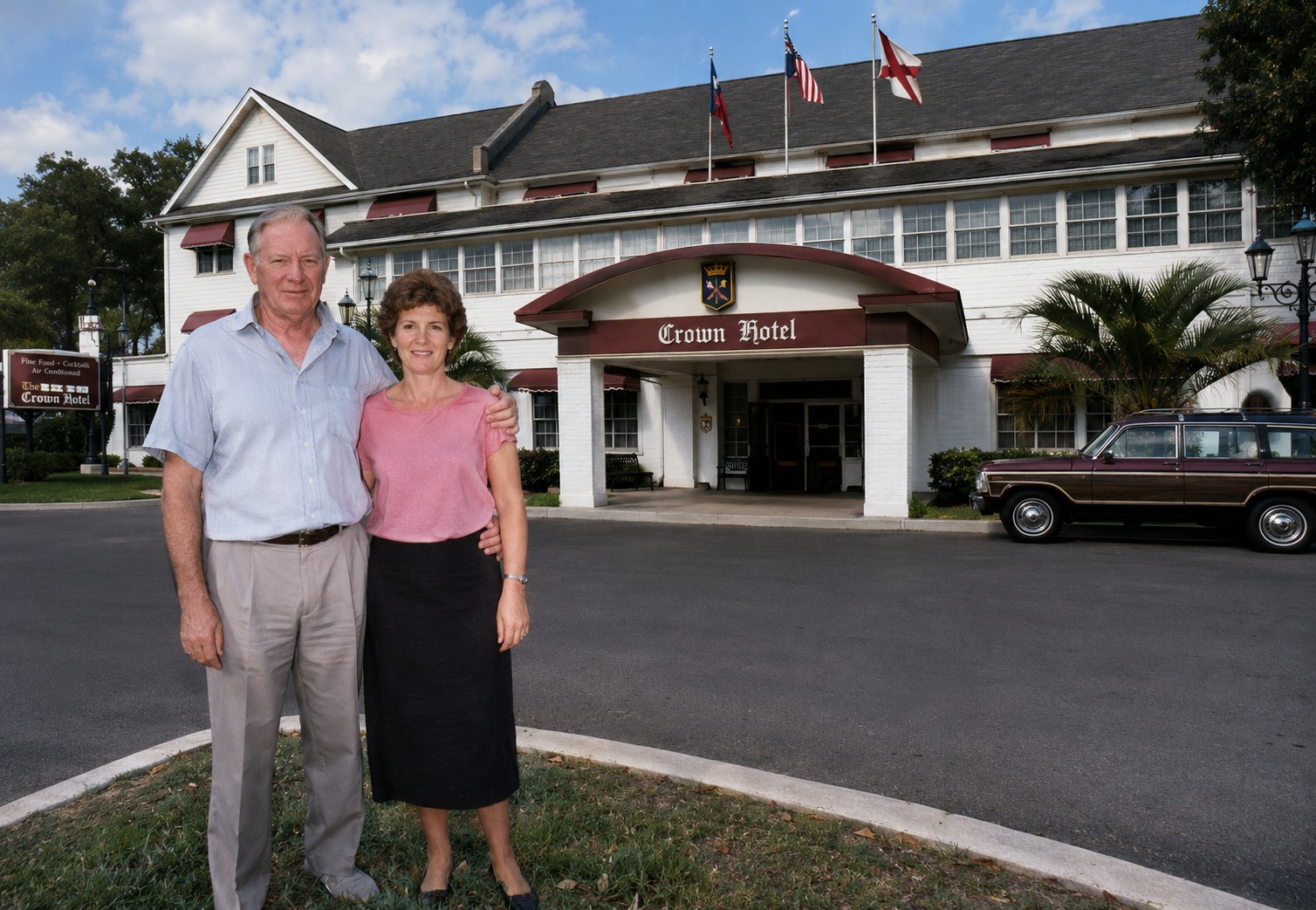
A crowning achievement: The Crown Hotel in 1982, shortly after the $2 million renovation. The two people walking together are Assistant Manager Ian Young and Front Desk Clerk Teri Adkisson — who would become the hotel’s longest continuously employed staff member, at twenty years and one week. AI-assisted restoration · Produced under HCPS v1.1.
❖ ❖ ❖
Chapter Eight
New Hotel Makes Headlines
1982 – 1986
Quickly becoming the star of Inverness and Citrus County, the Crown Hotel was the darling of travel scribes who wrote countless vanity pieces about it for newspapers, magazines and books. On April 26, 1984, the Lakeland Ledger wrote:
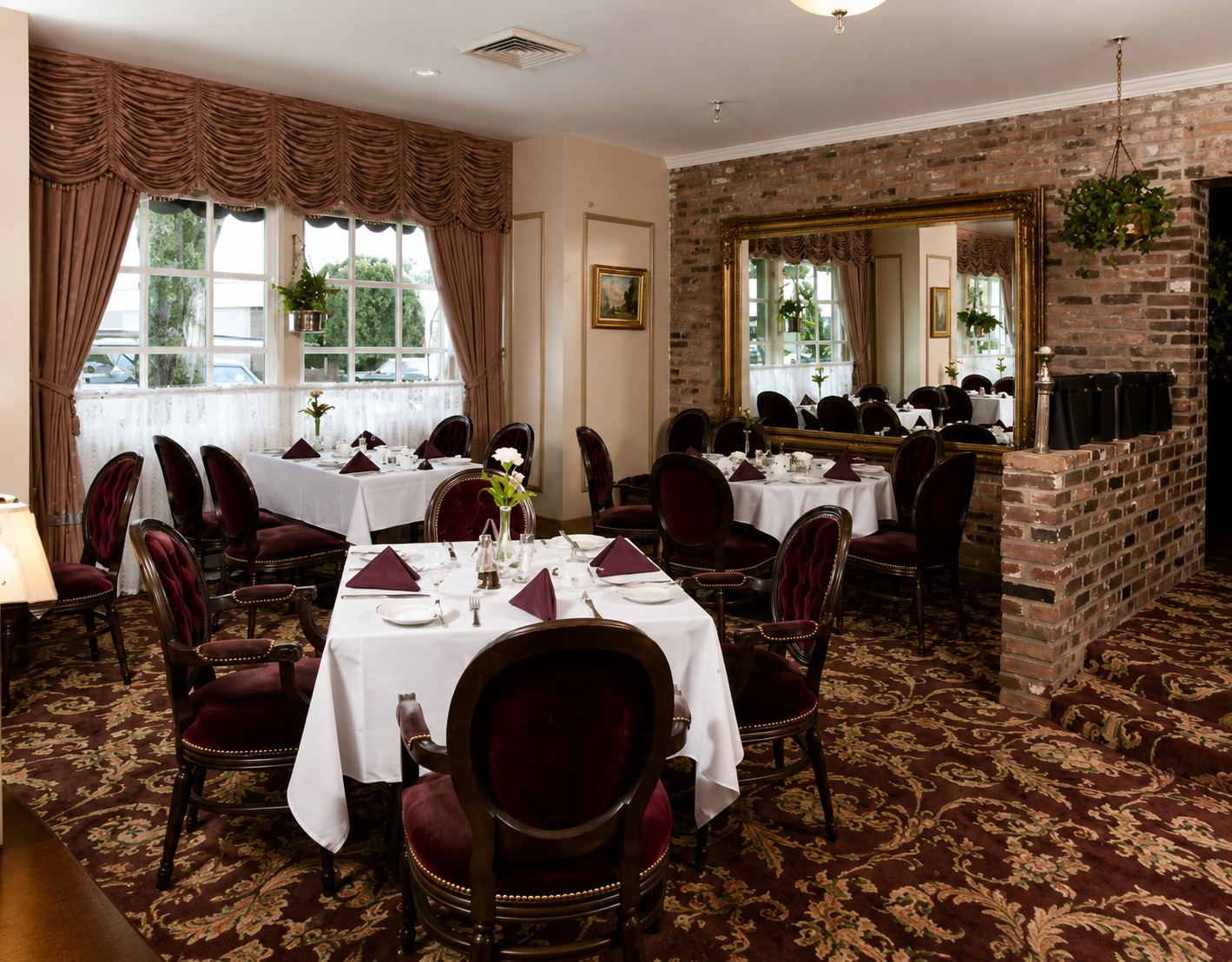
The Crown’s dining room suggests Victorian comfort — chairs upholstered in red felt, gold draperies and crystal chandeliers. More informal is the hotel’s pub, where you can throw darts and sip ale.
December 29, 1982. A view of the new Crown Hotel. Citrus Times — Rick Spence. AI-assisted restoration · Produced under HCPS v1.1.January 1, 1983. “Lighted by a huge chandelier, the Grand Stairway leads to the second floor.” Citrus Times — Bob Moreland. AI-assisted restoration · Produced under HCPS v1.1.January 28, 1982. The Bridal Suite on the third floor of the new Crown Hotel. Citrus Times — Bob Moreland. AI-assisted restoration · Produced under HCPS v1.1.January 28, 1982. Mirrored corner of Churchill’s Restaurant in the new Crown Hotel. Citrus Times — Bob Moreland. AI-assisted restoration · Produced under HCPS v1.1.St. Petersburg Times, January 3, 1983 — “The pool area in back of the hotel includes a dining area.” Citrus Times — Bob Moreland. AI-assisted restoration · Produced under HCPS v1.1.
The Crown impressed guests from all around, but just a few years in, the business struggled to turn a profit. On July 2, 1986, the St. Petersburg Times reported that an outside investor would be buying stock in the business.
New Investors May Buy Large Block of Crown Hotel Stock
The hotel is currently owned by Epicure Investments, Inc., a wholly owned subsidiary of the British firm Epicure Holdings. A group of American investors is negotiating to purchase a “large portion” of the stock, but less than half of it, said Michael Kovach, president of the company. Kovach, who was involved with the hotel’s massive renovation, said it is worth more than $3 million.
It was later reported that an unnamed Buffalo, New York investment firm purchased interest in the hotel for $1 million. While some staff left, major department heads — General Manager Ian Young, Assistant Manager Keitha Stoney and Chef Dennis Malone — remained.
❖ ❖ ❖
Chapter Nine
A Gem Loses Its Luster
1986 – 1990
AI-assisted restoration · Produced under HCPS v1.1.
The cash infusion may have helped save the hotel for a while, but the Crown continued to hemorrhage money. Just four years later, on March 31, 1990, the St. Petersburg Times reported the Crown Hotel was up for sale.
Crown Hotel Is For Sale, Will Stay Open
The Crown Hotel, promoted by Citrus County business leaders as the elegant symbol of what downtown revitalization can accomplish, is for sale. According to a prospectus, the property at 109 N. Seminole Ave. has been appraised at $1.7 million. The business — 34 hotel rooms, a restaurant for formal dining and a pub — has been operating at a loss for each of the last three years. Last year, the loss totaled $137,000.
One of the primary investors recently had a serious heart attack. In a letter to newspapers, general manager Ian Young said the hotel was on the market because the man’s family “would like him to slow down and divest himself of some of his investments.”
Downtown Inverness. Citrus Times, February 15, 1990. Photo by Bob Moreland. AI-assisted restoration · Produced under HCPS v1.1.
But selling the hotel didn’t take as long as some might have thought. By June 6, 1990, the St. Petersburg Times reported that a sale was just around the corner.
Historic Crown Hotel May Get New Owner
A prospective buyer is showing interest in the Crown Hotel, the historic inn that has been on the market for three months. Sheila Mohs, the sales and marketing representative, said she has been told that contracts may be exchanged in the next 15 to 20 days. Epicure Investments is looking for a buyer who wants to continue operating the hotel and become a part of the local community.
The Crown Hotel in the early 1990s when it was officially offered for sale. AI-assisted restoration · Produced under HCPS v1.1.
❖ ❖ ❖
Chapter Ten
New Owners Check In
1990 – 2001
On October 1, 1990 the Crown Hotel was sold to a private family from Wales. Nigel and Jill Sumner, along with their teenage children Caroline and Simon, moved to Inverness to operate the hotel. Proprietors of two other hotels in the past and having just sold one, the Sumners were originally looking to Florida for retirement when they stumbled upon the property.
Nigel & Jill Sumner in 1990 after purchasing The Crown Hotel. Photo: The St. Petersburg Times. AI-assisted restoration · Produced under HCPS v1.1.
Despite the previously reported $1.7 million appraisal, the Sumners purchased the property from Epicure for only $1 million. In an effort to lower overhead, cuts were made from the top: General Manager Ian Young and Chef Dennis Malone moved on. Only Assistant Manager Keitha Stoney would remain to help the Sumners run the hotel.
The Crown Hotel in the early 1990s when it was sold to the Sumners, a hotelier family from Wales. AI-assisted restoration · Produced under HCPS v1.1.
The Sumners would successfully operate the hotel for almost twelve years before once again opting for retirement. In late 2001, they offered the hotel for sale.
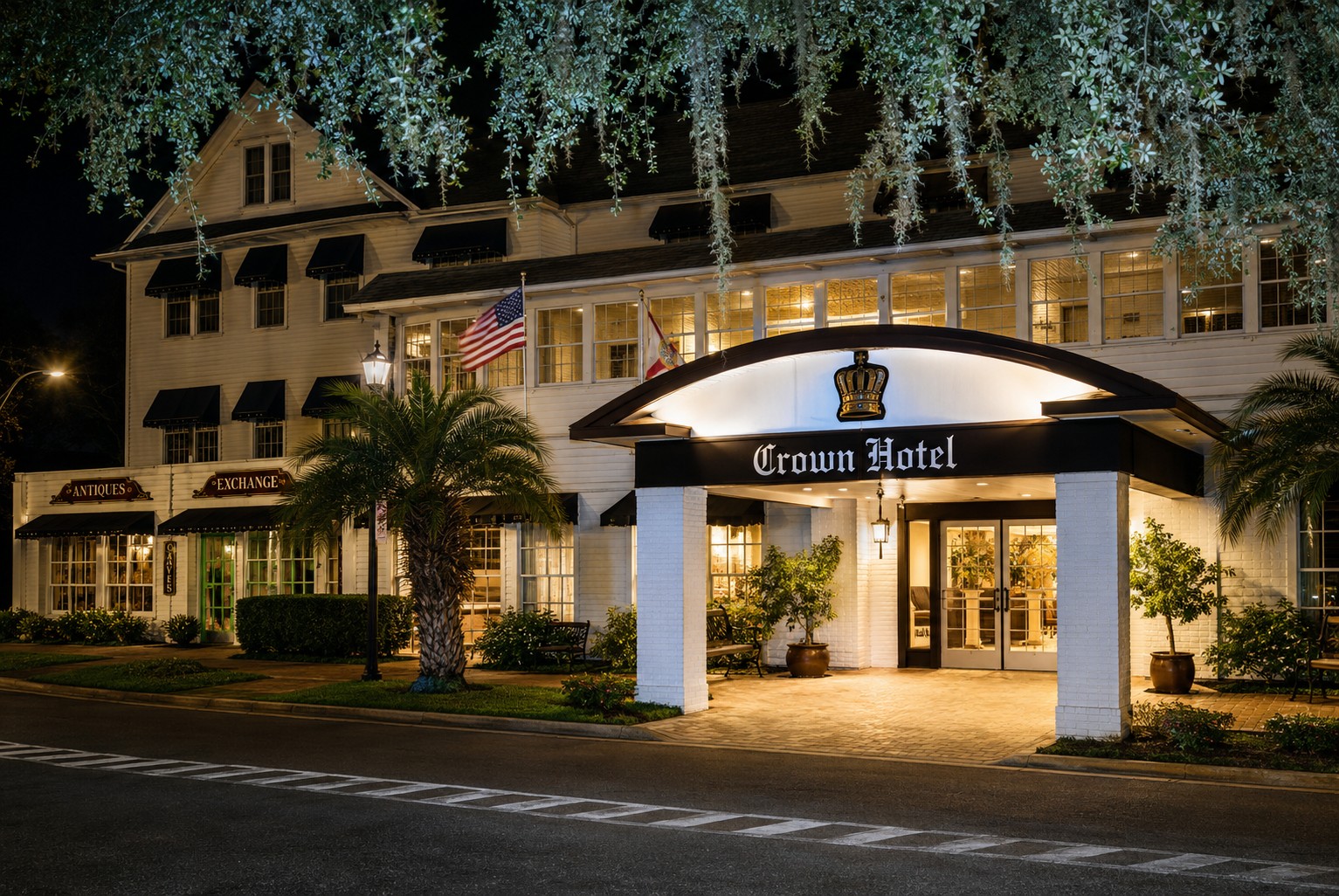
An evening view of the hotel circa 2000 under the ownership of the Sumners. Photo courtesy of John McCormack. AI-assisted restoration · Produced under HCPS v1.1.
❖ ❖ ❖
Chapter Eleven
The Sumners Check Out
2001 – 2004
On November 30, 2001, the Sumners sold the Crown Hotel to husband & wife team Thomas Dryburg and P.C. Hyland.
AI-assisted restoration · Produced under HCPS v1.1.
But dark days were just around the corner. Under the management of the inexperienced new owners, the business spiraled out of control, unpaid taxes piled up and the property fell into foreclosure in less than a year.
This promotional flyer, created by the hotel’s new owners, was not enough to bring in much-needed local business. AI-assisted restoration · Produced under HCPS v1.1.
By September 2002, local newspapers reported that the couple, accused of defaulting on a $1.15 million loan, had absconded in the middle of the night with a moving truck full of the hotel’s furnishings and valuables, leaving the mortgage company, the state, and the employees unpaid.
Workers struggle to keep Crown alive By Carrie Johnson, St. Petersburg Times, September 15, 2002
With its pristine white clapboard exterior and navy-blue striped awnings, the Crown Hotel looks frozen in time from the outside. Inside, however, is a different matter. A week after assuming control, employees from a Jacksonville hotel management company are still trying to sort out the mess left by the previous owners, Thomas Dryburg and his wife, P.C. Hyland.
According to Crown employees, Dryburg and his wife spent Labor Day weekend loading a large U-Haul trailer with bedding, pictures and furniture from the hotel. While they told workers they were leaving for vacation, Inverness police concluded they had absconded.
The new owners had immediately announced plans to restore the British-style inn and pub to its former glory, even planning a European-style spa. But it was not to be. Within weeks they offended the Rotary Club by barring it from the conference room; police were called numerous times for disturbances; the structure caught fire in February, forcing about 10 guests to evacuate; and Hyland was accused of slapping a 66-year-old guest during a dispute over a meal coupon.
Jill Sumner said she is “heartbroken” over the current state of the Crown. “They’ve done too much damage. In nine months, they’ve managed to destroy everything we had worked for.” “He told us all these wonderful stories and I believed him,” she said.
Photo: Citrus County Chronicle. AI-assisted restoration · Produced under HCPS v1.1.
On April 24, 2003, with foreclosure proceedings complete, the court put the hotel in the hands of the lender, the Small Business Loan Source of Houston, Texas. SBLS hired Landcom Hospitality Management, Inc. of Jacksonville to operate the hotel until it could be sold. Unable to attract a suitable buyer, the hotel sat on the market for a year, prompting SBLS to put the Crown up for auction with an opening bid of $1.4 million.
❖ ❖ ❖
Chapter Twelve
A New Start: Crown Court
2004
St. Petersburg Times — May 5, 2004. Photo: Ron Thompson. AI-assisted restoration · Produced under HCPS v1.1.AI-assisted restoration · Produced under HCPS v1.1.
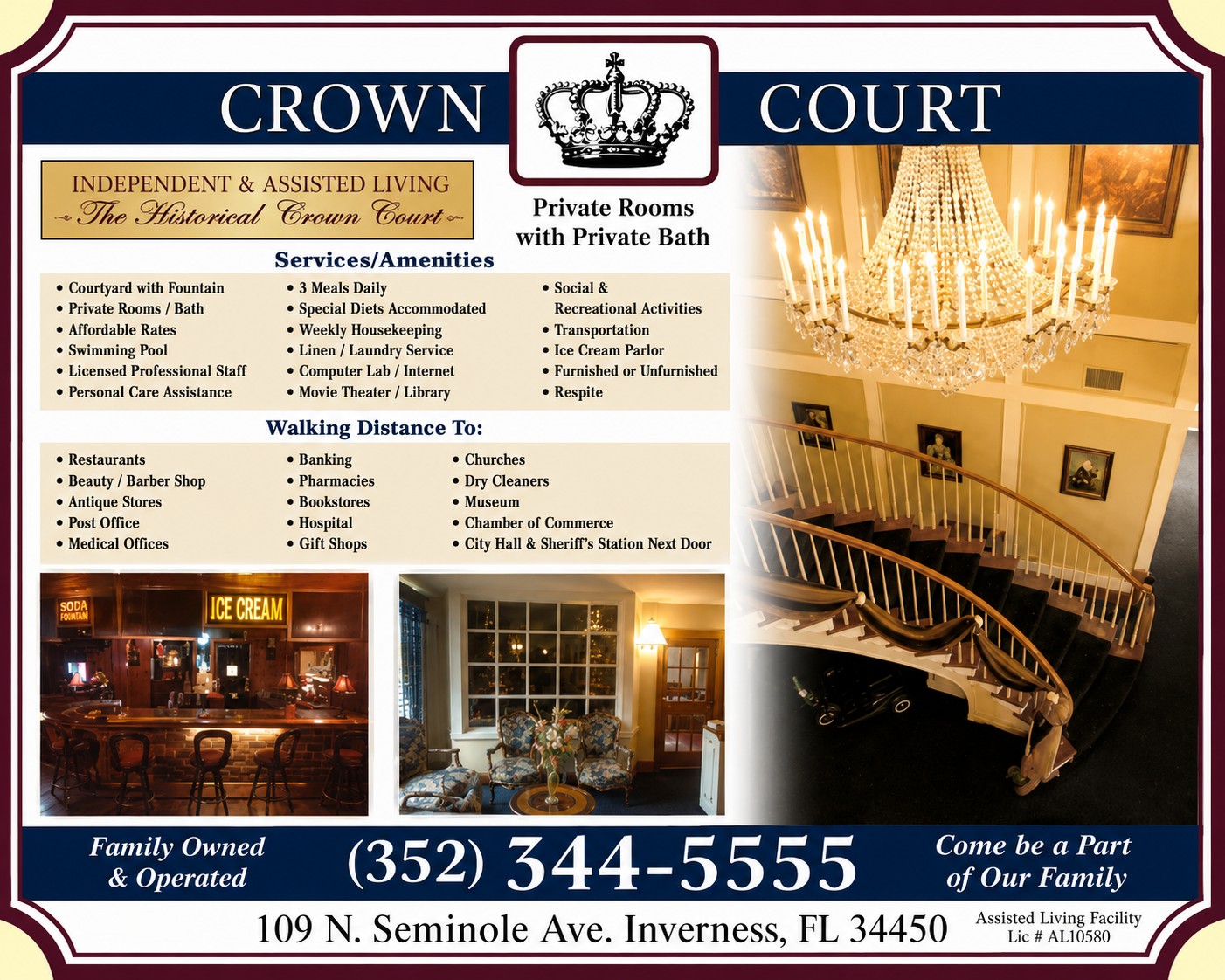
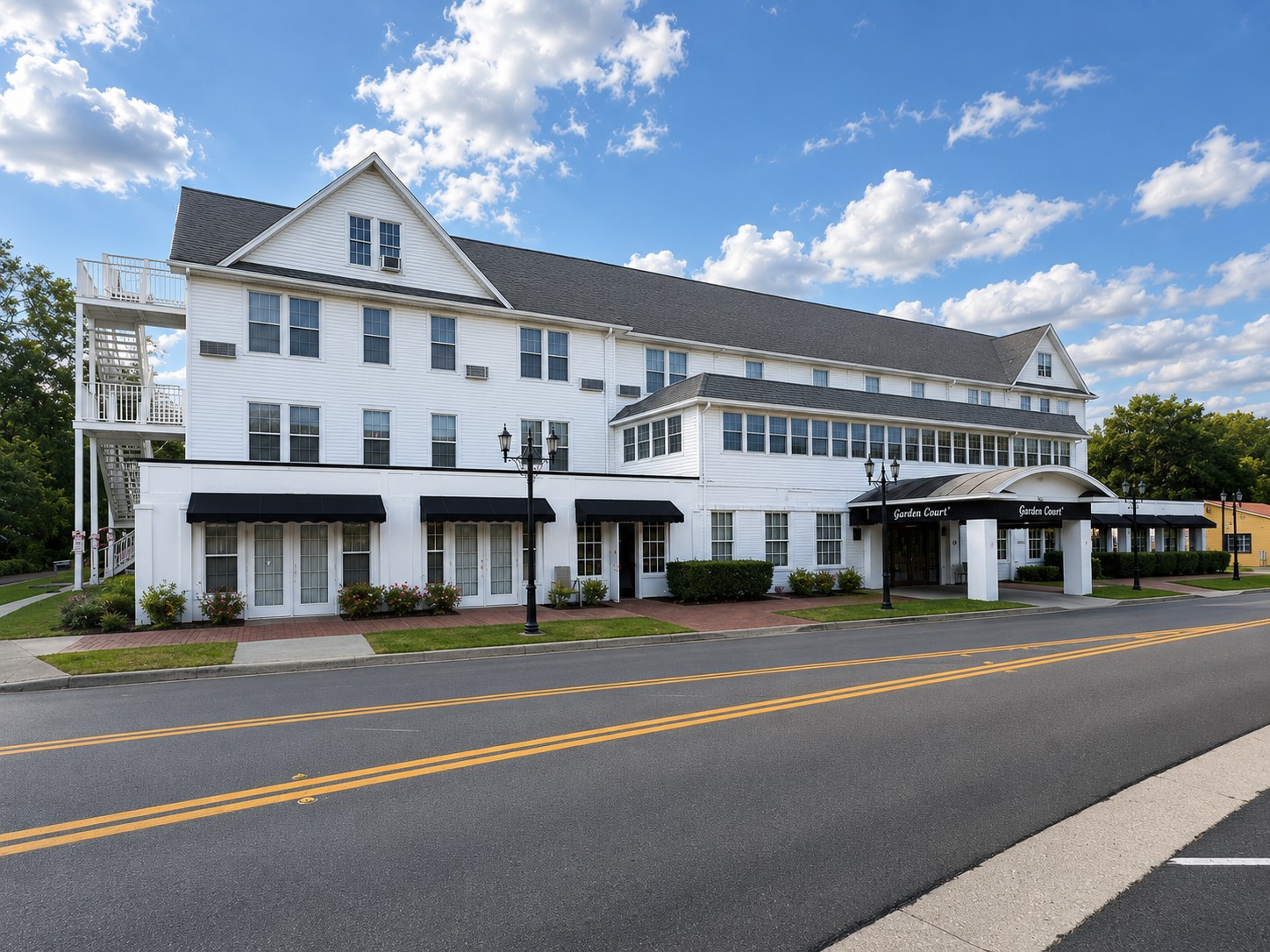
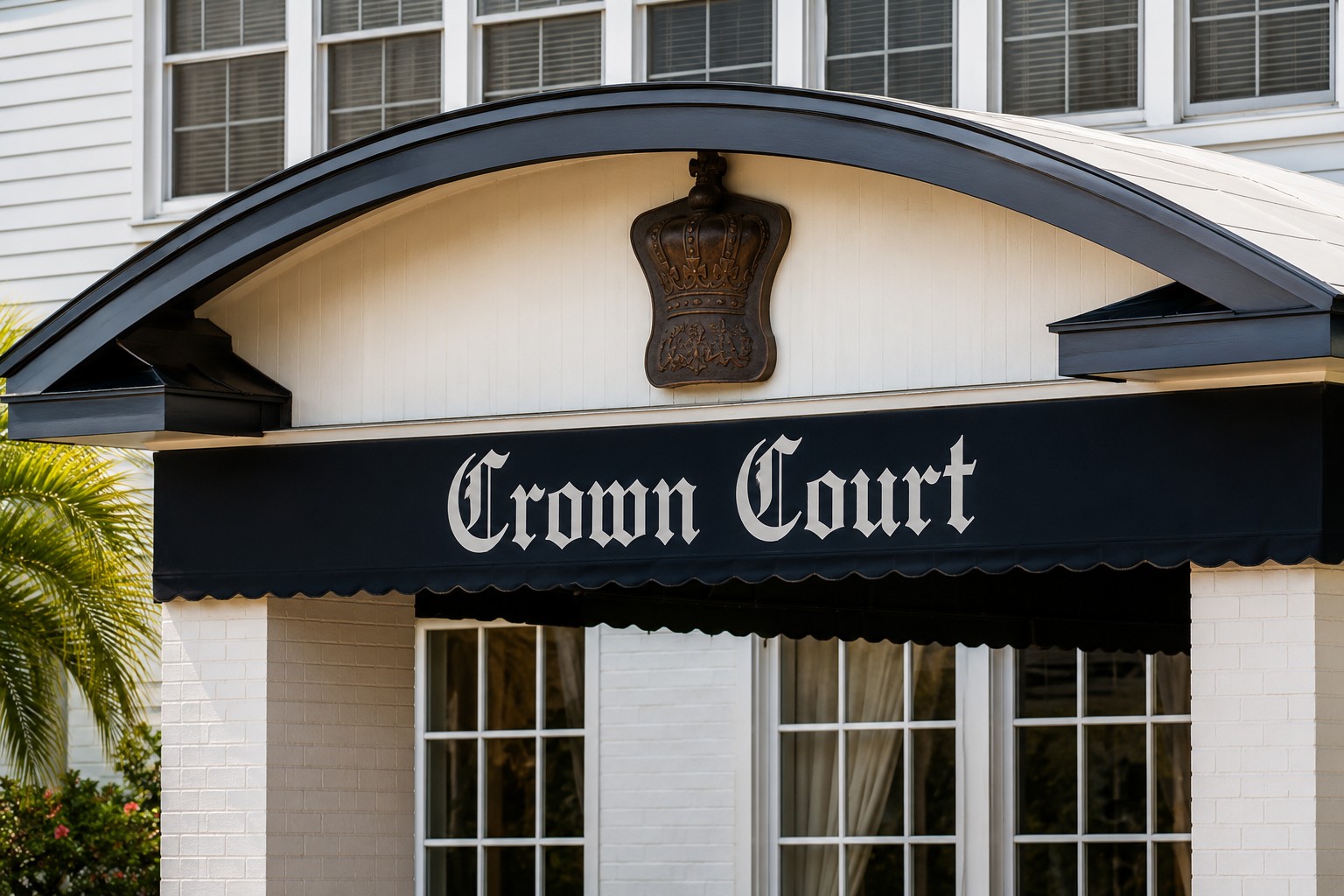
Despite the reported opening bid of $1.4 million, new owners Cary & Brenda Jensen purchased the hotel for just $900,000 on May 3, 2004. But they would spend another $200,000 transforming the building once again — this time into an assisted living facility called Crown Court.
AI-assisted restoration · Produced under HCPS v1.1.
Today, the property continues to provide guests with a cozy, comfortable place to stay — just as it has for over 100 years.
❖ ❖ ❖
Epilogue
The Story of the Stairs
A craftsman’s tale
Without debate, one of the most unique gifts that renovation brought to the hotel was the addition of the suspended, spiral staircase. The elegant fixture that became the centerpiece of the new hotel lobby was designed and built by the Driwood Moulding Company of Florence, South Carolina.
The Driwood Moulding Company designed and built the spiral staircase and extensive bannister. AI-assisted restoration · Produced under HCPS v1.1.
Randell Gelzer, General Manager and Executive Vice President of Driwood, started with the company in 1971 at the age of 28. Despite the many projects he has helmed over the years, Mr. Gelzer recalls working on the staircase his company designed specifically for the Crown Hotel back in 1980.
St. Petersburg Times — May 5, 2004. Photo: Ron Thompson. AI-assisted restoration · Produced under HCPS v1.1.
A former pilot in the US Air Force, Mr. Gelzer would periodically fly his twin-engine Navajo airplane from Florence to Inverness to discuss the project and take measurements. He recalls landing on the rural runway of the Inverness Airport one time when he was met by a Sheriff’s deputy who questioned him about his visit. On another occasion, he arrived to supervise the installation and was met with quite a unique sight — the entire hotel was covered in tarps for termite fumigation, an event which accidentally coincided with his visit.
Citrus Times — Bob Moreland. AI-assisted restoration · Produced under HCPS v1.1.
His two-man crew of artists worked tirelessly back in South Carolina for over 12 weeks — in excess of 1,000 man-hours — building and crafting the one-of-a-kind staircase. Once completed, the one-piece staircase was loaded onto a truck and traveled almost 450 miles to Inverness. A testament to the skill and craftsmanship of its builders, the grand staircase installed with ease and took its proper place as part of the new hotel lobby — an object of art and wonder which, to this day, does not cease to amaze those who walk through the front doors.
Built, Moved & Rebuilt
A Century of Construction
c. 1890 · The First Store
A single-story wooden general store rises at the corner of Line and Bay Streets — the town’s first.
c. 1907 · Moved & a Floor Added
The building is relocated to Main Street and a full second floor is added, turning the store into a two-story hotel with wrap-around porches.
Early 1920s · The Great Move
The entire structure is jacked up, split in half, moved around the corner to Seminole Avenue, and set atop a new first floor — two stories become three. A ballroom is added.
1926 · The Seminole Avenue Addition
The hotel reaches its permanent footprint at 109 N. Seminole; ground-floor storefronts are built in.
c. 1935 · The Portico
A front portico is added, giving the Orange Hotel a grander, more pronounced entrance.
1980 · The Great Fumigation
The whole landmark is draped in canvas for the largest dry-wood termite fumigation in Citrus County history — 600,000 cubic feet, three days.
1980–81 · The $2–3M Renovation
The interior is gutted and rebuilt to English-hotel standards: a new commercial kitchen, a swimming pool, and the 1,000-hour spiral staircase installed in a single piece.
2004 · Conversion to Assisted Living
The 34 hotel rooms become private residences; the grand staircase and historic character are carefully preserved.
2024–2026 · Modern Revival
Modernization throughout, and the 1981 pub reimagined as The Fox & Hounds Tavern with new commissioned murals.
The Archive Journals
A Century of Sanctuary & Service
For 136 years, this corner has existed for one singular purpose: providing warm, absolute care and security to those who cross the threshold.
Aunt Tom’s Table
For over fifty years, Tommie Lou Scott personally provided home-cooked meals and warm beds to trainmen, weary commercial travelers, and locals alike, cementing a lifelong culture of local community care.
The 27-Year Permanent Guest
In 1963, papers documented Mrs. Mary Nash, who traveled back to the hotel for 27 consecutive winters. When asked why, her answer was simple: “The food was delicious, and the folks were unusually friendly.”
From the Kitchen
A Century at the Table
For 136 years this address has fed travelers, locals, and now residents — here are the flavors of each era.
1900s–1950s
Aunt Tom’s Home Cooking
Hearty Southern fare for trainmen and winter guests — famous banquets, and meals so good people were turned away at the door. By the 1950s: breakfast 60¢, lunch 87¢.
1960s
The Shangri-La Dining Room
A businessmen’s luncheon with a thirteen-day rotating menu, Sunday dinner specials, and style shows in the dining room.
1980s–1990s
Churchill’s & the Fox & Hound
White-tablecloth fine dining under crystal chandeliers, Sunday brunch, and ale with pub fare beside a dart board in the English-village pub.
Today
Three Meals & an Ice-Cream Parlor
Chef-prepared meals daily for residents with special diets accommodated — plus an ice-cream parlor and the Fox & Hounds Tavern.
Early menus are drawn from documented accounts and the dishes typical of each era.
One Address, Many Doors
The Businesses That Lived Here
More than a hotel — over the decades the building has held shops, offices, restaurants, and lounges under one roof.
1890sDampier’s General StoreInverness’s very first store and trading post.
1900s–2004The Orange / Colonial / Crown HotelA lodging house for travelers across four names and a century.
Mid-centuryLa Mode Beauty ShopA long-time retail tenant on the ground floor.
Mid-centuryLaw Office of Charles FitzpatrickAn attorney’s practice kept in the building.
1970sShannon’s Cocktail LoungeA lounge with dancing and live music on weekend nights.
1980s–1990sChurchill’s, the Fox & Hound & “The Exchange”Fine-dining restaurant, English pub, and an antiques, gifts & collectibles shop.
TodayCrown Court & The Fox & Hounds TavernAn assisted-living community with a resident tavern and ice-cream parlor.
Foundation to Present
The Complete Timeline
136 years at 109 North Seminole Avenue — from a frontier general store to today’s assisted-living community.
c. 1868
Tompkinsville Founded
Alf Tompkins established the settlement; his brother-in-law, Francis M. Dampier Sr., received a lot to build a store — becoming the town’s first merchant. The community was later renamed Inverness.
c. 1890
Dampier’s General Store Built
Dampier built Inverness’s first general store at the corner of Line and Bay Streets — the modest wooden structure that became the seed of everything that followed.
c. 1907
Becomes the Orange Hotel
The building was relocated to Main Street and a second floor added, converting it into a lodging house — the Orange Hotel — facing Main Street where City Hall now stands.
Feb. 14, 1908
Tommie Lou Marries William Maloy
On Valentine’s Day, Tommie Lou married William M. Maloy, a railroad engineer from Vermont. They acquired the Orange Hotel soon after, beginning a nearly 60-year tenure.
1910–1920
A Flourishing Enterprise
Census records show steady growth — from four lodgers in 1910 to over ten boarders by 1920. “Aunt Tom” was becoming Citrus County’s most successful hotelier.
Early 1920s
The Florida Boom & the Great Move
During the land boom the hotel was jacked up, split in half, moved around the corner to Seminole Avenue, and placed atop a new first floor — growing from two stories to three. A ballroom was added.
1926
Settled at 109 N. Seminole Ave
The hotel reached its permanent location and an addition was built. A beauty shop and a law office occupied the ground floor; the Citrus High School banquet was held here.
1930s–1940s
Depression & Wartime Prosperity
Aunt Tom’s steady hand kept the hotel alive through the Depression and thriving through the war — by 1945, two guests for every room. Breakfast 60 cents, lunch 87 cents.
March 1946
“Pooch” the Doorman Mourned
The hotel’s beloved dog doorman was killed by a car. Columnist J.R. Harkreader wrote that arriving without Pooch was like reaching St. Petersburg on a cloudy day.
1959
Aunt Tom Sells After 58 Years
Tommie Lou Scott sold to Lynwood N. Smith of Auburndale, who renamed it the Colonial Hotel — ending the most remarkable era in the building’s history.
May 2, 1961
Foreclosure — Mercer Buys for $25,000
After the Colonial struggled, Leslie Mercer, a retired Dodge dealer from New Hampshire, bought it on the courthouse steps at a foreclosure sale.
Aug. 6, 1964
Sold to the Anttilas
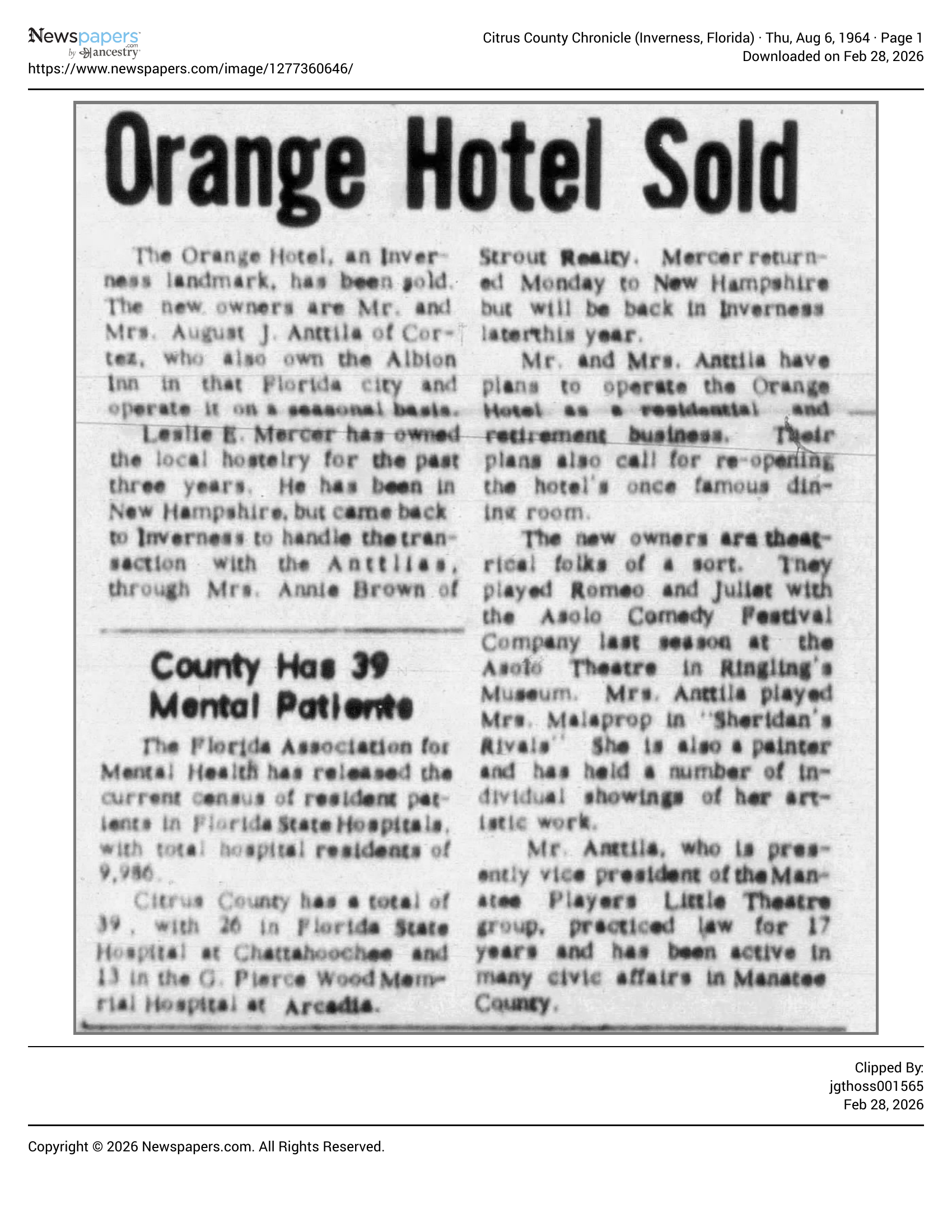
August J. Anttila and his wife of Cortez — theatrical performers from the Asolo Theatre — purchased the hotel, planning to reopen the famous dining room.
1980
Epicure Investments — $3 Million Renovation
Epicure Investments, led by Reginald Brealey of England, bought the aging Colonial and invested $3 million to transform it into a luxury British inn — the Crown Hotel.
1981
The Crown Hotel Opens
Churchill’s Restaurant opened with Victorian chairs and crystal chandeliers; the Fox and Hound pub recreated an English village. The grand spiral staircase, trucked 450 miles from South Carolina, was installed in one piece.
Oct. 1, 1990
The Sumner Family (Wales) Takes Over
Nigel and Jill Sumner bought the hotel for $1 million and moved their family from Wales to Inverness, operating it successfully for nearly twelve years.
Nov. 30, 2001
Sold to Dryburg & Hyland
The new owners promised restoration but within months fired staff, antagonized the Rotary Club, and ultimately abandoned the property — taking beef, comforters, and security cameras.
April 2003
Foreclosure — Again
A circuit judge appointed Landcom Hospitality Management as receiver; the Small Business Loan Source of Houston took possession and auctioned the hotel.
May 3, 2004
Jensen Purchase — Crown Court Born
Cary and Brenda Jensen bought it for $900,000 and spent $200,000 more converting it to Crown Court Assisted Living, preserving the grand staircase and historic character.
Dec. 2024
New Management Assumes Operations
Vera Healthcare Florida LLC (DBA Vera Assisted Living, Inverness Downtown) assumed management and day-to-day operations under a management agreement, ensuring continuity of care.
Sept. 2025
VSEVA Crown Court — A New Chapter
VSEVA Crown Court LLC acquired the building with a vision to bring the past into the future. In 2026 the 1981-era Fox and Hound pub was reimagined as The Fox & Hounds Tavern.
Thirteen Decades of Stewardship
The Owners
The families, firms, and stewards who shaped 109 N. Seminole Avenue — from the town’s first merchant to today’s ownership and care team.
c.1890–c.1914
Francis Marion Dampier Sr.
Founder · First Merchant of Inverness
Given a lot by his brother-in-law Alf Tompkins, Dampier built the town’s first general store and laid out the community he named Tompkinsville. Around World War I he sold to a New York hotel syndicate.
~24 yrsOwnership
Store→HotelTransformation
⏳ Exact dates — research in progress
c.1908–1959
Tommie Lou “Aunt Tom” Scott
née Waits · b. Mar. 12, 1875, Hawthorne, FL
Citrus County’s most beloved hotelier. She married William Maloy on Valentine’s Day 1908, acquired the Orange Hotel soon after, orchestrated the 1920s relocation, and ran it with legendary warmth for nearly six decades — selling at about age 84.
~58 yrsOwnership
$0.60Breakfast, ’57
2→3Stories
⏳ Exact start date — research in progress
1959–1961
Lynwood N. Smith
Businessman · Auburndale, FL
Bought the hotel from Aunt Tom and renamed it the Colonial Hotel. With motels overtaking downtown inns, the business struggled and faced foreclosure within two years — the plaintiff being the executrix of Aunt Tom’s estate.
~2 yrsOwnership
ForeclosureOutcome
1961–1964
Leslie D. & Lucille H. Mercer
Retired Dodge Dealer · Nashua, NH
Purchased the hotel at a $25,000 foreclosure sale on the courthouse steps. Mercer hoped to restore the dining room, ran it for three years, then returned to New Hampshire and sold to the Anttilas.
$25,000Purchase
3 yrsOwnership
1964–c.1980
August J. & Mrs. Anttila
Theatrical Performers · Cortez, FL
Accomplished stage performers who had played Romeo and Juliet at the Asolo Theatre. Mr. Anttila had also practiced law for 17 years. They bought the hotel intending to reopen its famous dining room.
~16 yrsOwnership
AsoloTheatre
⏳ Exact end date — research in progress
c.1970s–c.1980s
Possible Interim Ownership
Research in Progress
Unverified accounts suggest the Colonial Hotel may have changed hands during the 1970s — one describing a family running a restaurant and lounge with live music. County and newspaper records have not yet confirmed details.
⏳ Ownership in this period — research in progress
1980–1990
Epicure Investments, Inc.
Reginald Brealey (England) · Michael Kovach (Inverness)
A British-backed firm that invested $3 million in the building’s most significant renovation, transforming it into the Crown Hotel — a 34-room British inn with Churchill’s Restaurant and the Fox & Hound pub. Despite acclaim, it lost money.
$3MRenovation
$1.7MAppraised
34Rooms
1990–2001
Nigel & Jill Sumner
Private Family · Wales, UK
Moved their family from Wales to run the Crown, buying it for $1 million. It took nearly eight years to turn a profit. Selling in 2001, Jill later said the buyers “managed to destroy everything we had worked for” in just nine months.
$1MPurchase
~12 yrsOwnership
8 yrsTo Profit
2001–2003
Thomas Dryburg & P.C. Hyland
Central Florida · SBLS $1.15M loan
Promised restoration; instead fired staff, antagonized the Rotary Club, and clashed with a 66-year-old customer. Over Labor Day 2002 they vanished — taking beef, comforters, bar supplies, and the security cameras. The court appointed a receiver.
~9 moTo Collapse
$1.15MSBA Loan
2004–2025
Cary & Brenda Jensen
Crown Court Assisted Living
Bought the property for $900,000 and invested $200,000 converting it to Crown Court Assisted Living for ~40 residents, preserving the grand staircase. Operated under Erica’s Equities, Inc., with Cary Jensen as administrator.
$900KPurchase
~21 yrsOwnership
~40Residents
Sept. 2025–Present
VSEVA Crown Court LLC
OWNER · Raju Penumatcha
The current owner. As the real-estate and business owner, VSEVA is the steward behind the building’s preservation — safeguarding its history and funding the capital improvements that make modern assisted living possible. VSEVA engaged Vera as its operating partner.
Sept 2025Acquired
OwnerReal Estate
Dec. 2024–Present
Vera Healthcare Florida LLC
Vera Assisted Living · Management & Operations
Not the owner — the management and operations partner. Vera runs day-to-day care and the modern vision under a management agreement, and in 2026 reimagined the pub as The Fox & Hounds Tavern. It operates two Citrus County communities.
Dec 2024Mgmt Start
2FL Communities
From the Archive
A Century in the Headlines
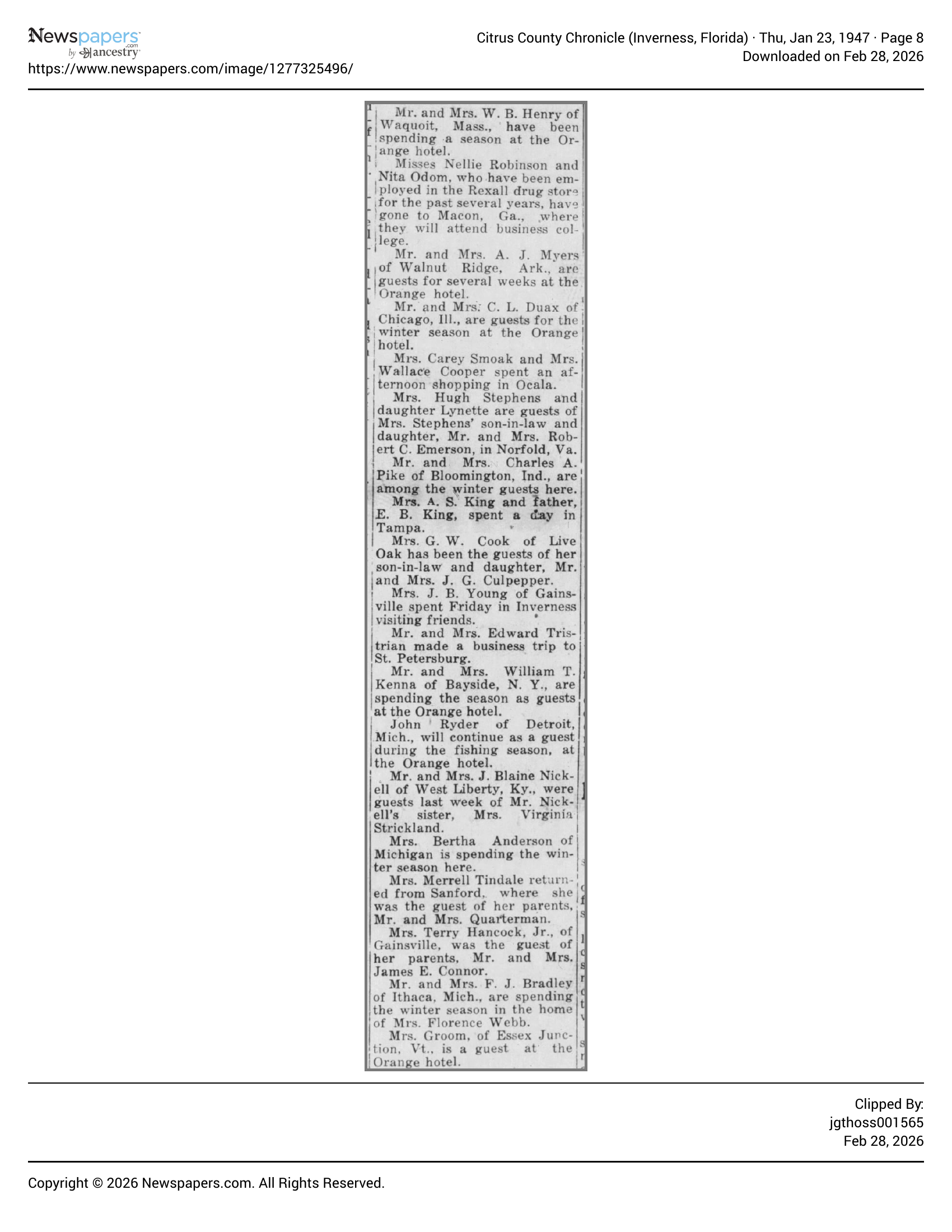
Original Citrus County Chronicle pages tracing the building across the decades. Click any clipping to read the full scan.
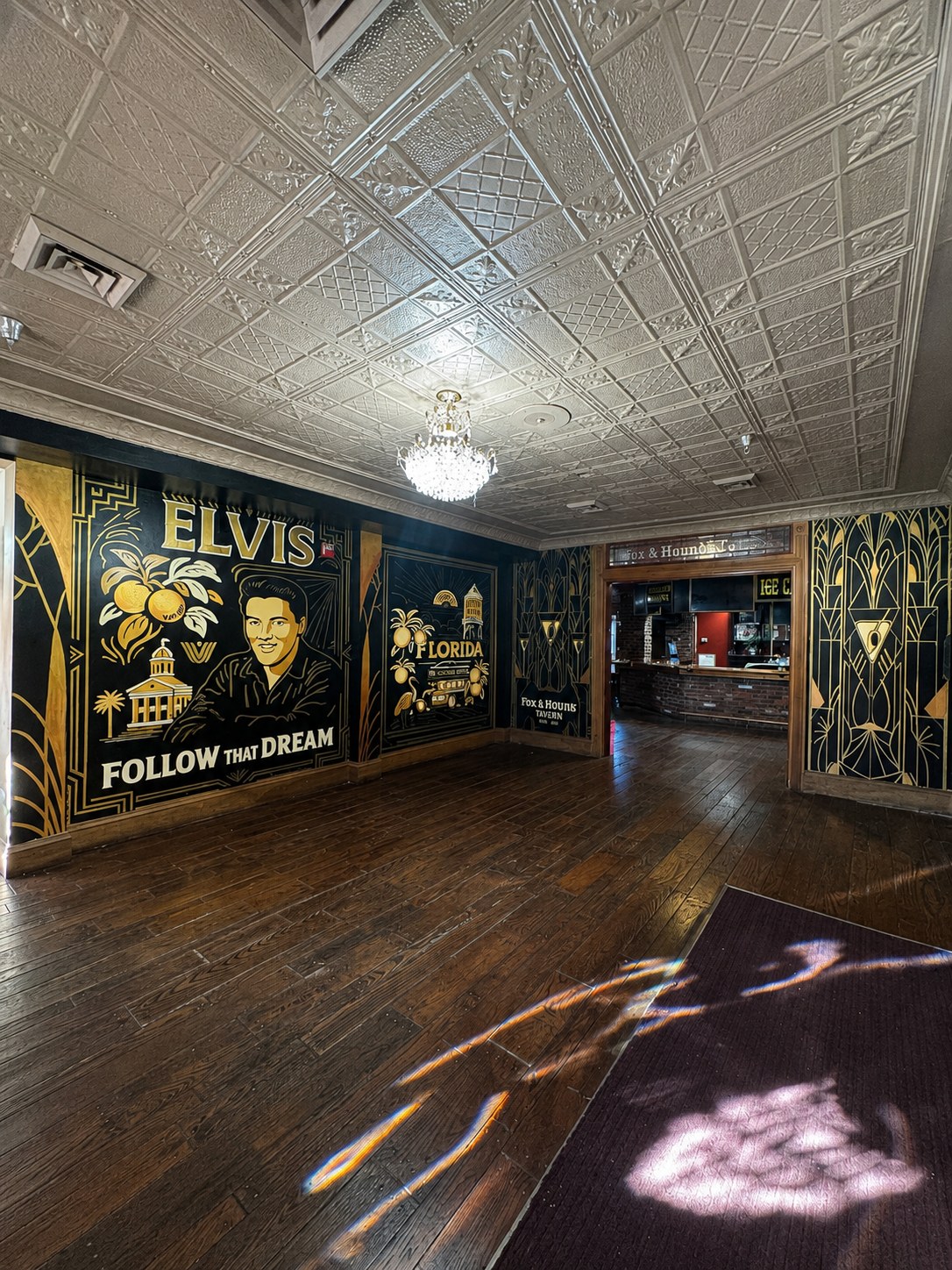
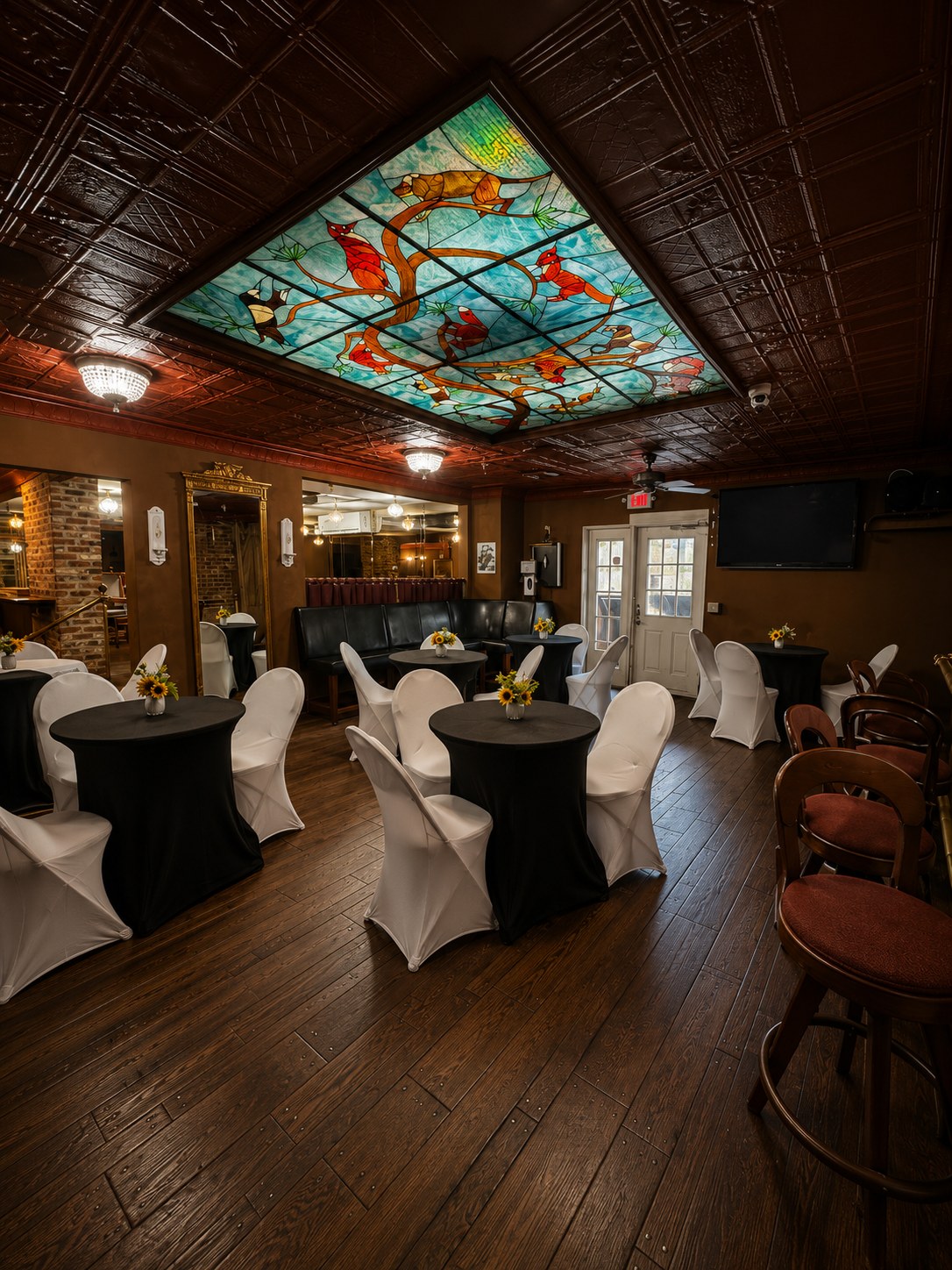
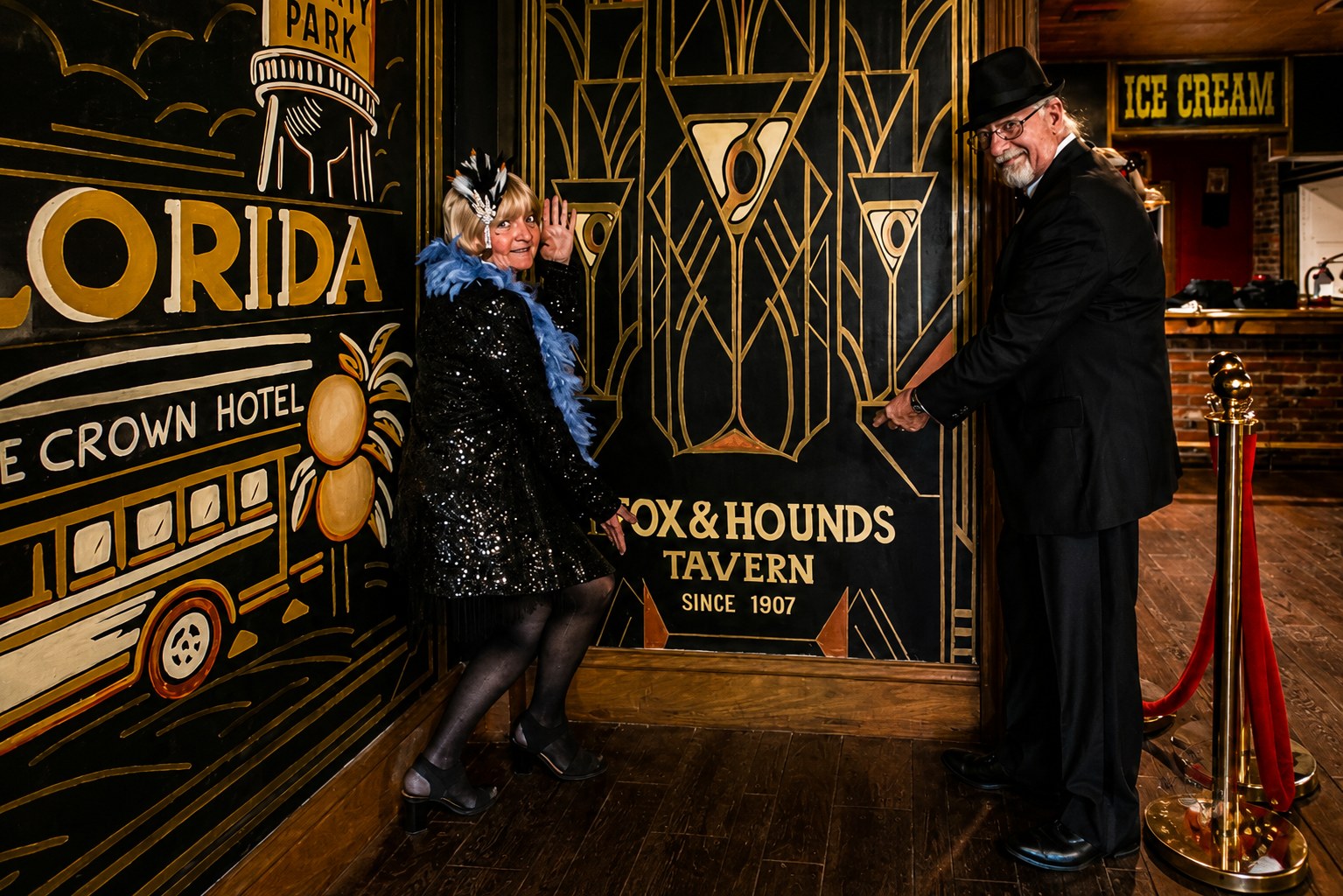
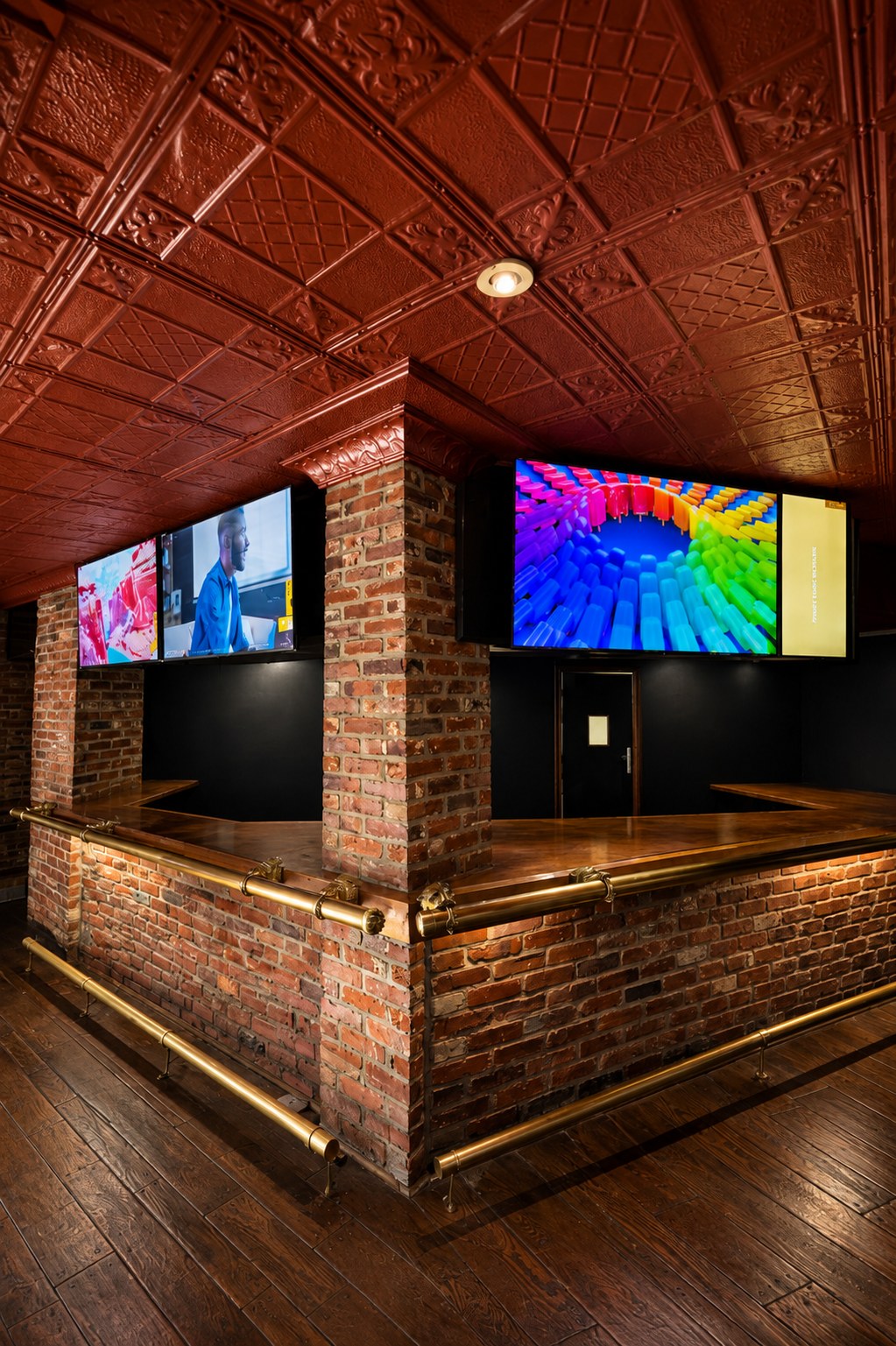
136 years of history, brought back to life — hand-painted Art Deco murals, the restored Fox & Hounds Tavern, stained glass overhead, and a genuine experience for the residents who call this historic building home.
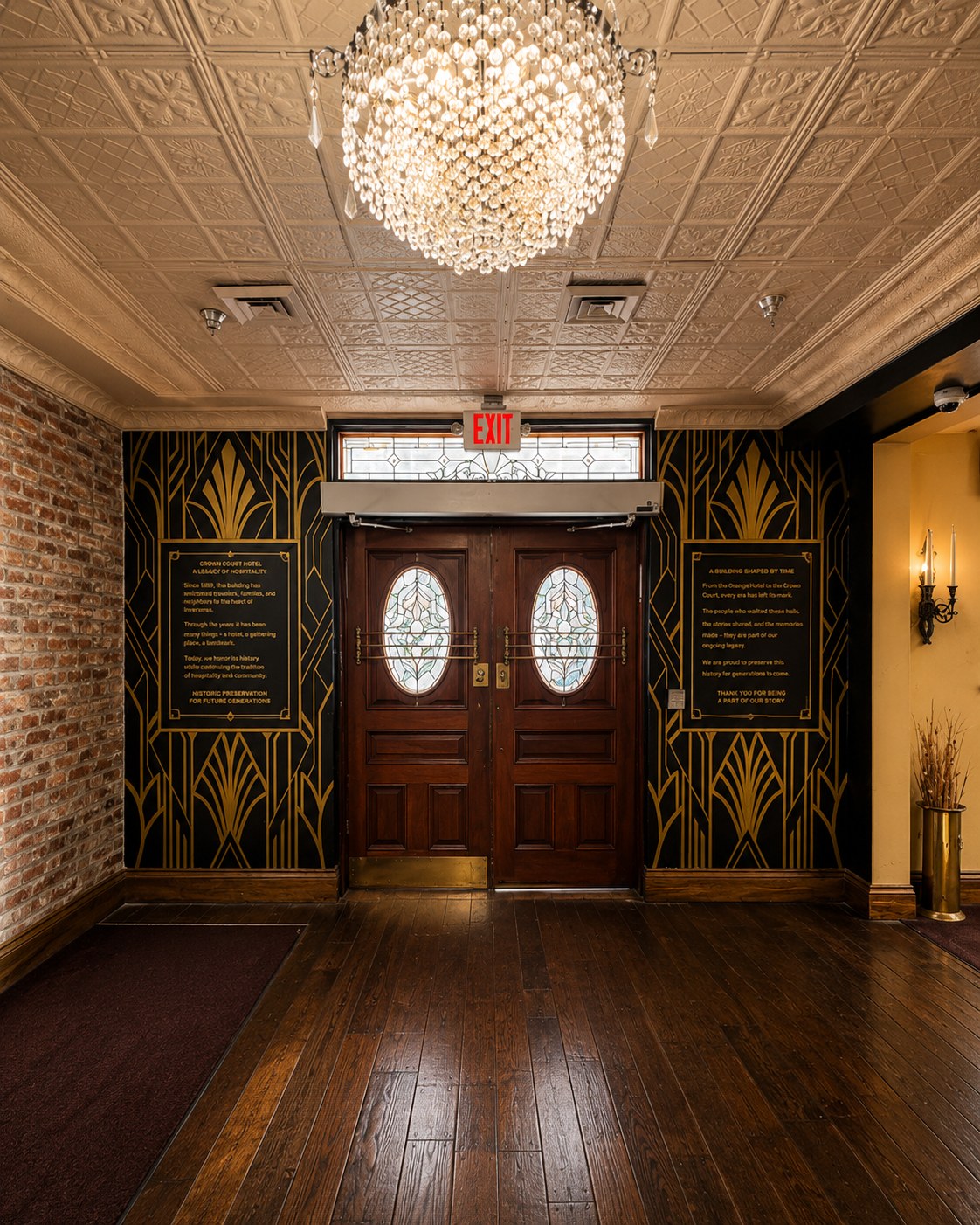
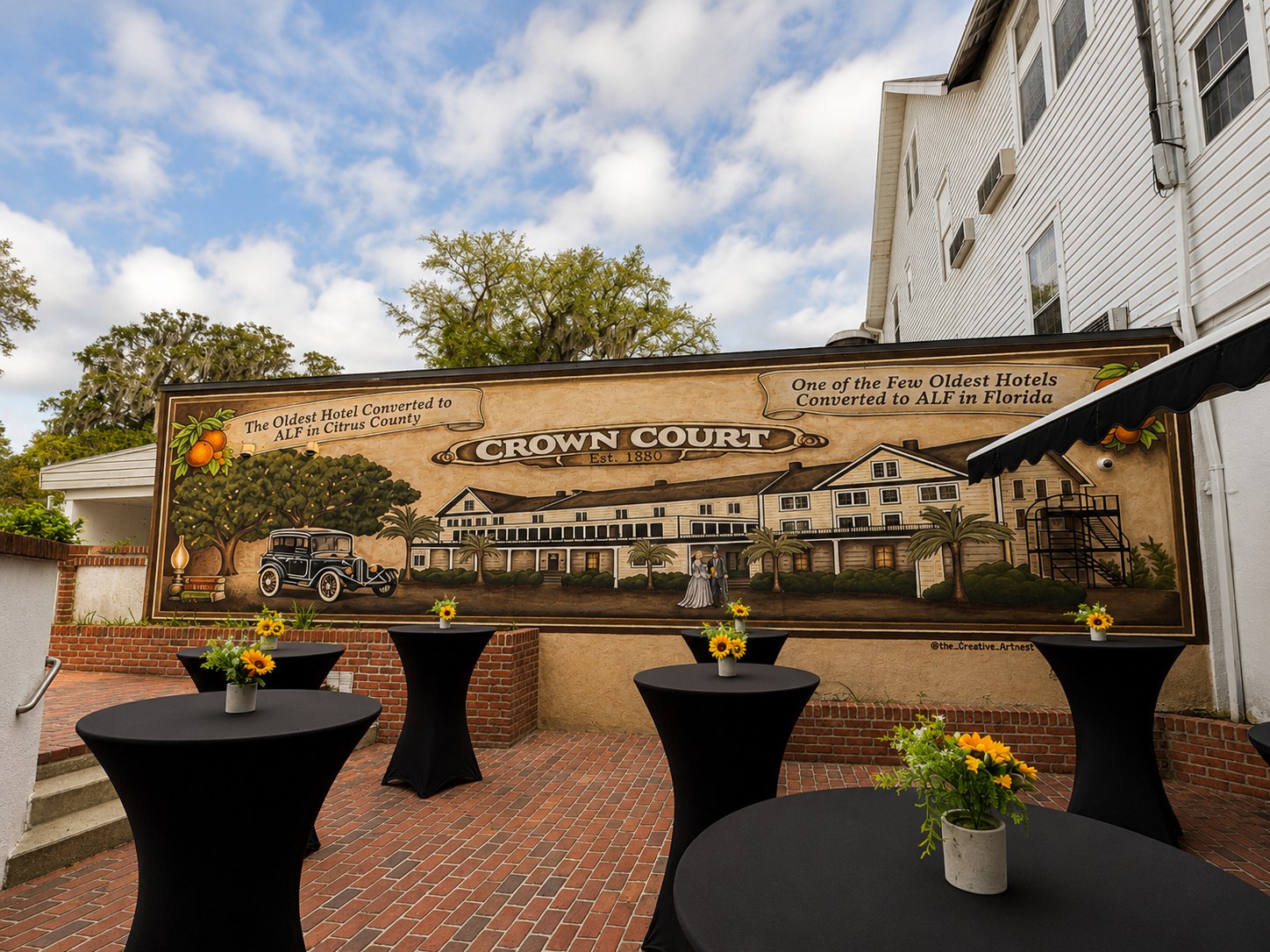
The grand entrance — gilded Art Deco murals and the original stained-glass doors welcome every guest.“Follow That Dream” — an Elvis & Florida mural beside the Fox & Hounds Tavern.The event room beneath a restored stained-glass ceiling of Florida foxes and cardinals.Roaring-Twenties nights at the Fox & Hounds Tavern — “Since 1907.”The reimagined sports bar — exposed brick, brass rails, and big screens.The Crown Court mural — “one of the oldest hotels converted to assisted living in Florida.”
The Next Chapter
From a Landmark to a Sanctuary
The building that welcomed Citrus County travelers for over a century is, today, a home — a boutique assisted-living community where the grand staircase still stands and the history is something residents live inside, not behind glass.
Owned by VSEVA Crown Court LLC and operated by Vera Assisted Living, Inverness Downtown (Vera Healthcare Florida LLC), Crown Court pairs original turn-of-the-century character with attentive, modern assisted-living care — in a setting like nowhere else in Citrus County.
This history is compiled from 23+ primary and secondary sources — municipal records, U.S. Census data, newspaper archives (1946–2025), and state collections. All facts cross-referenced where possible.
Government & Municipal Records
1City of Inverness, “Tompkinsville” — official municipal history of the founding settlement. inverness-fl.govMunicipal
2The Dampier Building Historical Marker, HMdb.org, Marker #117177. hmdb.orgMarker
3Old Courthouse Heritage Museum, “How Did Inverness Get Its Name?” cccourthouse.orgMuseum
5City of Inverness, “Historic Structures” — survey including the Crown Hotel at 109 N. Seminole Ave. inverness-fl.govMunicipal
6Hampton Dunn Postcard Collection, “Orange Hotel, Inverness, Florida” — USF Digital Collections. digitalcommons.usf.eduUniversity
7U.S. Federal Census, 1910 — Citrus County, FL. William M. Maloy household with four lodgers. (Ancestry / FamilySearch)Federal
8U.S. Federal Census, 1920 — Citrus County, FL. Orange Hotel grown to ten-plus boarders under Tommie Lou Maloy. (Ancestry / FamilySearch)Federal
Newspaper Archives
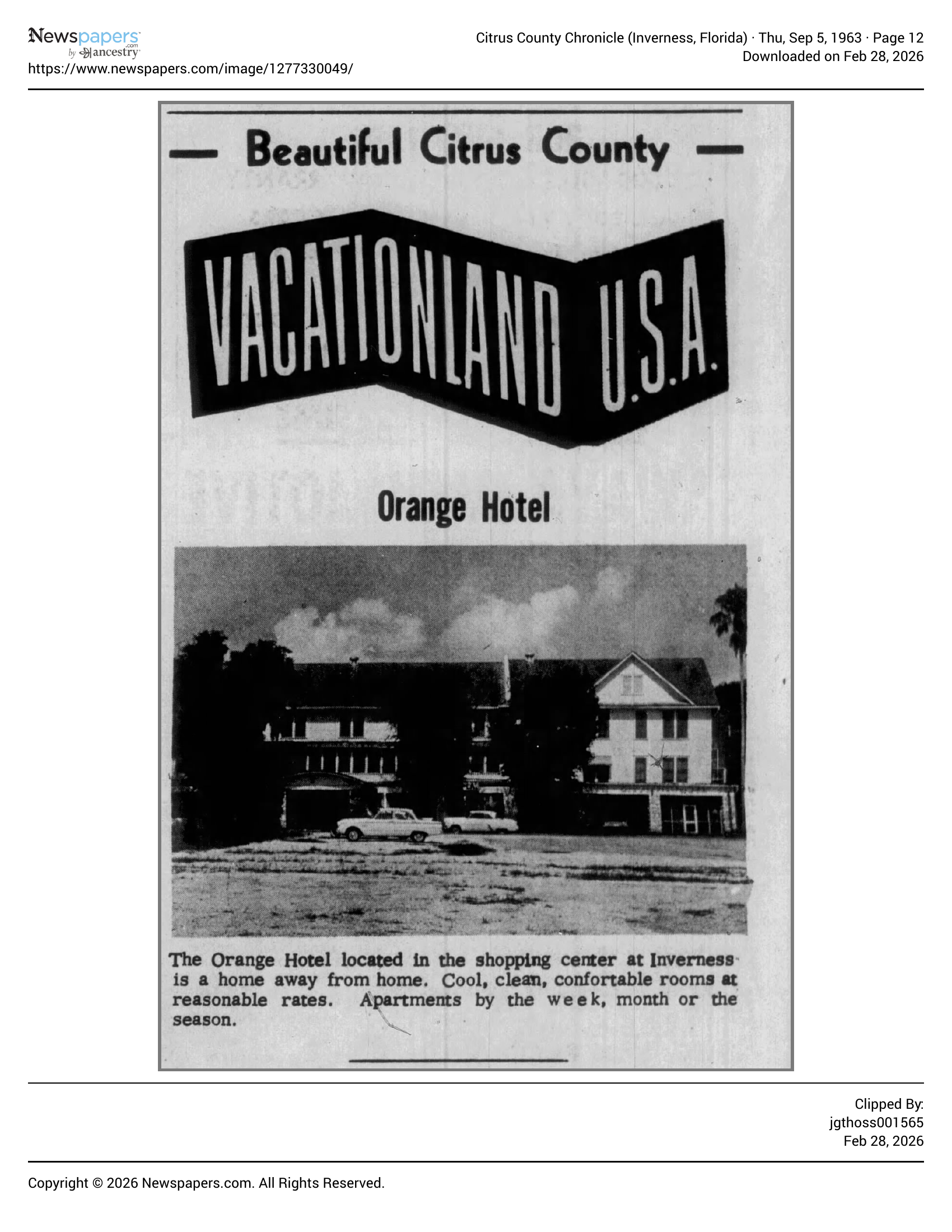
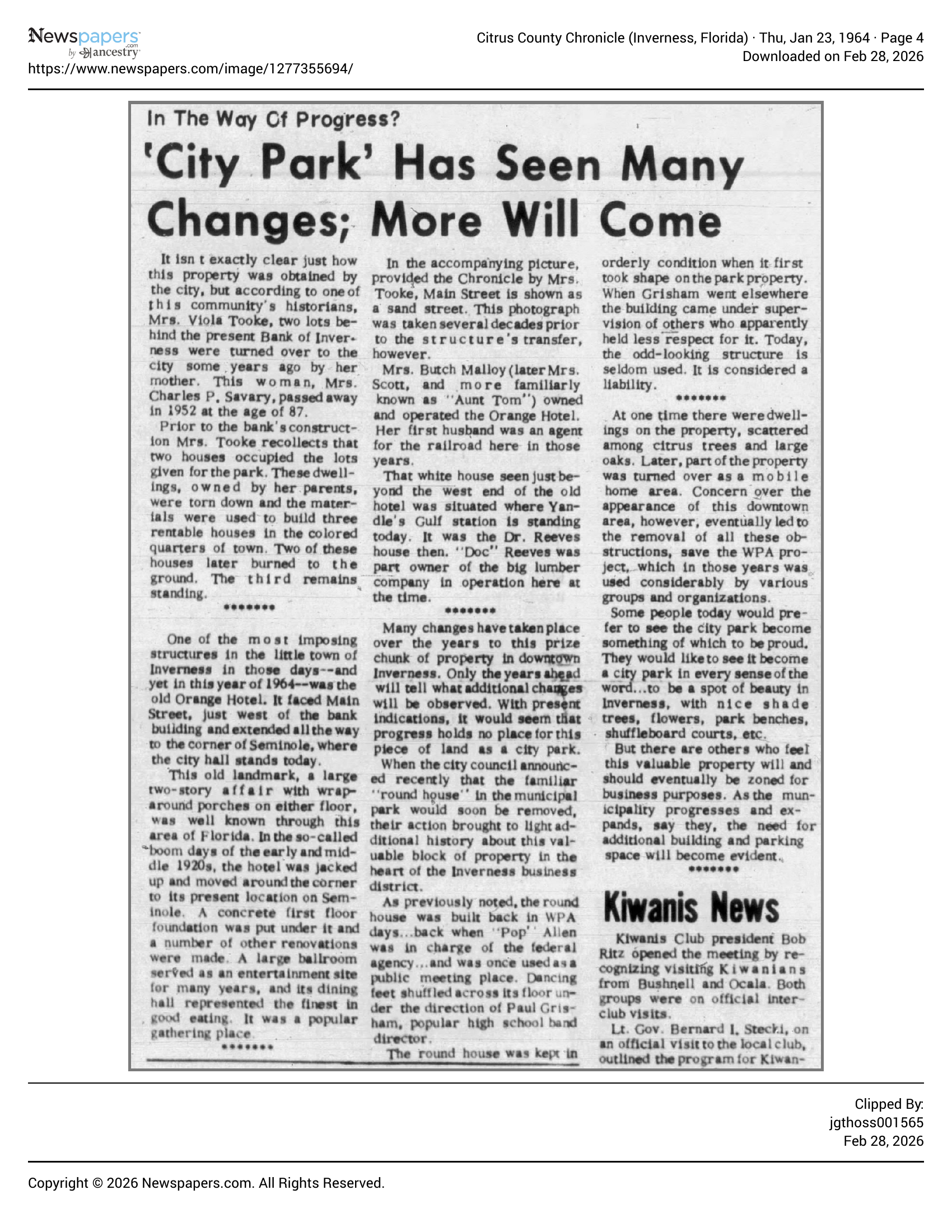
9Citrus County Chronicle, Jan. 23, 1964, p.4 — retrospective on the 1920s relocation to Seminole Avenue.Newspaper
10Citrus County Chronicle, c.1957 — menu prices and advertisements under Aunt Tom.Newspaper
11Citrus County Chronicle, Mar. 14, 1946, p.7 — J.R. Harkreader’s column mourning “Pooch.”Newspaper
12Citrus County Chronicle, c. Apr. 1961 (foreclosure/Mercer) & Jan. 17, 1963, p.12 (Mrs. Nash profile).Newspaper
13Citrus County Chronicle, Aug. 6, 1964, p.1 — “Orange Hotel Sold” to the Anttilas.Newspaper
14Citrus County Chronicle, June 4, 1980, p.3 — Epicure Investments’ purchase & $3M renovation.Newspaper
15Citrus County Chronicle, Dec. 25, 1987 — Crown Hotel renovation feature.Newspaper
17Tampa Bay Times, “Crown Hotel Deserved Better,” Sep. 8, 2002. tampabay.comNewspaper
18Tampa Bay Times, “Workers Struggle to Keep Crown Alive,” Sep. 15, 2002. tampabay.comNewspaper
19Tampa Bay Times, “New Chapter Beginning for the Crown Hotel,” Apr. 25, 2003. tampabay.comNewspaper
20Citrus County Chronicle, c.2004 — the Jensen purchase and conversion to Crown Court Assisted Living.Newspaper
21Citrus County Chronicle, “Vera Assisted Living Transforms Former Crown Court Facility,” Sep. 2025. chronicleonline.comNewspaper
Archives, Blogs & Secondary Sources
4Larry LaFond, The Crown Hotel (blog) — the most comprehensive privately compiled history of the building. thecrownhotel.blogspot.comBlog
16Driwood Moulding Company, Florence, SC — maker of the grand spiral staircase. driwood.comCompany
22Yield PRO, “Kennedy Funding Closes $3.725M Acquisition & Renovation Loan of The Crown Court,” Oct. 2025. yieldpro.comTrade
23Vera Assisted Living — official website (facility operations, amenities, The Fox & Hounds Tavern). vera-alf.comOfficial
Photographic & Archival Collections
•Florida Memory (State Library & Archives of Florida) — historical photographs incl. the B-Type London bus replica. floridamemory.comState Archive
•FLGenWeb Project, Citrus County — Dampier Cemetery records & genealogy. rootsweb.comGenealogy
•Wikipedia, “Inverness, Florida” & “Citrus County, Florida” — general context. wikipedia.orgEncyclopedia